Why Your Mobile App Isn’t Growing (And How Paid User Acquisition Fixes It)

Allocate 60-70% of your initial user acquisition budget to testing multiple paid channels simultaneously rather than committing to a single platform. Run controlled experiments across Facebook Ads, Google App Campaigns, TikTok, and Apple Search Ads for at least two weeks each, measuring cost per install (CPI) and Day-7 retention rates to identify which channels deliver users who actually engage with your app beyond the first open.
Structure your campaigns around specific user segments instead of broad targeting. Define your ideal user by behaviors and demographics—such as “fitness enthusiasts aged 25-34 who previously downloaded health apps”—then create dedicated ad sets with messaging that speaks directly to their pain points. This precision reduces wasted ad spend by 40-50% compared to generic targeting approaches.
Implement attribution tracking before launching any paid campaigns. Set up Mobile Measurement Partners (MMPs) like AppsFlyer or Adjust to connect ad spend with actual user actions, enabling you to identify which campaigns generate profitable users versus those who install and immediately churn. Without proper attribution, you’re essentially funding user acquisition blindfolded.
Cap your customer acquisition cost (CAC) at one-third of your user’s lifetime value (LTV) from day one. This ratio ensures sustainable growth while leaving room for optimization. Calculate LTV by analyzing in-app purchase rates, subscription conversions, and ad revenue from your first 1,000 users, then use this benchmark to establish maximum acceptable CPIs across all channels. Profitable user acquisition depends on this fundamental economic model, not on vanity metrics like total downloads.
What Paid User Acquisition Actually Means for Your Mobile App
Paid user acquisition is the practice of investing marketing dollars to attract new users to your mobile app through channels like paid search, social media advertising, display networks, and influencer partnerships. Unlike organic growth strategies that rely on app store optimization, word-of-mouth, and content marketing, paid acquisition gives you direct control over your growth trajectory and allows you to scale at a predictable pace.
The fundamental difference lies in speed and control. While organic methods build momentum gradually over time, paid channels deliver immediate results and let you target specific user segments with precision. You’re essentially buying your way into users’ attention, which becomes crucial when you need to meet growth targets or compete in crowded app categories.
For most mobile apps, paid acquisition becomes essential once initial launch momentum plateaus. That early spike of downloads from your existing network and press coverage only takes you so far. To reach the next growth tier, you need a systematic approach to finding and converting your ideal users at scale.
Paid acquisition also provides valuable data. Every campaign teaches you which messages resonate, which audiences convert best, and what your actual cost per valuable user looks like. This insight informs not just your marketing strategy but your entire product development roadmap.
The key is viewing paid acquisition not as a short-term download boost but as a long-term investment in building a sustainable user base. When executed strategically with proper tracking and optimization, paid channels become reliable growth engines that complement your organic efforts and accelerate your path to profitability.

The Core Channels That Drive Real App Installs

Social Media Advertising Platforms
Social media platforms offer powerful targeting capabilities that make them essential channels for mobile app user acquisition. Each platform serves distinct audiences and provides unique advantages for reaching potential users.
Facebook remains the largest social advertising platform, offering access to over 2 billion users with sophisticated targeting options based on demographics, interests, behaviors, and lookalike audiences. Its pixel tracking enables precise conversion measurement, and typical cost-per-install (CPI) ranges from $2-$5 depending on your target market and app category. The platform’s automated campaign optimization tools learn from user behavior to improve performance over time.
Instagram, owned by Facebook, excels at reaching younger demographics through visually engaging content. The platform’s story ads and reels format drive strong engagement rates, with average click-through rates between 0.5-1%. Instagram works particularly well for lifestyle, entertainment, and consumer-focused apps where visual storytelling matters.
TikTok has emerged as a high-growth channel for reaching Gen Z and millennial audiences. The platform’s algorithm-driven content discovery means your ads can achieve viral reach without massive budgets. TikTok’s cost-per-install typically runs $3-$8, with engagement rates often exceeding traditional social platforms.
Snapchat targets a predominantly young audience, with 75% of users under 34 years old. The platform offers AR-enabled ad formats that drive interactive experiences. Typical CPI ranges from $2.50-$5, making it cost-competitive for apps targeting younger demographics.
When selecting platforms, consider where your target users spend time and test multiple channels to identify which delivers the strongest return on ad spend.
Search and App Store Advertising
Search and app store advertising targets users with the highest intent—people actively looking for solutions your app provides. Apple Search Ads and Google App Campaigns place your app directly in front of these searchers right when they’re ready to download.
Apple Search Ads appear at the top of App Store search results when users type relevant keywords. You only pay when someone taps your ad, making it a cost-effective channel for reaching qualified users. The platform offers simple campaign setup with automated bidding options, allowing you to start capturing downloads quickly without complex configuration. Focus on targeting keywords that match your app’s core functionality and monitor which terms drive the highest-quality users.
Google App Campaigns automate the process across Google’s entire ecosystem—Search, Play Store, YouTube, and the Display Network. You provide creative assets and set your target cost-per-install, then Google’s machine learning optimizes placement and bidding automatically. This automation saves time while reaching users across multiple touchpoints throughout their decision journey.
Both platforms work best when combined with strong app store optimization. Your ad may get the click, but your store listing must convince users to complete the download. Use clear, benefit-focused ad copy that mirrors your app store messaging for consistency.
Start with modest budgets on both platforms to gather performance data. Track not just installs but post-install actions to identify which keywords and campaigns deliver users who actually engage with your app.
Programmatic and Display Networks
Programmatic advertising and display networks offer mobile app marketers significant scale beyond social media and search platforms. These channels use automated technology to purchase ad inventory across thousands of apps and websites, reaching users wherever they spend their digital time.
Programmatic platforms like Google Display Network, InMobi, and Tapjoy connect advertisers with publishers through real-time bidding systems. This automation allows you to target specific audiences based on demographics, interests, and behaviors while optimizing bids automatically based on performance data. The result is efficient budget allocation without constant manual adjustments.
Display networks provide several in-app advertising formats including banner ads, interstitials, and native placements that blend seamlessly with app content. Video ads have become particularly effective, offering higher engagement rates and better storytelling opportunities compared to static formats.
The primary advantage of programmatic channels is reach. You can access users across gaming apps, news platforms, utility apps, and entertainment services—exposing your app to audiences who may never see your social or search campaigns. This diversification reduces dependence on any single channel and helps identify new user segments.
However, quality control requires attention. Implement fraud prevention measures and maintain detailed whitelists and blacklists of publishers. Start with premium programmatic marketplaces before expanding to open exchanges. Monitor metrics like install-to-registration rates and day-one retention carefully, as programmatic traffic can vary significantly in quality compared to other channels. Set clear performance thresholds and pause underperforming placements quickly to protect your budget.
Building Your Paid Acquisition Strategy Without Wasting Budget
Setting Acquisition Goals That Actually Matter
Install numbers look impressive in reports, but they rarely tell the complete story of your acquisition success. To build a sustainable user acquisition strategy, you need goals that directly tie to business outcomes and profitability.
Start with Cost Per Install (CPI) as your baseline efficiency metric. Calculate your maximum acceptable CPI by working backward from your revenue projections. If your average user generates $15 in lifetime value, and you need a 3x return, your CPI ceiling is $5. This simple calculation prevents overspending on channels that can’t deliver profitable growth.
Lifetime Value (LTV) deserves equal attention to acquisition costs. Track how much revenue users generate over 30, 60, and 90-day periods. Different acquisition channels often deliver users with vastly different quality levels. A channel with a $3 CPI might seem attractive until you discover those users have half the LTV of users from a $6 CPI channel.
Return on Ad Spend (ROAS) brings these metrics together into a single profitability indicator. Calculate ROAS by dividing revenue generated by ad spend. A 3:1 ROAS means every dollar spent returns three dollars in revenue. Most profitable apps maintain ROAS between 2:1 and 5:1, depending on their business model and growth stage.
Set up automated reporting systems to track these metrics daily. Waiting for monthly reviews means wasting budget on underperforming campaigns. Regular monitoring allows quick optimization decisions that protect your acquisition budget while maximizing returns.
Audience Targeting That Brings Quality Users
Acquiring users is only valuable when they’re the right users. Broad targeting might fill your funnel, but it rarely delivers sustainable growth. Instead, focus on precision targeting that brings users who will actually engage with your app and stick around.
Start by defining your ideal user profile. Look beyond basic demographics like age and location. Examine behavioral patterns: What problems do they need solved? Which apps do they currently use? What triggers them to download new applications? This depth of understanding prevents wasted ad spend on users unlikely to convert.
Use platform-specific targeting features strategically. Facebook and Instagram offer detailed interest-based targeting, allowing you to reach users based on their actual behaviors and preferences. Google App Campaigns leverage machine learning to identify high-intent users across search, YouTube, and the Display Network. TikTok excels at reaching younger demographics through interest and behavioral signals.
Layer your targeting criteria rather than casting a wide net. Combine demographics with interests and behaviors to create specific audience segments. Test lookalike audiences based on your best existing users to find similar high-quality prospects.
Monitor performance metrics beyond just installs. Track which audience segments deliver better post-install engagement and higher user retention rates. This data reveals which targeting parameters actually work, allowing you to refine your approach and allocate budget toward segments that generate real business value rather than vanity metrics.
Budget Allocation Across Channels
Start with a conservative budget split across 2-3 primary channels rather than spreading resources too thin. A common starting framework allocates 60% to proven channels like Facebook or Google, 30% to emerging platforms showing promise, and 10% to experimental tests. This approach protects your core acquisition while allowing room for discovery.
Test methodically by running campaigns for at least 7-14 days before making budget decisions. Monitor cost per install and user quality metrics daily, but avoid knee-jerk reactions to short-term fluctuations. Set clear benchmarks upfront: if a channel delivers target CPA within two weeks, increase budget by 20-30%. If performance lags 30% below targets, reduce spending or pause entirely.
Implement automated rules within your ad platforms to prevent budget waste on underperforming campaigns. These systems can pause ads when CPA exceeds thresholds or shift budget toward top performers without manual intervention.
Scale winning channels gradually rather than doubling budgets overnight. Sudden increases often inflate costs as platforms exhaust your best audiences. Instead, increase spending by 15-20% every few days while maintaining performance standards. Document what works in each channel to build a repeatable acquisition playbook.
Creative Assets That Convert Browsers Into Users
Your ad creative is the first impression potential users have of your app, and you have just seconds to make it count. The most effective creatives don’t just look good—they communicate clear value and compel action immediately.
Start with a hook that addresses a specific pain point or desire. In the first three seconds of a video ad or the headline of a static image, answer the question: “What’s in it for me?” Show your app solving a real problem rather than listing features. A fitness app shouldn’t lead with “GPS tracking and calorie counter”—it should show someone achieving their weight loss goal.
Video creatives consistently outperform static images across most platforms, but they need to work without sound. Add captions to every video, as 85% of social media videos are watched on mute. Keep videos between 15-30 seconds, front-loading the key message and value proposition.
For static ads, simplicity wins. Use high-quality visuals of your actual app interface rather than generic stock photos. Include a clear call-to-action button and minimal text—aim for six words or fewer in your headline. Test different formats: carousel ads work well for showcasing multiple features, while single-image ads often drive lower cost-per-install.
Platform-specific optimization matters significantly. What works on Facebook won’t necessarily work on TikTok or Google App Campaigns. TikTok users respond to authentic, user-generated content styles, while Facebook audiences may prefer more polished productions. Google App Campaigns require providing multiple assets that their system tests and combines automatically.
Build a testing framework from day one. Create at least five creative variations for each campaign, testing different hooks, visuals, and calls-to-action. Rotate out underperforming creatives every two weeks—ad fatigue happens quickly in mobile advertising. Track which creative elements drive not just installs, but quality users who remain engaged beyond the first session.
The goal isn’t winning design awards. It’s creating ads that convert browsers into active, retained users while maintaining sustainable acquisition costs.
Tracking and Attribution: Know What’s Working
Without accurate tracking, you’re essentially flying blind with your user acquisition budget. You might be spending thousands on campaigns that barely convert while underinvesting in your most profitable channels.
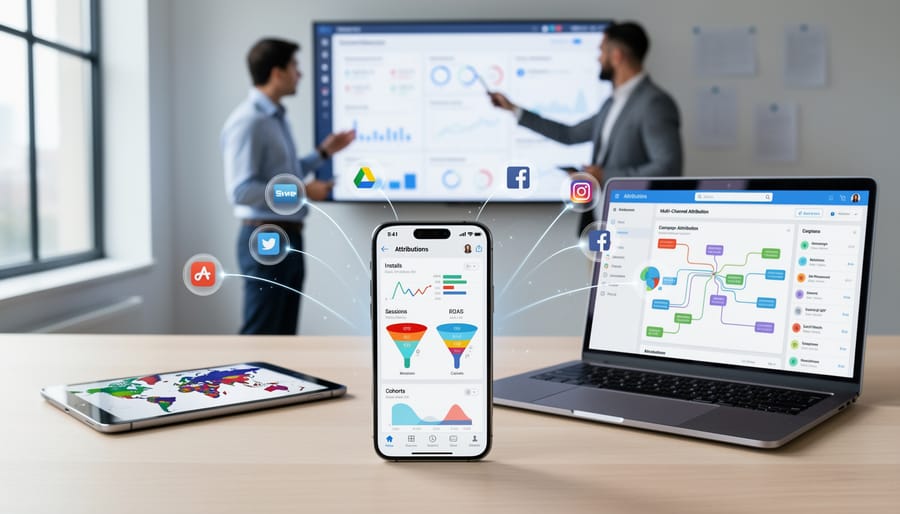
Mobile Measurement Partners (MMPs) like AppsFlyer, Adjust, and Branch solve this problem by connecting user actions back to specific marketing touchpoints. These platforms track the entire user journey, from the first ad impression through install and beyond, giving you visibility into which campaigns actually drive valuable users.
Setting up proper attribution starts with choosing the right model for your business. Last-click attribution credits the final touchpoint before installation, making it simple but potentially misleading. Multi-touch attribution distributes credit across multiple interactions, providing a more complete picture of how users discover your app. For most businesses starting out, last-click offers a practical baseline that you can refine as you gather more data.
Implementation requires three key components. First, integrate your chosen MMP’s SDK into your app to track in-app events like purchases, registrations, or level completions. Second, connect all your advertising platforms to the MMP so data flows automatically between systems. Third, define which events matter most to your business and ensure they’re properly configured for tracking.
The real value emerges when you move beyond install tracking to post-install behavior. A campaign might deliver cheap installs but terrible retention rates. Another might cost more upfront but attract users who spend significantly more over time. Your MMP dashboard should answer one critical question: which campaigns bring users who actually generate revenue?
Set up automated reporting that delivers key metrics to your team weekly. This eliminates manual data pulling and keeps everyone aligned on what’s working. Track cost per install, retention rates at days 1, 7, and 30, and return on ad spend by campaign and channel.
Using Automation to Scale Your Acquisition Efforts
As your mobile app acquisition campaigns grow across multiple channels, managing everything manually becomes unsustainable. Automation tools let your team scale operations without proportionally increasing workload or sacrificing performance.
Automated bidding systems continuously adjust your bids based on real-time performance data, ensuring you pay optimal prices for installs across different times of day and audience segments. Instead of manually tweaking bids dozens of times daily, these systems respond to performance shifts instantly, maintaining your target cost-per-install while maximizing volume.
Campaign optimization tools take this further by automatically reallocating budget toward high-performing ad sets and pausing underperformers. This removes the guesswork and time drain of daily performance reviews, allowing your marketing team to focus on strategic decisions and creative development rather than spreadsheet management.
Automated reporting consolidates data from multiple acquisition channels into unified dashboards, eliminating hours spent pulling reports from different platforms and reconciling metrics. You get clear visibility into which channels drive quality users at scale, making strategic planning sessions more productive.
The real advantage of automation isn’t just time savings. It’s the ability to test more variations, respond faster to market changes, and manage complexity that would overwhelm manual processes. Your team shifts from task execution to strategic oversight, identifying new opportunities and developing compelling creative that resonates with your target audience.
Start by automating repetitive tasks like bid adjustments and basic reporting, then gradually expand to more sophisticated optimization as you build confidence in the systems.
Common Mistakes That Drain Your Acquisition Budget
Even well-intentioned acquisition campaigns can hemorrhage budget when common mistakes go unaddressed. Understanding these pitfalls helps you protect your investment and maximize returns.
Broad targeting without audience segmentation ranks among the most expensive mistakes. Casting too wide a net attracts users unlikely to engage with your app, inflating cost per acquisition while delivering poor lifetime value. Define specific user personas based on demographics, behaviors, and interests before launching campaigns. Most advertising platforms offer granular targeting options that significantly improve conversion quality when properly configured.
Neglecting post-install engagement represents another critical error. Acquiring users means nothing if they uninstall within days. Many marketers focus exclusively on install numbers while ignoring the onboarding experience and retention strategies. Track day-one, day-seven, and day-thirty retention rates to identify where users drop off, then optimize accordingly.
Install fraud drains billions annually from acquisition budgets. Click farms, bot networks, and device farms generate fake installs that appear legitimate but deliver zero value. Implement fraud detection tools and monitor for suspicious patterns like abnormal install spikes or geographic anomalies. Working with reputable ad networks reduces exposure, but vigilance remains essential.
Optimizing for installs rather than quality users creates a false sense of success. Five thousand installs mean little if only fifty become paying customers. Shift focus toward user quality metrics including average revenue per user, customer acquisition cost versus lifetime value ratios, and engagement depth. Automated tracking systems help monitor these metrics in real-time, enabling quick adjustments before significant budget waste occurs.
Finally, failing to test and iterate leaves money on the table. Run A/B tests on creative assets, audience segments, and bidding strategies continuously to identify what performs best for your specific app and audience.
Paid user acquisition isn’t an expense—it’s a strategic investment in your mobile app’s future. When executed with clear objectives and disciplined testing, paid channels become powerful engines for sustainable growth that extends far beyond the initial download.
The key to success lies in treating user acquisition as an ongoing optimization process rather than a set-it-and-forget-it campaign. Your most valuable competitive advantage comes from continuous testing of ad creatives, audience segments, and channel combinations. Small improvements in conversion rates or cost per acquisition compound over time, transforming mediocre campaigns into profitable growth machines.
Data-driven decision-making separates successful user acquisition strategies from budget-draining experiments. Track every metric that matters—not just installs, but activation rates, retention curves, and actual revenue per user. This visibility allows you to identify which channels deliver users who stick around and generate value, not just those who download and disappear.
Remember that the relationship between customer acquisition cost and lifetime value determines your path forward. When you acquire users for less than they generate over their lifetime, you’ve built a scalable growth model. When those numbers flip, it’s time to reassess your targeting, creative approach, or channel mix.
Success in paid user acquisition requires patience, analytical rigor, and willingness to adapt. Start with manageable budgets, establish clear benchmarks, automate reporting processes where possible, and scale what works. Your commitment to testing and refinement today builds the foundation for predictable, profitable growth tomorrow.
Leave a Reply