Category: Virtual and Augmented Reality Marketing

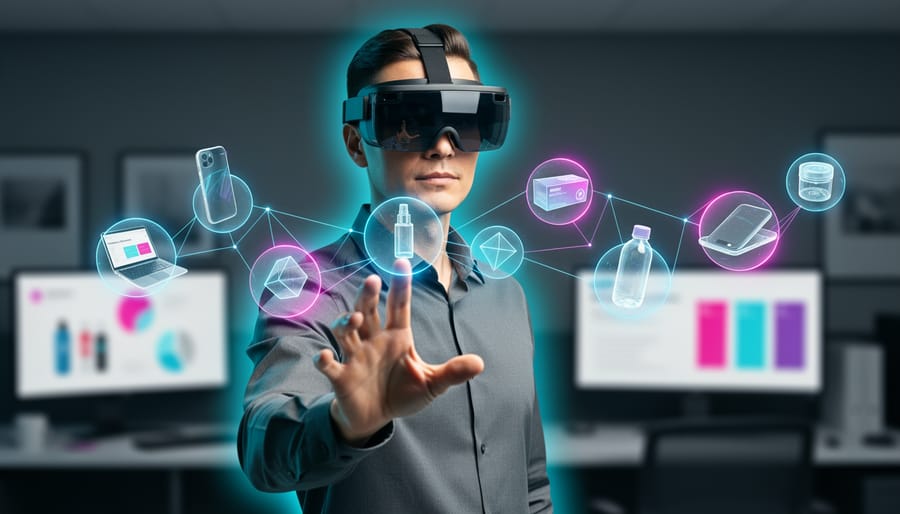
Business professional in an office wearing a VR/AR headset, reaching toward floating holographic nodes connected to 3D product models, cool blue lighting and blurred monitors in the background, no visible text.

Why Your CRM Fails in VR/AR Environments (And How to Fix It)

Connect your CRM directly to VR/AR platforms through API integrations that automatically sync customer interactions from virtual showrooms, AR product demos, and immersive experiences into your existing customer database. Implement automated tracking workflows that capture behavioral data when prospects engage with 3D product visualizations or virtual consultations, triggering personalized follow-up sequences based on specific actions like completing a virtual tour or requesting AR assistance.
Map your traditional customer journey stages to immersive touchpoints by identifying where …

READ MORE

Over-the-shoulder view of a person using a smartphone to see AR visual cues around a Wi‑Fi router, with soft daylight and a blurred background showing a VR headset and laptop, no visible text or logos

How VR and AR Are Transforming Customer Service (Without the Complexity)

Evaluate whether Virtual Reality (VR), Augmented Reality (AR), or Mixed Reality (MR) fits your specific customer service needs by mapping each technology to your business challenges. VR creates fully immersive digital environments ideal for product demonstrations and training simulations. AR overlays digital information onto the real world through smartphones or tablets, perfect for guided troubleshooting and visual product configuration. MR combines both approaches, allowing customers to interact with digital objects in physical spaces—valuable for complex B2B sales presentations.
Start small with AR-enabled customer support, …

READ MORE

Young shopper in a retail aisle holding a smartphone that displays an AR 3D sneaker hovering above products, with small glowing coin and badge icons and no visible text; shelves and other shoppers softly blurred under even store lighting.

AR Gaming Campaigns That Actually Drive Sales (Not Just Engagement)

Launch AR marketing campaigns that deliver measurable results by starting with platform selection based on your audience demographics—Instagram and Snapchat for Gen Z consumers, WebAR for broader accessibility without app downloads. Define clear conversion metrics before deployment, whether that’s product trials, time spent engaging, or direct purchases, then track these through UTM parameters and platform analytics.
Design experiences that solve customer pain points rather than showcasing technology for its own sake. Virtual try-ons reduce return rates by 40% for fashion retailers, while furniture visualization tools …

READ MORE

Market researcher in a modern lab wearing a VR headset, reaching toward a holographic virtual supermarket aisle with glowing product highlights; background lab equipment softly blurred and no readable text visible.

Why VR and AR Are Changing How Smart Businesses Understand Their Customers

Traditional market research methods tell you what customers say they want. Virtual and augmented reality technologies show you what they actually do. Deploy VR simulations to test product designs and retail layouts before committing capital—companies using this approach reduce costly redesigns by up to 60%. Use AR applications to observe genuine consumer reactions to packaging, shelf placement, and product features in controlled environments that mirror real shopping conditions. Capture behavioral data automatically through eye-tracking, heat mapping, and interaction patterns that reveal subconscious preferences traditional surveys miss …

READ MORE

Customer wearing a VR headset with hands mid-gesture in a modern UX lab, observed by a blurred marketing team behind glass under soft blue lighting, representing immersive feedback gathering.

Google VR Services Just Changed How Smart Businesses Gather Customer Feedback

Google VR Services represents a breakthrough technology stack that enables businesses to deploy virtual reality experiences for gathering customer feedback in real-time. By leveraging Google’s Cardboard, Daydream, and ARCore platforms, companies can now immerse customers in product demonstrations, service scenarios, and brand environments while capturing authentic emotional responses and behavioral data that traditional surveys miss.
The technology works through three core components: VR-enabled feedback collection tools, spatial analytics that track where customers focus their attention, and automated reporting systems that …

READ MORE

Over-the-shoulder view of a customer holding a smartphone in a retail aisle with an AR overlay showing a floating 3D product and loyalty icons without text; store shelves and other shoppers softly blurred in the background.

Enterprise AR Is Transforming Customer Loyalty (Here’s How to Use It)

Augmented reality has evolved beyond consumer gaming apps into a strategic tool that drives measurable business results. Enterprise AR now enables companies to transform customer loyalty programs by creating immersive experiences that increase engagement rates by up to 70% and boost repeat purchase behavior significantly.
The technology works by overlaying digital content onto real-world environments through smartphones or tablets—no specialized hardware required. For businesses, this means you can launch AR-powered loyalty initiatives using customers’ existing devices, eliminating the adoption barriers that plagued earlier …

READ MORE

Shopper immersed in a virtual reality shopping environment with holographic product displays and virtual assistants, representing the transformation of retail through VR technology.

Virtual Reality Is Transforming How We Shop (And Retailers Are Taking Notice)

Virtual reality is revolutionizing retail by creating immersive shopping experiences that transform customer experience from passive browsing to active engagement. Forward-thinking retailers are leveraging VR technology to drive sales, reduce returns, and build stronger customer relationships through personalized virtual showrooms and interactive product demonstrations.
This shift represents more than just technological advancement—it’s a fundamental reimagining of how customers discover, evaluate, and purchase …

READ MORE

A customer in a retail store using a smartphone to engage with augmented reality, where virtual products and dynamic information are displayed, illustrating the integration of digital and physical shopping experiences.

Interactive AR Shopping: The Future of Retail Is Already Here

Interactive augmented reality transforms ordinary retail environments into immersive digital experiences, merging physical products with virtual elements that customers can manipulate in real-time. By implementing an AR shopping experience, businesses enable customers to visualize products in their own space, interact with 3D models, and make informed purchasing decisions before buying. This technology bridges the gap between online and in-store shopping, delivering a competitive edge through personalized engagement and reduced return rates. …

READ MORE

Diverse group of customers using augmented reality technology in a futuristic retail setting for virtual try-ons and product visualizations.

AR Shopping Will Change Your Business (Here’s How It Works)

Augmented Reality (AR) shopping experiences are revolutionizing retail by delivering 83% higher customer engagement and a 40% increase in conversion rates across digital platforms. Leading brands like IKEA, Sephora, and Nike have transformed their customer journey by enabling virtual product try-ons, interactive catalog browsing, and immersive showroom experiences—all through customers’ smartphones.
For business owners and marketing professionals, AR shopping represents a strategic opportunity to bridge the digital-physical divide while addressing key consumer pain points. The technology allows customers to visualize …

READ MORE

Split-screen visualization featuring traditional social media advertisement alongside an AR-enhanced digital advertisement, illustrating the interactive and immersive nature of augmented reality in modern marketing.

Social Media AR Transforms Digital Ads: What Smart Marketers Need to Know

Social media augmented reality revolutionizes how brands transform customer experience through immersive digital interactions. By overlaying virtual elements onto real-world environments through popular platforms like Instagram, Snapchat, and Facebook, businesses now engage customers in unprecedented ways. Recent data shows AR-enhanced social media campaigns driving 94% higher conversion rates compared to traditional posts.
The convergence of AR technology with social platforms creates powerful opportunities for marketers: …

READ MORE

All Rights Reserved. Copyright © 2026.