Is AI Capable of Emotions? What It Means for Customer Interaction
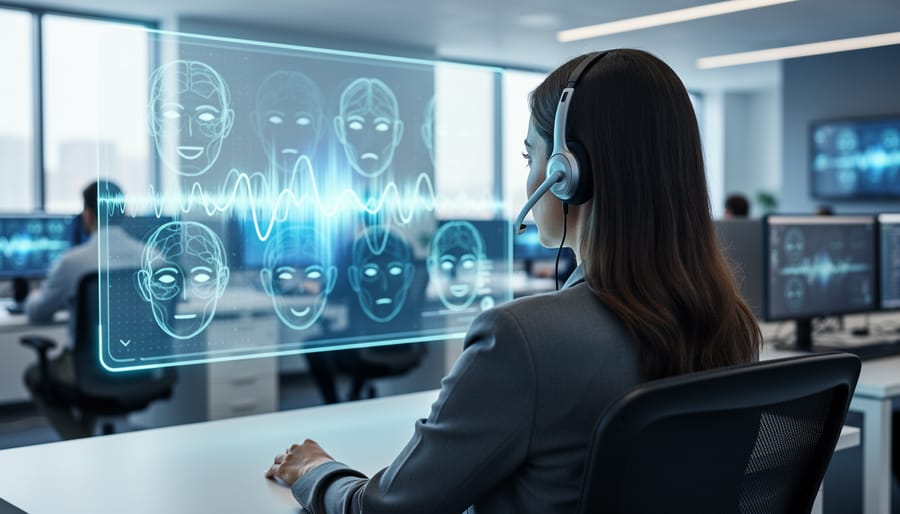
No, AI is not capable of genuine emotions. What we call “emotional AI” or “emotion recognition technology” refers to systems that detect, interpret, and respond to human emotional signals through facial expressions, voice tone, and text analysis, but the technology itself experiences nothing.
This distinction matters because businesses are now deploying emotion recognition systems across customer service platforms, chatbots, and automated communication tools. Understanding what these systems actually do versus what they appear to do helps you set realistic expectations and implement them effectively.
The question isn’t academic. If you’re considering emotion-aware automation for your business, you need to know whether you’re investing in technology that truly understands your customers or simply recognizes patterns in their behavior. The answer shapes everything from how you train your team to work alongside these tools to how you communicate their use to clients.
Current emotion recognition systems analyze observable signals. They measure micro-expressions, vocal pitch changes, word choice, and typing patterns. They then match these signals against vast datasets of labeled emotional responses. The output is a probability score indicating likely emotional states, not an empathetic understanding of what your customer feels.
This article breaks down how emotion detection works in practical terms, examines the specific applications that deliver value in client communication and marketing automation, and clarifies where the technology excels and where human judgment remains essential. You’ll walk away knowing exactly what emotion AI can handle in your business operations and what still requires the irreplaceable human touch.
What Emotion Recognition in AI Actually Means

Emotion recognition in AI refers to technology that identifies and interprets human emotional states without experiencing those emotions itself. Think of it as a sophisticated pattern-matching system: the AI analyzes observable signals, facial movements, voice characteristics, word choices, and maps them to emotional categories based on statistical models. The system doesn’t feel happy when it detects a smile or stressed when it hears tension in someone’s voice. It simply recognizes patterns it has been trained to associate with those emotional states.
This distinction matters for businesses implementing customer interaction automation. When a chatbot adjusts its tone based on detected frustration, or when a call routing system prioritizes angry callers, the AI isn’t empathizing with the customer’s experience. It’s executing a programmed response triggered by recognized patterns. The outcome can still be effective customer service, but the mechanism is fundamentally different from human emotional understanding.
- Emotion Recognition
- The process of identifying human emotional states through analysis of expressions, voice, text, or physiological signals. AI systems classify these signals into categories like anger, joy, or frustration without subjective experience.
- Affective Computing
- A branch of AI focused on developing systems that can recognize, interpret, and simulate human emotions. It encompasses the technology behind emotion-aware customer service tools and sentiment analysis platforms.
- Emotional AI
- AI systems designed to detect and respond to human emotions, commonly used in customer interaction contexts. These systems analyze emotional signals but do not possess emotional consciousness themselves.
- Sentiment Analysis
- The automated process of determining emotional tone in text, often used to gauge customer satisfaction in support tickets, reviews, or social media. It classifies text as positive, negative, or neutral based on language patterns.
The practical value for businesses lies in consistency and scale. An emotion recognition system can monitor thousands of customer interactions simultaneously, flagging issues that need human attention and routing straightforward cases to automated responses. It won’t replace the nuanced understanding of an experienced customer service representative, but it can handle the pattern-recognition tasks that consume most of their time, freeing humans to address complex situations requiring genuine empathy and judgment.
How AI-Driven Emotion Recognition Works
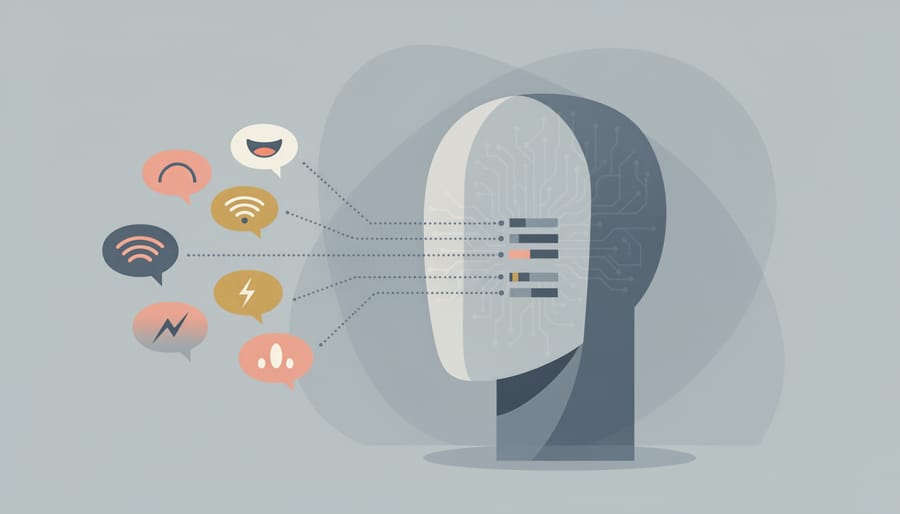
Input Sources AI Uses to Detect Emotion
AI emotion recognition systems pull from four distinct input channels, each revealing different aspects of a customer’s emotional state during interactions.
Facial analysis tracks micro-expressions, brief, involuntary movements that flash across a person’s face in fractions of a second. During video calls or in-store interactions captured on camera, AI monitors eyebrow position, mouth curvature, eye widening, and nostril flare. A customer service system might flag raised inner eyebrows and tightened lips as signs of confusion or frustration, prompting the automated system to offer additional help or route the interaction to a human agent.
Voice analysis examines pitch changes, speaking speed, volume fluctuations, and pauses. A customer whose voice rises in pitch and speeds up while describing a problem likely feels agitated. Call center AI uses these vocal cues to assess satisfaction in real time, adjusting automated responses or prioritizing callback urgency based on detected stress levels.
Text analysis scans word choice, punctuation patterns, and sentence structure in chat conversations and emails. Repeated exclamation marks, all-caps typing, or negative word clusters signal strong emotions. Sentiment analysis tools measure the intensity and polarity of customer messages, feeding this data into customer journey mapping to identify friction points where dissatisfaction spikes.
Response timing rounds out the picture. Long pauses before answering, rapid-fire messages, or abrupt conversation endings provide behavioral context. A customer who suddenly goes silent after a pricing discussion might be experiencing sticker shock, prompting the system to offer payment options or discounts without waiting for explicit objection.
Pattern Matching vs. Emotional Understanding
When AI analyzes emotional signals, it’s essentially performing sophisticated statistical pattern matching rather than experiencing any internal emotional state. The system compares incoming data, a frown, specific word choices, or vocal tremors, against vast databases of labeled examples to predict which emotion category best fits the pattern. It’s similar to how spam filters identify unwanted emails by recognizing characteristic patterns without “understanding” what spam actually is.
This distinction matters less than you might think for customer interaction automation. A customer service chatbot doesn’t need to genuinely feel empathy to recognize frustration in a message and escalate the conversation appropriately. The system requires only reliable correlation between detectable patterns and effective responses. When a voice analysis tool identifies stress markers in a caller’s speech, it can trigger helpful interventions whether or not the software comprehends what stress feels like subjectively.
The practical advantage lies in consistency and scale. Human agents experience fatigue, distraction, and emotional variability that affect their perception. AI systems maintain the same pattern-recognition accuracy across thousands of simultaneous interactions, catching emotional cues that rushed or overwhelmed staff might miss. For automated processes, pattern matching delivers measurable improvements in response quality without requiring consciousness.
Types of Emotion Recognition Systems for Customer Interaction
Businesses deploy four main types of emotion recognition systems, each analyzing different communication channels to interpret customer sentiment during interactions.
Text-based sentiment analysis examines written communication from emails, chat messages, social media posts, and support tickets. These systems scan word choice, punctuation patterns, capitalization, and emoji use to classify messages as positive, negative, or neutral. Advanced versions detect specific emotions like frustration, confusion, or satisfaction. Customer service platforms use this technology to automatically flag urgent or angry messages for priority handling, route complex emotional situations to human agents, and track satisfaction trends across thousands of interactions without manual review.
Voice emotion detection analyzes spoken language during phone calls or voice-based interactions. These systems evaluate vocal characteristics including pitch variation, speaking rate, volume changes, and pauses between words. A rising pitch combined with faster speech might indicate excitement or stress, while a flat monotone could signal disengagement. Call centers implement this technology to alert supervisors when a conversation turns tense, suggest script adjustments to agents in real-time, and identify training opportunities by reviewing calls where emotional signals weren’t handled effectively.
Facial expression analysis uses camera input to detect emotional states from visual cues. The technology maps facial features and tracks movements in areas like the eyebrows, mouth corners, and eye regions to recognize expressions associated with happiness, confusion, anger, or surprise. Retail businesses use this approach during video consultations, while some companies experiment with it for in-person customer interactions or video support sessions. Privacy concerns limit its deployment compared to text and voice systems.
Multimodal emotion recognition combines multiple input types for more accurate assessment. A system might analyze both the words a customer types and how quickly they’re typing, or evaluate voice tone alongside the actual content of what’s being said. These integrated systems catch emotional signals that single-channel analysis might miss. For instance, a customer might write “I’m fine” in a chat, but rapid typing with multiple corrections suggests frustration. Combining inputs helps automated systems make better routing decisions and provides more reliable data for quality monitoring.
The choice between these systems depends on your primary customer communication channels and specific business needs rather than technical sophistication alone.
How Businesses Use Emotion Recognition in Customer Interactions
Businesses deploy emotion recognition across their customer interaction workflows to automate responses, personalize communication at scale, and catch service issues before they escalate. The technology integrates into existing systems, from chatbots to call centers, without requiring complete infrastructure overhauls.
- Automated customer service routing analyzes incoming messages or calls for frustration signals, then escalates high-emotion cases to human agents while directing routine inquiries to automated systems
- Chatbot response adjustment changes tone and phrasing mid-conversation when detecting confusion or irritation, switching from promotional language to problem-solving mode
- Call center quality monitoring flags conversations where agents miss emotional cues, providing coaching opportunities and identifying training gaps across teams
- Personalized marketing messages adapt email subject lines and body copy based on sentiment patterns from previous customer interactions, improving open rates and conversion
- Customer satisfaction prediction spots dissatisfaction signals three to five exchanges before a customer explicitly complains, triggering proactive retention efforts
These applications share a common advantage: consistency. Emotion AI applies the same detection criteria to every interaction, eliminating the variability that comes from tired or distracted human reviewers. A system monitoring 10,000 chat sessions daily catches patterns individual managers would miss.
The automation benefit compounds when you layer emotion recognition into workflows you’re already running. Add sentiment analysis to your existing chat platform, and suddenly you’re routing 40% fewer frustrated customers to overloaded support queues. Integrate voice emotion detection with your CRM, and sales teams get real-time coaching alerts during prospect calls. These aren’t theoretical gains, companies using emotion recognition results report 15-25% improvements in first-contact resolution rates.
The practical value centers on speed and scale. Emotion AI processes client communication faster than any human team, flagging priority cases within seconds of receiving them. When combined with broader customer service tools and generative AI CX capabilities, businesses handle higher volumes without proportionally increasing headcount, a direct path to better margins and more responsive service.
What Emotion AI Can and Cannot Do

Emotion recognition AI excels at specific, measurable tasks while falling short in areas that require genuine human understanding. Knowing where these systems perform reliably and where they struggle helps you set appropriate expectations for customer interaction automation.
AI emotion detection systems reliably identify patterns across massive data sets with consistent accuracy. They analyze thousands of customer interactions simultaneously, spotting emotional signals in text sentiment, voice patterns, and facial expressions faster than any human team could manage. These systems maintain the same analytical standards across every interaction, eliminating the variability that comes with human fatigue or personal biases. They scale effortlessly, handling ten customer conversations or ten thousand with identical processing capability.
The limitations become apparent when context and nuance matter. AI systems trained primarily on Western facial expressions often misread emotions in customers from different cultural backgrounds, where the same expression might signal a completely different feeling. Sarcasm, irony, and layered meaning in text regularly confuse sentiment analysis tools that interpret words literally. A customer typing “Oh great, another delay” reads as positive to many systems because they detect the word “great” without grasping the frustration.
AI cannot feel empathy, despite how advanced the technology becomes. When a system adjusts its chatbot response based on detected sadness, it’s executing a programmed conditional response, not offering genuine compassion. The customer receives helpful language, but the machine experiences nothing. This distinction matters for your business planning: emotion AI works best as a support tool that flags concerns for human follow-up, not as a complete replacement for human customer service representatives.
The most persistent misconception treats emotion AI as a step toward conscious machines. Current systems have zero self-awareness and no inner experience. They’re sophisticated pattern-matching tools, not entities capable of feelings or subjective states. Understanding this prevents both overestimating what the technology can deliver and underestimating its practical value for automated customer communication.
Common Questions About AI and Emotions
Most businesses considering emotion recognition technology face similar concerns before implementation. Here’s what you need to know about the practical realities.
Can AI replace human empathy in customer service?
No. AI detects emotional patterns and adjusts responses accordingly, but it cannot replicate genuine human empathy or handle complex emotional situations requiring nuanced judgment. Think of it as a first-response tool that escalates to humans when needed.
Will customers accept emotion recognition technology?
Acceptance depends on transparency and value. Customers generally accept emotion AI when it improves their experience, faster resolutions, more relevant responses, and when you clearly communicate how you use the technology.
How accurate is emotion detection in real-world use?
Accuracy varies by system and context, typically ranging from 70-85% for basic emotions in controlled conditions. Performance drops with cultural differences, sarcasm, or mixed emotional states, which is why human oversight remains essential.
What privacy concerns should businesses address?
You need clear consent mechanisms, secure data storage, and transparent policies about what emotional data you collect and how long you retain it. Many jurisdictions now regulate biometric data, including voice and facial analysis.
Regarding edge cases, automated emotion systems work best for routine interactions with clear emotional signals. When the system detects confusion, unusually high frustration, or conflicting emotional cues, the standard approach is immediate handoff to human agents. You should build these escalation triggers into your workflow from the start rather than trying to make AI handle every scenario. The goal isn’t perfect emotion recognition, it’s using automation to improve average interactions while preserving human judgment for complex cases.
AI doesn’t feel emotions, it processes data patterns that correlate with emotional states. That distinction matters less than you might think for practical business applications. What counts is whether the technology can identify when a customer is frustrated, confused, or satisfied, then trigger appropriate responses. On that measure, emotion recognition systems deliver measurable value.
For customer-facing teams, these tools solve real workflow problems. They route upset customers to experienced agents before situations escalate. They adjust chatbot responses when text sentiment turns negative. They flag satisfaction risks in real time, giving you chances to intervene before losing business. The technology scales pattern recognition capabilities you can’t replicate manually across thousands of daily interactions.
The business case centers on automation efficiency and communication quality, not replicating human consciousness. Emotion AI handles repetitive analysis, scanning sentiment across chat transcripts, monitoring voice tone on support calls, tracking facial cues during video consultations, so your team focuses on complex problem-solving and relationship building where human judgment matters most.
Integration doesn’t require overhauling existing systems. Most emotion recognition platforms connect through APIs to CRM software, marketing automation tools, and communication channels you already use. Start with one clear use case, sentiment-based ticket routing or chatbot escalation triggers, then expand as you prove ROI.
The technology continues improving, but it works now for defined business contexts. If better client communication and scalable personalization matter to your operation, emotion recognition deserves evaluation alongside other automation investments.
Leave a Reply