Why Users Abandon Your App (And How to Make Them Stay)
Getting users to download your app is only half the battle—keeping them engaged determines your success. The hard truth: 77% of users abandon apps within three days of installation, and most apps lose 90% of daily active users within 30 days. This churn represents lost revenue, wasted acquisition costs, and missed growth opportunities.
The problem isn’t your product concept. Most retention failures stem from disconnected user experiences, poor onboarding, and lack of ongoing communication. While app store optimization drives downloads, systematic retention strategies transform casual installers into loyal, paying customers.
Retention isn’t about bombarding users with notifications or adding unnecessary features. It requires understanding user behavior patterns, identifying drop-off points, and implementing targeted interventions at critical moments in the user lifecycle. The most successful apps deploy automated systems that deliver personalized experiences without requiring constant manual oversight.
This guide provides proven retention tactics organized by user journey stage—from first launch through long-term engagement. Each strategy includes specific implementation steps, recommended tools, and measurable outcomes. Whether you’re facing 30-day retention rates below 10% or looking to optimize an already successful app, these approaches address the core reasons users disengage and provide clear paths to improvement.
The difference between thriving apps and forgotten downloads lies in deliberate retention systems. Master these strategies to reduce churn, increase lifetime value, and build sustainable growth.
What App Retention Really Means for Your Business
The True Cost of Poor Retention
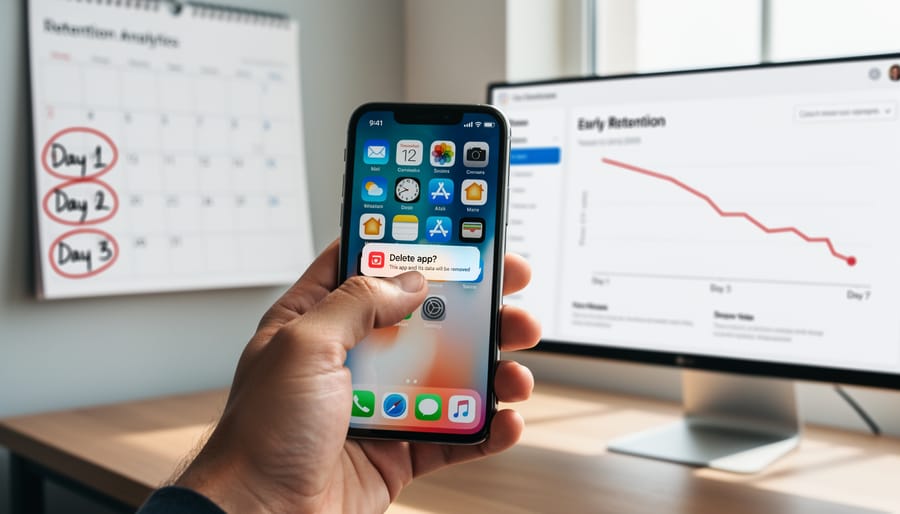
Poor user retention carries a hefty price tag that extends far beyond the surface-level metrics. When users abandon your app, you’re not just losing active accounts—you’re watching your marketing investment evaporate.
Consider the basic math: if acquiring new users costs you $5 per download and your retention rate sits at 20% after 30 days, you’re effectively paying $25 for each user who sticks around. Through paid user acquisition campaigns, these costs can climb even higher, sometimes reaching $50 or more per install in competitive categories.
The lifetime value equation becomes equally troubling. A user who churns in week one never converts to a paying customer, never refers friends, and never contributes to your revenue stream. If your average customer lifetime value is $100 but 80% of users leave before making a purchase, you’re leaving $80 on the table for every download.
Beyond direct financial losses, poor retention creates competitive vulnerability. Users who leave your app often migrate to competitors, strengthening rival platforms while weakening your market position. This exodus compounds over time, making it progressively harder to build the engaged user base necessary for sustainable growth and profitability.
Map Your User Journey Before You Lose Them
The First 24 Hours: Your Make-or-Break Window
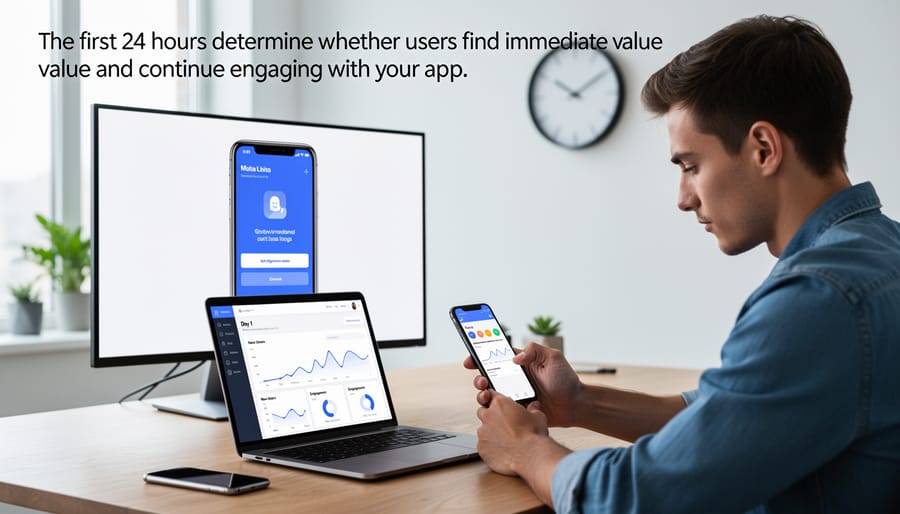
Your app’s first 24 hours represent the most critical window for user retention. Research shows that 77% of users who abandon an app do so within the first three days, with the steepest drop-off occurring in those crucial initial hours. This makes your onboarding experience not just important, but essential to your app’s long-term success.
The key to winning this window lies in reducing friction at every touchpoint. Eliminate unnecessary registration steps by offering guest access or social login options. Users want to experience your app’s value before committing personal information. Each additional form field increases abandonment risk by approximately 5-10%, so request only what you absolutely need upfront.
Demonstrate concrete value within the first 90 seconds. Don’t waste time with lengthy tutorials or feature tours that delay gratification. Instead, guide users to complete one meaningful action that showcases your app’s core benefit. For a fitness app, that might mean logging their first workout. For a productivity tool, creating their first task. This quick win creates immediate investment and shows users exactly why they downloaded your app.
Implement effective onboarding strategies through progressive disclosure, revealing features gradually as users need them rather than overwhelming them immediately. Use contextual tooltips that appear at relevant moments instead of forcing users through a pre-determined tutorial sequence.
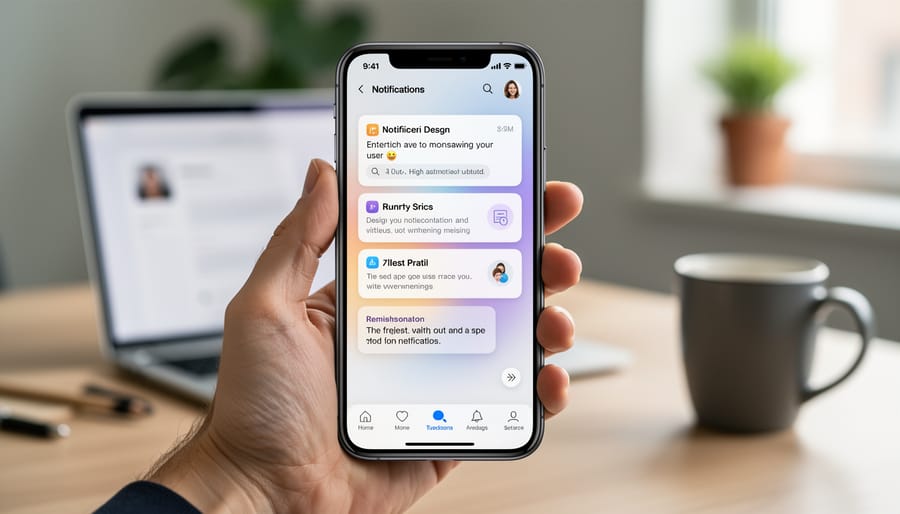
Set engagement hooks by establishing a clear next step. Send a well-timed push notification within 6-12 hours asking users to return and complete a second action. This creates habit formation early and signals that your app provides ongoing value worth returning to regularly.
Personalization That Actually Works
Behavioral Triggers That Bring Users Back
Strategic behavioral triggers transform passive users into active, returning customers by delivering timely, relevant messages based on specific actions or inactions. These automated campaigns work around the clock to recapture attention and drive meaningful engagement.
Abandoned cart reminders represent one of the most effective trigger-based campaigns. When users add items to their cart but don’t complete checkout, send a gentle reminder within 24 hours. Follow up with a second message after 48 hours, potentially including a limited-time incentive. This sequence recovers an average of 10-15% of abandoned transactions without requiring manual intervention.
Achievement notifications celebrate user progress and encourage continued engagement. When someone completes their profile, reaches a usage milestone, or unlocks a new feature, acknowledge it immediately. These positive reinforcement moments create emotional connections and remind users of the value they’re gaining from your app.
Usage milestones deserve special attention. Track metrics like days active, purchases completed, or content consumed, then trigger celebratory messages at meaningful thresholds. A “You’ve been with us for 30 days” notification reinforces commitment and can include exclusive rewards for loyalty.
Re-engagement sequences target dormant users with carefully timed messages. Start with a friendly check-in after seven days of inactivity, highlighting new features or personalized content. If there’s no response, send a second message after 14 days with a compelling reason to return. A final message at 30 days might include a special incentive or ask for feedback about their absence.
The key to successful trigger campaigns is relevance and timing. Monitor open rates and conversion metrics for each trigger type, then refine your messaging and timing based on actual user behavior patterns.
Push Notifications Without the Push-Back
In-App Messaging for Deeper Engagement
In-app messaging serves as your direct communication channel with active users, delivering timely guidance exactly when they need it. Unlike push notifications that interrupt users outside your app, contextual messages appear at strategic moments during the user journey, enhancing rather than disrupting the experience.
Start with tooltips that highlight key features during a user’s first session. These brief, non-intrusive messages explain how specific functions work without overwhelming new users. For example, when someone reaches a particular screen for the first time, display a simple tooltip pointing out the most valuable action they can take there.
Feature announcements keep your existing user base informed about new capabilities and improvements. Time these messages to appear when users log in after an update, but make them dismissible so power users can proceed uninterrupted. Include a clear benefit statement explaining how the new feature solves a problem or saves time.
Contextual messages work best when triggered by specific user behaviors. If someone abandons a task midway three times, display a helpful tip or offer assistance. When users achieve milestones, acknowledge their progress with encouraging messages that reinforce value.
The key to effective in-app messaging lies in restraint. Limit message frequency to prevent fatigue and always provide an easy dismissal option. Use A/B testing to determine optimal timing and messaging that resonates with your audience. Track engagement metrics for each message type to identify what drives action versus what gets ignored, then refine your approach accordingly.
Build Habits Through Smart Feature Design
The most successful apps don’t just attract users—they become daily habits. This happens through strategic feature design based on proven psychological principles, not by accident.
At the core of habit formation lies the habit loop: trigger, action, and reward. Your app needs to create clear triggers that prompt users to open it. These can be external (push notifications, time-based reminders) or internal (emotional states, specific situations). The key is making these triggers relevant and timely, not intrusive.
The action itself must be simple and frictionless. Every unnecessary step in your user flow increases the chance someone will abandon the process. Automated processes work particularly well here—features that learn user preferences and streamline repetitive tasks reduce friction while increasing value.
Variable rewards keep users coming back. While consistency builds trust, introducing unpredictability in positive outcomes creates anticipation. This could mean varying content recommendations, surprise achievements, or unexpected benefits. Think of how social media apps vary the content you see or how fitness apps celebrate milestones differently each time.
Investment is the often-overlooked fourth component. When users invest time, data, or effort into your app, they’re more likely to return. Features like personalized profiles, saved preferences, progress tracking, or accumulated content all increase switching costs. The more someone customizes their experience, the harder it becomes to start fresh elsewhere.
Practical implementation starts with identifying your core value proposition. What problem does your app solve daily? Design features that reinforce this value through repetition. If you’re a productivity app, automated task suggestions based on user patterns create both value and habit. For communication apps, seamless contact synchronization reduces barriers to regular use.
Track behavioral data to understand which features drive retention. Monitor how often users engage with specific features, completion rates for key actions, and the typical path users take before churning. This information reveals where your habit loops succeed or fail, allowing you to optimize accordingly without guesswork.
Automate Your Retention System
Manual retention efforts don’t scale. When your app has hundreds or thousands of users, you can’t personally reach out to each one at the right moment. This is where automated CRM workflows become essential for maintaining engagement without burning out your team.
Start with a welcome sequence that activates immediately after signup. This automated series should guide new users through core features over their first 7-14 days. Send the first message within minutes of registration, confirming their account and highlighting one key action to take. Follow up on days 2, 5, and 7 with tips, feature spotlights, and success stories. These messages should adapt based on user behavior—if someone completes a key action, skip the reminder and move them to the next stage.
Re-engagement campaigns target users showing declining activity. Set triggers based on specific behaviors like “hasn’t opened the app in 7 days” or “completed action once but not twice.” Your automation platform should monitor these signals and deploy personalized messages accordingly. For example, if a user hasn’t logged in for a week, send an email highlighting new content or features they’ve missed. After 14 days of inactivity, shift to a different message emphasizing the value they’re leaving behind.
Win-back flows address users who’ve gone cold. These are your last-chance campaigns before users are likely lost forever. Trigger these after 30-60 days of inactivity with compelling offers, major feature announcements, or direct requests for feedback about why they left. Make these messages feel personal and valuable, not desperate.
Lifecycle communications keep active users engaged through automated milestones. Celebrate achievements like “first week completed,” “10 tasks finished,” or usage anniversaries. These moments create emotional connections and remind users of their progress.
The key to successful automation is segmentation. Don’t send identical messages to everyone. Use behavioral data, preferences, and usage patterns to personalize each workflow. Monitor performance metrics for each automated sequence—open rates, click-throughs, and subsequent app engagement—and refine your messages based on what actually drives retention.
Set up these systems once, then let them run continuously while you focus on strategy and optimization.
Measure What Matters and Act on It
Tracking the right metrics transforms retention from guesswork into a systematic process. Focus on metrics that directly indicate user engagement and lifetime value rather than superficial numbers that look impressive but don’t drive decisions.
Your core retention metrics should include Day 1, Day 7, and Day 30 retention rates, which reveal how many users return after initial download. Monitor session frequency and length to understand engagement depth. Track feature adoption rates to identify which functionalities keep users coming back, and measure time-to-value—how quickly new users experience your app’s core benefit.
Set up automated dashboards that display these metrics in real-time. Tools like Mixpanel, Amplitude, or Google Analytics for Firebase can consolidate this data without requiring manual compilation. Configure alerts for significant drops in retention rates so you can respond immediately rather than discovering problems weeks later during monthly reviews.
The most critical step is closing the feedback loop between data and action. Establish a weekly review process where you examine retention trends alongside user feedback. When you notice Day 7 retention declining, investigate what changed in the user experience during that timeframe. Did you release a new feature? Modify your onboarding flow? Adjust push notification timing?
Create a simple decision framework: if a metric drops below your baseline threshold, you investigate within 24 hours and implement a test solution within one week. This rapid response system prevents small issues from becoming major churn problems.
Avoid vanity metrics like total downloads or app store rankings that don’t connect to revenue or sustainable growth. Instead, calculate cohort-based retention to understand how different user groups behave over time. This granular view helps you identify which acquisition channels bring quality users and which marketing messages resonate with people who actually stick around.

Improving app retention isn’t a one-time project you can check off your list and forget. It’s an ongoing process that requires consistent attention, testing, and refinement. The strategies outlined in this guide work best when implemented systematically rather than all at once. Start by selecting one or two tactics that align most closely with your current challenges, whether that’s improving onboarding, refining your push notification strategy, or building a more robust email sequence.
As you implement these strategies, pay close attention to your retention metrics and user feedback. What works for one app may not work for another, so continuous testing and optimization are essential. The beauty of modern retention tools is that many can be automated, freeing your team from repetitive manual tasks. This automation gives you more time to focus on what truly matters: analyzing user behavior patterns, developing strategic improvements, and maintaining meaningful communication with your clients.
Remember that retained users become your most valuable asset. They cost less than acquiring new users, spend more over time, and often become advocates for your app. By treating retention as the ongoing priority it deserves, you’ll build a sustainable foundation for long-term growth.
Leave a Reply