Why VR and AR Are Changing How Smart Businesses Understand Their Customers

Traditional market research methods tell you what customers say they want. Virtual and augmented reality technologies show you what they actually do. Deploy VR simulations to test product designs and retail layouts before committing capital—companies using this approach reduce costly redesigns by up to 60%. Use AR applications to observe genuine consumer reactions to packaging, shelf placement, and product features in controlled environments that mirror real shopping conditions. Capture behavioral data automatically through eye-tracking, heat mapping, and interaction patterns that reveal subconscious preferences traditional surveys miss entirely.
These immersive research tools transform abstract consumer feedback into quantifiable insights. Create virtual store environments where customers navigate aisles, select products, and make purchase decisions while your system records every hesitation, comparison, and choice. Layer AR elements onto physical spaces to test how new signage, displays, or product variations perform without physical production costs. The resulting data streams integrate directly into your analytics platforms, eliminating manual transcription and interpretation delays that slow traditional research cycles.
The technology has matured beyond enterprise-only applications. Small and medium-sized businesses now access VR and AR research platforms through subscription models that cost less than conducting a single traditional focus group series. More importantly, the VR and AR customer experience data you collect provides competitive advantages by revealing the gap between stated preferences and actual behavior—the difference between what customers think they want and what drives their purchasing decisions.
What VR and AR Market Research Actually Means for Your Business
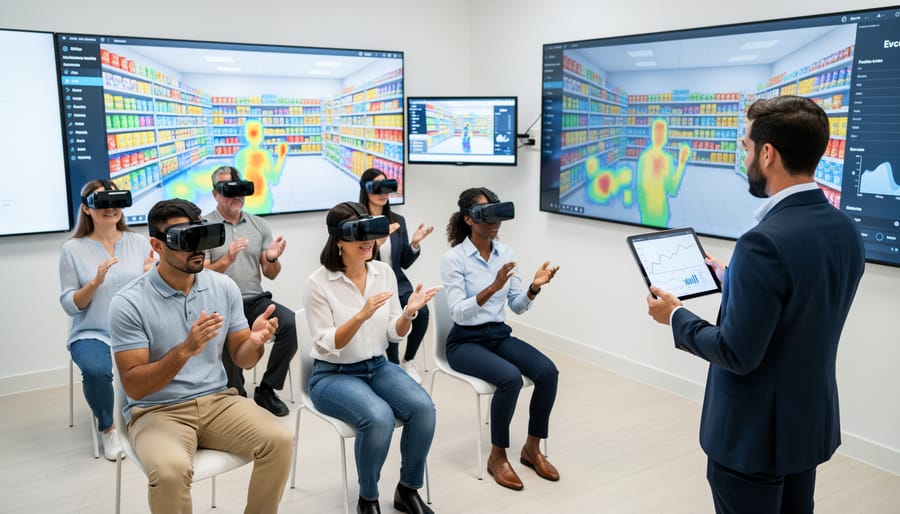
The Difference Between Traditional and Immersive Research
Traditional market research relies on explicit feedback through surveys, interviews, and focus groups. While these methods provide valuable data, they depend on participants accurately reporting their feelings and motivations. The challenge? People often struggle to articulate their emotional responses or may unconsciously modify their answers based on social expectations.
Immersive research using VR and AR changes this dynamic by capturing what people actually do rather than what they say they’ll do. When a participant walks through a virtual store environment, their eye movements, hesitation patterns, and product interactions reveal genuine preferences. For example, a traditional focus group might show positive responses to a new product display, but VR research could reveal that shoppers consistently walk past it without noticing.
The technology tracks subconscious behaviors that participants themselves don’t recognize. Heat mapping shows exactly where attention focuses, dwell time measures genuine interest, and physiological responses indicate emotional engagement. A beverage company testing packaging designs discovered through VR that consumers spent 40% more time examining bottles they ultimately didn’t report preferring in post-session surveys.
This doesn’t make traditional methods obsolete. Surveys and interviews remain cost-effective for straightforward questions and broad demographic data. However, when you need to understand the gap between stated preferences and actual behavior, or when testing expensive physical prototypes isn’t feasible, immersive research provides insights that conventional approaches simply cannot access. The automated data collection also eliminates manual analysis time, delivering faster, more objective results.
Real-World Applications That Drive Business Results
Virtual Store Testing and Product Placement
Retailers are discovering that testing store layouts and product placement in virtual store environments delivers significant cost savings and performance improvements before committing to physical changes. This approach allows businesses to experiment with multiple configurations, shelf arrangements, and packaging designs without the expense of in-store implementation.
Major retailers like Walmart and Tesco have used VR testing to optimize product placement, finding that virtual trials can increase sales by 7-12% when successful layouts are implemented in actual stores. The process is straightforward: create a digital replica of your store, test different configurations with sample shoppers, and measure engagement metrics like dwell time, product interactions, and purchase intent.
The financial benefits are substantial. Traditional store remodels cost between $50,000 to $200,000 per location, while VR testing runs approximately $5,000 to $15,000 for comprehensive studies. You can test dozens of variations in weeks rather than months, gathering data from hundreds of virtual shoppers across different demographics.
Packaging design testing in VR has proven particularly valuable for consumer goods companies. Procter & Gamble reported that VR shelf testing helped identify packaging designs that improved product visibility by 23%, leading to better shelf performance without expensive trial-and-error in physical retail environments. This automated testing process provides clear data on what works, enabling confident decisions before investing in physical changes.
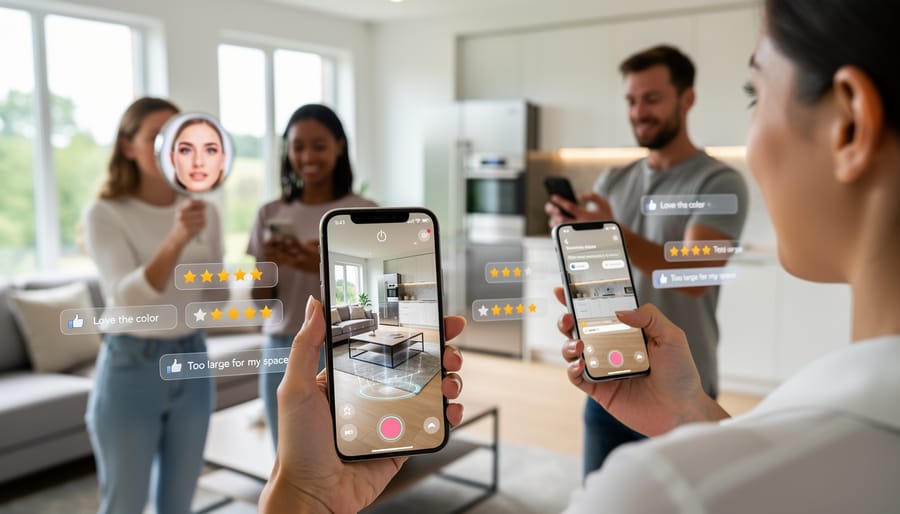
Product Design and Prototype Testing
Virtual environments allow businesses to test product concepts with real consumers before committing to expensive manufacturing. Through immersive simulations, companies can present prototypes in realistic settings, enabling potential customers to interact with products as if they were physical items. This approach delivers immediate feedback on design choices, functionality concerns, and overall appeal while eliminating traditional prototyping costs.
The process works through automated digital platforms where users examine 3D product models, test different configurations, and provide structured feedback. Businesses can quickly iterate on designs based on this input, adjusting colors, features, or packaging within hours rather than weeks. AR product testing particularly excels at showing how items fit into real-world environments, from furniture in living rooms to cosmetics on different skin tones.
Small to medium-sized businesses benefit most from this streamlined approach. Traditional focus groups require facility rentals, physical prototypes, and complex scheduling. Virtual testing runs continuously with participants joining from anywhere, generating data automatically through built-in analytics that track interaction patterns, time spent on features, and preference ratings.
The key advantage lies in speed and cost efficiency. Companies receive actionable insights within days, communicate changes to their development teams immediately, and validate improvements through follow-up testing cycles. This rapid iteration process helps businesses launch products that already resonate with target audiences, reducing market risk and improving initial sales performance.
Consumer Journey Mapping and Experience Testing
VR and AR technologies transform consumer journey mapping by capturing what traditional surveys miss: actual behavior and genuine emotional responses. These immersive platforms automatically track eye movements, revealing exactly where customers focus their attention during interactions with your products, stores, or digital experiences. This automated data collection eliminates the guesswork inherent in asking customers what they remember noticing.
The technology monitors micro-expressions and physiological responses throughout simulated shopping experiences, identifying frustration points before customers consciously recognize them. For instance, when testing a store layout, the system records hesitation patterns at decision points, attention drops during product searches, and emotional responses to pricing displays. This VR customer feedback provides actionable insights you can implement immediately.
Heat mapping features visualize aggregate attention data across multiple test subjects, showing which elements attract engagement and which get ignored. Rather than relying on what customers say they’d do, you observe their actual behavior in controlled environments. The automated analysis identifies patterns across demographics, revealing specific pain points for different customer segments.
Most valuable for busy business owners: these platforms generate comprehensive reports without manual analysis. You receive clear visualizations of customer flow, attention metrics, and emotion tracking data, complete with recommendations for optimization. This streamlined process means you can test multiple journey variations quickly, refining your customer experience based on concrete behavioral evidence rather than assumptions.
The Advantages That Make VR/AR Worth Your Investment
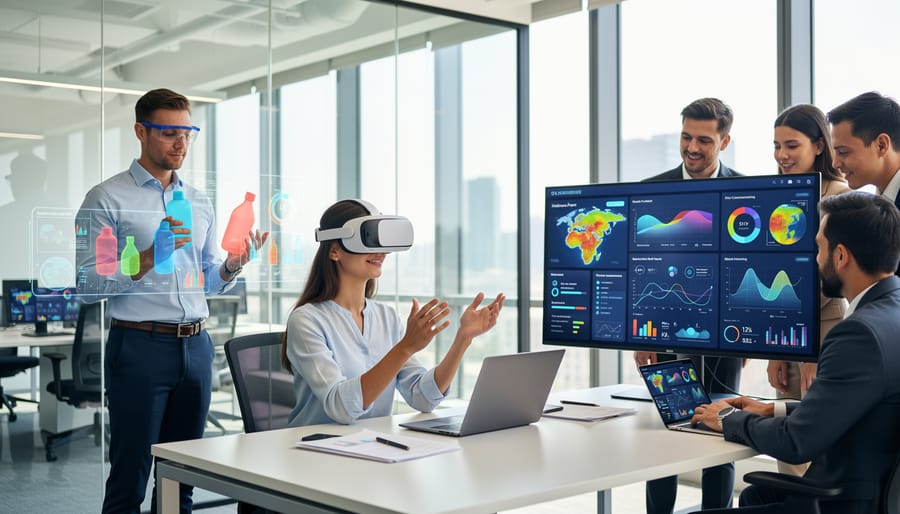
Cost Savings Through Virtual Testing
Virtual testing through VR and AR significantly reduces your research budget by eliminating major cost centers. Traditional product testing requires physical prototypes that can cost thousands per iteration. Virtual environments allow you to test multiple variations simultaneously without manufacturing a single physical sample.
Consider a typical research scenario: renting a focus group facility costs $150-300 per hour, plus participant compensation and refreshments. With virtual testing platforms, participants can engage from home, cutting venue expenses entirely. You’re also saving on travel costs for team members who can observe remotely.
The iteration advantage delivers substantial savings too. Physical product testing might require three to five redesign cycles, each involving new prototypes and additional testing sessions. Virtual testing enables real-time modifications and instant retesting, compressing what would take months into weeks.
A practical example: A furniture company testing five product designs traditionally might spend $25,000 on prototypes, venues, and logistics across three testing rounds. Virtual testing could reduce this to $8,000 in platform fees and participant compensation. That’s a 68 percent reduction while gathering richer data through automated eye-tracking and interaction analytics. These automated processes also free your team to focus on strategic decisions rather than logistical coordination.
Faster Insights and Automated Data Collection
VR and AR technologies transform the traditional research timeline by eliminating weeks of manual data processing. These platforms capture how consumers interact with virtual products through automated data collection, tracking eye movements, hand gestures, navigation patterns, and dwell times without requiring participants to fill out lengthy surveys.
Real-time analytics dashboards display engagement metrics as research sessions unfold, showing which product features attract attention and where confusion occurs. Eye-tracking reveals precisely what elements consumers notice first, while heat maps highlight areas of sustained interest. This immediate feedback allows you to adjust testing parameters on the fly rather than waiting for post-study analysis.
The automation extends beyond data capture to preliminary analysis. Machine learning algorithms identify behavioral patterns across participant groups, flagging significant trends and outliers automatically. What traditionally required days of analyst time now generates actionable insights within hours of completing sessions, accelerating your decision-making process and reducing research costs by up to 40 percent while maintaining accuracy.
Deeper, More Accurate Consumer Understanding
Traditional surveys and focus groups rely on what consumers say they do, but VR and AR research reveals what they actually do. When people interact with products or environments in immersive settings, their natural behaviors emerge without the filtering that occurs in self-reported data. A shopper might claim they carefully read product labels, but VR tracking shows they actually make decisions within seconds based on packaging color and placement.
This behavioral accuracy stems from reduced social desirability bias. Participants forget they’re being studied when immersed in realistic scenarios, leading to genuine reactions rather than responses they think researchers want to hear. Eye-tracking data shows exactly where attention focuses, heat maps reveal movement patterns, and interaction metrics capture hesitation points that verbal feedback misses.
These automated data collection processes eliminate human observation errors and provide quantifiable metrics that strengthen business cases. When you present leadership with concrete behavioral data rather than subjective opinions, you build confidence in strategic decisions. The technology captures micro-expressions, decision timelines, and engagement levels simultaneously, delivering a complete picture of consumer psychology that transforms guesswork into informed action.
Getting Started Without Overcomplicating Things
Choosing the Right Approach for Your Business Size
Selecting the right VR or AR solution depends on your budget, research objectives, and organizational size. Small businesses and startups should consider mobile AR surveys as an entry point. These solutions use smartphone applications to overlay digital elements onto real environments, allowing customers to interact with virtual products in their actual spaces. The investment is minimal, often costing between $5,000-$15,000 for initial setup, with quick deployment times and straightforward data collection.
Mid-sized companies with more substantial budgets can explore web-based VR platforms that don’t require expensive headsets. These browser-accessible tools create immersive 3D environments where participants can navigate virtual stores or test product configurations. Investment typically ranges from $20,000-$50,000, with the advantage of reaching broader audiences without hardware distribution challenges.
Larger enterprises conducting extensive consumer research may benefit from full VR simulation platforms using dedicated headsets. These systems provide the highest level of immersion and data accuracy, capturing detailed behavioral metrics including gaze tracking, movement patterns, and emotional responses. While requiring investments of $75,000 or more, they deliver comprehensive insights for major product launches or retail redesigns.
When choosing your approach, prioritize solutions that offer automated data collection and reporting. This reduces manual analysis time and accelerates decision-making. Start with pilot projects using simpler technologies before scaling to more complex systems. Most providers offer modular options, allowing you to expand capabilities as your research needs grow and demonstrate clear ROI from initial implementations.
Working with Research Partners vs. In-House Solutions
Deciding between partnering with a specialized research firm or building in-house VR/AR capabilities depends on your specific business context. Consider your frequency of use first. If you’re planning to conduct VR/AR research quarterly or more often, investing in internal capabilities may prove cost-effective over time. For occasional projects—once or twice a year—outsourcing typically makes better financial sense.
Business size matters significantly in this decision. Small to medium-sized enterprises usually benefit from working with research partners who already have the technology, trained personnel, and proven methodologies. This approach eliminates upfront hardware costs, software licensing fees, and staff training expenses. You gain immediate access to expertise without the learning curve.
Larger organizations with substantial research budgets might justify building internal capabilities, particularly if VR/AR insights directly inform product development cycles. However, even large companies often start by outsourcing to understand the technology’s value before committing to internal infrastructure.
Consider your team’s technical capacity. In-house solutions require staff members who can operate VR/AR equipment, analyze spatial data, and troubleshoot technical issues. Research partners handle these complexities, letting you focus on interpreting results and applying insights to business decisions.
A hybrid approach works well for many businesses: partner with specialists for your initial projects to validate the technology’s value, then gradually build internal capabilities as your needs scale. This minimizes risk while maintaining flexibility as your research requirements evolve.
What to Watch Out For and How to Avoid Common Mistakes
While VR and AR market research offers exciting possibilities, understanding its limitations helps you make smarter investment decisions. The technology isn’t a magic solution that replaces all traditional research methods, and recognizing this upfront prevents costly missteps.
The most common mistake is assuming VR/AR research works for every research question. These technologies excel at spatial experiences, product interactions, and emotional responses to environments, but they’re often overkill for straightforward preference surveys or basic demographic research. Start by asking whether your research question genuinely benefits from immersive technology. If traditional methods can answer it effectively at lower cost, stick with what works.
Sample size presents another challenge. VR/AR studies typically involve smaller participant groups due to higher per-response costs and logistical complexity. Don’t expect the same sample sizes as online surveys. Instead, focus on the depth and quality of insights rather than sheer volume. Combining VR/AR research with traditional methods often provides the best balance between rich qualitative data and statistical confidence.
Technical barriers can skew your results if you’re not careful. Participants unfamiliar with VR headsets may struggle with the technology itself rather than focusing on your research questions. Always include orientation time and clear instructions. Consider your target demographic carefully. If your actual customers aren’t tech-savvy, heavily VR-dependent research might not reflect real-world behavior accurately.
Budget misalignment is preventable with proper planning. Set realistic expectations about costs upfront, including hardware, software development, participant recruitment, and data analysis. Request detailed quotes that break down each component. Many providers offer scalable solutions starting with simpler AR mobile experiences before committing to full VR environments.
Finally, ensure your research partner demonstrates clear reporting processes. Automated data collection is valuable, but you need actionable insights delivered in formats your team can actually use for decision-making.
VR and AR-based market research is no longer reserved for enterprise-level corporations with massive budgets. These technologies have become increasingly accessible, offering businesses of all sizes powerful tools to understand their customers better and make smarter decisions.
The key is knowing when these methods add real value. Use VR and AR research when you need deeper emotional insights, want to test products or environments before they exist, or need to eliminate geographical barriers in your research. Traditional methods still work well for straightforward surveys and basic data collection, but immersive technologies excel at revealing the unconscious behaviors and preferences that surveys often miss.
Start by identifying one specific research challenge where visualization or immersion would provide clearer answers than traditional methods. Whether it’s testing a store layout, evaluating packaging designs, or understanding how customers interact with your product, there’s likely a VR or AR application that fits your needs and budget.
Ready to explore how immersive research can work for your business? Reach out to research providers who specialize in automated, scalable solutions that don’t require technical expertise on your end. The right partner will help you determine if VR or AR research makes sense for your specific goals and guide you through a straightforward implementation process.
Leave a Reply