How Influencer Partnerships Transform B2B Marketing Results

Align your influencer partnerships and strategic alliances under a single, unified messaging framework that speaks directly to your buyer’s journey stages. Stop treating influencer collaborations and partnership marketing as separate initiatives—integrate them into your core content calendar, sales enablement tools, and customer touchpoint mapping to eliminate mixed messages and maximize reach.
Map each partnership to specific business outcomes by establishing clear KPIs before launch. Define whether you’re driving brand awareness, lead generation, or deal acceleration, then select influencers and partners whose audiences align with those goals. This prevents the common pitfall of pursuing relationships that generate vanity metrics without moving revenue needles.
Automate your partnership tracking and communication workflows to maintain consistency across multiple collaborators. Use centralized platforms to coordinate content approvals, track performance data, and ensure all partners receive timely updates about campaign adjustments. This operational efficiency becomes critical when managing 5+ simultaneous partnerships—manual coordination collapses at scale.
Build your integrated strategy around authentic, long-term relationships rather than transactional one-off campaigns. B2B buyers conduct extensive research across multiple touchpoints before making decisions, meaning your partnerships must deliver consistent value over months, not weeks. Select collaborators who genuinely use and understand your solution, then empower them with the resources and flexibility to communicate authentically to their networks.
The difference between scattered partnership efforts and integrated marketing lies in strategic coordination—where every influencer post, co-marketed webinar, and partnership announcement reinforces the same core value propositions to the same target accounts at optimal moments in their buying journey.
What B2B Integrated Marketing Actually Means
The Core Components of Integration
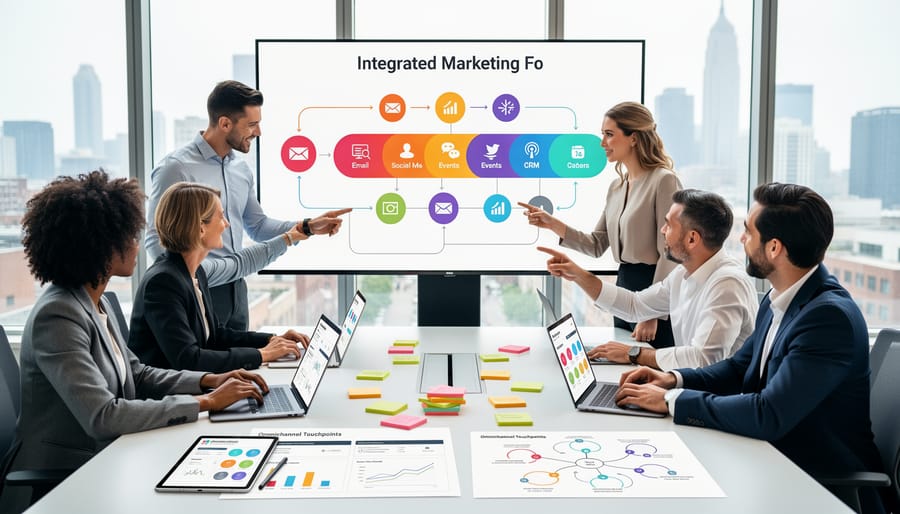
True integrated marketing communications requires four fundamental components working in harmony.
First, consistent messaging forms the foundation. Your brand story, value proposition, and key messages must remain uniform across all channels—whether communicated through partner content, influencer posts, email campaigns, or sales presentations. This consistency builds trust and reinforces recognition among B2B buyers who typically interact with multiple touchpoints before making decisions.
Second, coordinated timing ensures maximum impact. Launch influencer content alongside partnership announcements, align social media posts with email sends, and synchronize sales outreach with marketing campaigns. Automated scheduling tools streamline this coordination, eliminating manual errors and ensuring your message reaches prospects at optimal moments throughout their buying journey.
Third, unified data tracking provides the insights needed for continuous improvement. Integrate analytics across all platforms to monitor how influencer engagement affects partnership leads, track customer progression through combined touchpoints, and measure which integrated tactics drive actual conversions. Without unified tracking, you’re operating blind.
Fourth, seamless customer journey mapping connects every interaction. Document how prospects move from initial awareness through influencer discovery, partner referrals, and direct engagement. Identify gaps where integration breaks down and opportunities where combined efforts amplify results. Map these journeys to guide your automation setup, ensuring no prospect falls through the cracks between channels.
When these components work together, they transform disconnected marketing activities into a cohesive system that drives predictable B2B growth.
Why B2B Integration Differs from B2C
B2B integrated marketing operates in a fundamentally different landscape than consumer-focused campaigns. The most significant distinction lies in the extended sales cycle—where B2C purchases might happen within minutes, B2B transactions typically span weeks or months. This extended timeline requires sustained, coordinated messaging across multiple touchpoints to maintain momentum and build trust throughout the buyer’s journey.
Another critical difference involves the decision-making process. Unlike individual consumers making independent choices, B2B purchases require consensus among multiple stakeholders—from department heads to C-suite executives. Each decision-maker brings different priorities and concerns, demanding tailored content that addresses varied perspectives while maintaining a cohesive brand message.
The financial stakes also shift the integration approach. Higher-value transactions mean prospects conduct thorough research, seek proof of ROI, and expect personalized engagement. This necessitates deeper relationship-building through strategic partnerships and industry influencers who carry credibility with these sophisticated buyers.
Finally, B2B integration demands more sophisticated tracking and automated processes to nurture leads effectively over time. The complexity requires marketing and sales alignment that consumer campaigns don’t typically face, making coordinated messaging and automated follow-up systems essential for converting prospects into long-term clients.
The Rising Power of B2B Influencers and Strategic Partnerships
Who B2B Influencers Really Are
In B2B marketing, influencers look different from the social media personalities dominating consumer markets. They’re industry analysts from firms like Gartner or Forrester who publish research that shapes purchasing decisions. They’re technical experts who speak at conferences and contribute to trade publications. They’re consultants and practitioners whose opinions carry weight in professional circles because they’ve solved real problems in the field.
These influencers include software developers who maintain popular GitHub repositories, executives who share strategic insights on LinkedIn, and authors of respected industry blogs. They’re the people your target audience already follows for guidance—not because of follower counts, but because of proven expertise and credibility.
What makes B2B influencers valuable isn’t their reach alone, but their ability to influence decisions within organizations. When a respected analyst recommends a solution or a thought leader validates an approach, it carries more weight than traditional advertising because these voices have earned trust through consistent, substantive contributions to their fields. Understanding this distinction helps you identify the right partners for your integrated marketing strategy.

Partnership Marketing vs. Traditional Advertising
Traditional advertising channels like paid search, display ads, and trade publications offer broad reach but often lack the credibility and precision that B2B buyers demand. Partnership marketing delivers a compelling alternative by leveraging established relationships and shared audiences.
The cost differential is significant. While a single trade publication ad might cost thousands with uncertain ROI, a data-driven partnership strategy focuses resources on pre-qualified audiences who already trust your partner. This targeted approach reduces wasted spend and improves conversion rates.
Credibility stands as the most critical advantage. When a respected industry partner endorses your solution, you bypass the skepticism that accompanies traditional ads. B2B buyers trust peer recommendations and expert validation far more than promotional messaging.
Audience targeting becomes inherently more precise through partnerships. Rather than casting wide nets with demographic filters, you access specific segments your partner has already cultivated. This alignment means your message reaches decision-makers at companies matching your ideal customer profile, with context and relevance already established. The result is shorter sales cycles and higher-quality leads compared to cold outreach through conventional advertising channels.
Building Your Integrated Influencer and Partnership Strategy

Identifying the Right Influencers and Partners for Your Business
Finding the right influencers and partners requires a systematic approach grounded in clear criteria. Start by defining your ideal customer profile and reverse-engineer from there. The influencers and partners you select should already have credibility and reach within your target market segment.
Evaluate potential partners using these practical metrics. First, assess audience alignment by examining demographics, industry focus, and engagement patterns. A partner with 10,000 highly engaged followers in your niche often outperforms one with 100,000 general followers. Second, review content quality and consistency. Their messaging should complement your brand values without creating dissonance. Third, analyze past partnership performance through case studies or references from other businesses they’ve collaborated with.
Implement a straightforward vetting process. Request media kits or partnership proposals that include audience analytics, engagement rates, and previous campaign results. Schedule discovery calls to gauge communication style and professionalism. Check for authenticity by reviewing comment sections and engagement patterns to identify potential fake followers or inflated metrics.
Prioritize partners who understand B2B sales cycles and can commit to long-term relationships rather than one-off promotions. The best partnerships develop over time as both parties learn to synchronize their messaging and automate collaboration workflows.
Document your selection criteria in a scorecard format to maintain consistency across evaluations and streamline decision-making when multiple opportunities arise simultaneously. This automated approach saves time while ensuring objective partner selection.
Mapping Influencer Content to Your Customer Journey
Strategic influencer and partner content works best when aligned with your buyer’s journey stages. Start by conducting thorough customer journey mapping to identify where your prospects need different types of validation and information.
At the awareness stage, deploy thought leadership content from industry influencers. This includes blog posts, social media commentary, and educational webinars that introduce your solution category without heavy promotion. Partner content here should focus on industry trends and challenges rather than specific products.
During the consideration phase, leverage case studies and comparison content from trusted voices. Influencers can provide authentic reviews, participate in panel discussions, or co-create technical guides. Partnership content should demonstrate integration capabilities and combined value propositions that address specific pain points.
In the decision stage, deploy detailed product demonstrations, ROI calculators, and implementation guides featuring both influencer endorsements and partner testimonials. Video testimonials and success stories carry significant weight here.
For retention and expansion, use influencer content for ongoing education, feature announcements, and community building. Partner content should focus on advanced use cases and optimization strategies.
Automate content distribution by creating workflows that trigger relevant influencer and partner materials based on prospect behavior and journey stage. This ensures consistent, timely delivery without manual intervention, allowing your team to focus on relationship building and strategic communication with high-value prospects.
Creating Consistent Messaging Across All Touchpoints
Brand consistency builds trust with B2B buyers, yet overly rigid messaging can stifle the authentic voices that make influencers and partners effective. The key is establishing clear guardrails while preserving personality.
Start by creating a concise brand messaging guide that outlines your core values, key differentiators, and non-negotiables rather than scripting exact language. Share approved terminology for your products and services, along with messaging to avoid. This framework gives partners freedom to communicate naturally while maintaining your brand identity.
Implement a tiered content approval workflow based on partnership maturity and content type. New partners may require full review cycles, while established collaborators with proven alignment can operate with lighter oversight. Use automated approval systems that route content based on predefined criteria, reducing bottlenecks and keeping campaigns moving.
Provide partners with branded assets like logos, color palettes, and visual templates they can customize. This ensures visual consistency without forcing cookie-cutter content. Regular communication through scheduled check-ins helps address questions before they become problems.
Consider creating a shared content calendar that gives all partners visibility into messaging themes and timing. This coordination prevents conflicting messages while allowing each voice to contribute unique perspectives that reinforce your overall integrated marketing strategy.
Automation Tools That Make Integration Manageable
Automating Relationship Management and Communication
Managing relationships with multiple influencers and partners can quickly become overwhelming without the right systems in place. CRM integration streamlines this process by centralizing all communications, touchpoints, and partnership details in one accessible location. When your CRM connects with your marketing automation platform, you eliminate repetitive manual tasks and ensure no partnership opportunity falls through the cracks.
Automated workflows enable you to maintain consistent communication without constant manual intervention. Set up trigger-based emails for partnership milestones, automated follow-ups after collaborative campaigns, and scheduled check-ins with key influencers. This consistency builds trust and demonstrates professionalism while freeing your team to focus on strategic relationship building rather than administrative coordination.
Beyond email automation, integrated systems can track engagement metrics, flag when partners need attention, and provide real-time visibility into campaign performance. Your team receives alerts when influencer content goes live, partner referrals come through, or joint initiatives hit specific benchmarks. This proactive approach transforms relationship management from reactive scrambling into strategic orchestration, allowing you to nurture more partnerships effectively while maintaining the personal touch that makes B2B relationships thrive.
Tracking Performance Across Multiple Partners
Managing multiple influencer relationships and partnership channels creates a complex data landscape that demands sophisticated tracking solutions. Modern attribution platforms automatically consolidate performance metrics from diverse sources—social media campaigns, co-marketing initiatives, referral programs, and content collaborations—into unified dashboards that reveal which partnerships drive actual revenue.
The key is implementing tools that connect partnership activities directly to business outcomes. Marketing automation platforms with multi-touch attribution capabilities track the entire customer journey, showing how each partner interaction contributes to conversions. This eliminates guesswork and replaces subjective assessments with concrete ROI data.
Look for analytics solutions that offer automated reporting features, saving your team hours of manual data compilation. These systems should track engagement metrics, lead quality scores, conversion rates, and revenue attribution across all partnership channels simultaneously. Real-time alerts notify you when specific partnerships exceed or underperform benchmarks, enabling quick strategic adjustments.
The most effective approach combines automated data collection with clear visualization. Instead of drowning in spreadsheets, stakeholders receive digestible reports that highlight top-performing partners, identify opportunities for optimization, and demonstrate clear return on partnership investments. This transparency strengthens both internal decision-making and external partner communications, creating accountability that drives continuous improvement.
Measuring Success and ROI

Key Metrics That Actually Matter
Skip the vanity metrics like follower counts and impressions. In B2B integrated marketing, what matters is business impact. Start by tracking engagement quality—look beyond likes to measure meaningful interactions like content shares, comment depth, and time spent with your materials. These signals indicate genuine interest from decision-makers.
Pipeline influence tells you which partnerships and influencer collaborations actually contribute to sales opportunities. Use automated tracking systems to monitor how prospects interact with partnership-driven content throughout their buyer journey. This data shows you where to invest more resources.
Deal velocity measures how quickly opportunities move through your sales funnel. When integrated marketing works, deals close faster because prospects arrive better educated and pre-qualified through trusted third-party voices.
Finally, focus on customer lifetime value from partnership-acquired customers. These relationships often yield higher-quality leads who stay longer and spend more. Set up automated reporting that connects partnership sources directly to revenue outcomes. This approach transforms your metrics from interesting numbers into actionable insights that guide smarter marketing decisions and prove ROI to stakeholders.
Attribution Models for Multi-Touch Campaigns
In B2B integrated campaigns involving multiple influencers and partners, buyers rarely convert after a single touchpoint. They might discover your solution through an influencer’s content, engage with a partner’s webinar, and later respond to your direct outreach. Understanding which channels deserve credit requires implementing proper attribution models.
Start by tracking every touchpoint in your CRM system. Tag interactions by source—whether they originated from influencer content, partner referrals, or direct campaigns. For complex B2B journeys, multi-touch attribution provides more accuracy than last-click models, distributing credit across all contributing channels.
Consider using time-decay attribution, which gives more weight to touchpoints closer to conversion while still acknowledging earlier awareness-building efforts. This approach fairly represents both your influencers who generate initial interest and partners who help close deals.
Automated attribution tools can eliminate manual tracking headaches, pulling data from various platforms into unified dashboards. Share these insights regularly with your influencer and partner network, showing them exactly how their contributions drive pipeline growth. This transparency strengthens relationships and encourages continued collaboration, while helping you allocate budget more effectively across your integrated marketing channels.
Common Pitfalls and How to Avoid Them
Maintaining Authenticity While Scaling
As your influencer and partnership programs expand, protecting genuine relationships becomes critical to sustained success. The key is implementing systems that support growth without replacing the human elements that made your partnerships valuable in the first place.
Start by documenting your relationship-building processes early. Create templates for personalized outreach, but always customize key details that reflect genuine research about each potential partner. This approach allows your team to scale efficiently while maintaining the personal touch that builds trust.
Establish clear communication protocols that prioritize quality interactions. Rather than flooding partners with generic updates, use automated tools to schedule regular check-ins at strategic intervals, ensuring each touchpoint adds value. Track partnership milestones and preferences in a centralized system so anyone on your team can continue conversations seamlessly without losing context.
Set partnership tiers based on engagement levels and strategic alignment. This framework helps you allocate appropriate resources to each relationship without overextending your team. Your most strategic partners deserve more hands-on attention, while newer or smaller partnerships can benefit from streamlined communication processes.
Most importantly, involve partners in content creation from the start. Co-created content naturally maintains authenticity because it reflects both parties’ genuine perspectives. Schedule quarterly strategy sessions to align on goals and gather feedback, demonstrating your commitment to mutual success rather than transactional exchanges.
Managing Expectations and Timelines
B2B influencer and partnership marketing requires patience and realistic goal-setting. Unlike direct response campaigns, these strategies typically take 3-6 months to gain traction and 6-12 months to demonstrate substantial ROI. Initial efforts focus on relationship building, content creation, and audience trust development rather than immediate conversions.
Plan for a phased approach: months 1-3 concentrate on partner onboarding and content development, months 4-6 show early engagement metrics and brand awareness growth, and months 7-12 reveal measurable pipeline impact and revenue attribution. Building momentum happens gradually as partnerships mature and audience familiarity increases.
Communicate these timelines clearly with stakeholders from the outset. Automated tracking systems help demonstrate incremental progress through engagement rates, content reach, and lead quality improvements before revenue materializes. Set milestone-based expectations rather than immediate sales targets, and monitor leading indicators like partner engagement frequency, content performance, and relationship depth to validate you’re on the right path.
Integrated influencer and partnership marketing delivers a clear competitive advantage in B2B: it amplifies your reach through trusted voices while building sustainable business relationships. Companies that successfully combine these approaches see higher-quality leads, shorter sales cycles, and improved customer retention. The difference between those who succeed and those who struggle isn’t about complicated tactics or massive budgets. It comes down to strategic planning and consistent execution.
Start by auditing your current relationships. Identify industry voices already aligned with your values and potential partners whose offerings complement yours. Map out how these connections fit into your broader marketing goals. From there, establish clear processes for outreach, collaboration, and measurement. Automated systems can handle routine communication tasks, freeing your team to focus on relationship building and strategic decisions.
Set realistic timelines. Building authentic partnerships takes time, typically three to six months before seeing significant results. Track metrics that matter: engagement quality, lead source attribution, and partnership-generated revenue. Regular review cycles help you refine your approach based on actual performance data.
The businesses winning with integrated marketing aren’t necessarily the largest or most established. They’re the ones committed to showing up consistently, delivering value to partners and audiences alike, and treating relationships as long-term investments rather than quick wins. Your next step is straightforward: choose one partnership opportunity and one influencer relationship to develop this quarter. Execute well on those foundations, measure the results, and expand from there.
Leave a Reply