Why Your Marketing Strategy Needs Both Lifecycle and Growth Marketing (Not Just One)

Your marketing strategy shouldn’t be an either-or decision between lifecycle marketing and growth marketing—you need both, but applied at the right stages of your business journey.
Growth marketing focuses on rapid customer acquisition through experimentation across all funnel stages. It prioritizes testing, data analysis, and scalable tactics that drive new users into your pipeline quickly. Lifecycle marketing, conversely, focuses on nurturing existing customers through targeted communications at each stage of their relationship with your brand, from awareness through advocacy.
The fundamental difference lies in timing and objective: growth marketing asks “how do we get more customers faster?” while lifecycle marketing asks “how do we maximize value from each customer relationship?” Most businesses struggle because they apply one approach when they actually need both working in tandem.
Early-stage companies typically need growth marketing to establish market presence and achieve initial traction. Once you have a steady customer base, lifecycle marketing becomes essential to prevent the leaky bucket syndrome where acquisition costs skyrocket because you’re constantly replacing churned customers rather than retaining and expanding existing relationships.
The most effective strategy integrates both approaches. Use growth marketing to fill your pipeline with qualified leads, then apply lifecycle marketing principles to automate nurture sequences, segment communications based on behavior, and create systematic touchpoints that move customers from one stage to the next. This combination creates a sustainable engine where acquisition feeds retention, and retention data informs smarter acquisition strategies.
What Growth Marketing Really Means

The Core Pillars of Growth Marketing
Growth marketing operates on four fundamental pillars that distinguish it from traditional marketing approaches. Understanding these components helps you determine if this strategy aligns with your business goals.
Data-driven experimentation forms the foundation. Every decision stems from measurable results rather than assumptions. Growth marketers track specific metrics like customer acquisition cost, conversion rates, and activation rates to identify what works and what doesn’t. This approach eliminates guesswork and focuses resources on proven tactics.
Rapid testing cycles keep momentum strong. Instead of planning lengthy campaigns, growth marketing emphasizes quick experiments across multiple channels. You might test three different landing page designs in one week, analyze the results, and immediately implement the winner. This speed allows you to adapt to market changes faster than competitors.
Acquisition-focused metrics drive strategy. While traditional marketing often emphasizes brand awareness, growth marketing zeros in on concrete actions: sign-ups, purchases, and active users. These metrics directly connect to revenue, making it easier to justify marketing spend and demonstrate ROI to stakeholders.
Scalability ensures sustainable growth. Growth marketers design processes and campaigns that can expand without proportional cost increases. Automated email sequences, referral programs, and viral loops exemplify scalable tactics. Once established, these systems generate consistent results while requiring minimal ongoing investment, allowing your team to focus on discovering the next growth opportunity.
When Growth Marketing Works Best
Growth marketing delivers the strongest results during specific business phases where rapid scaling and user acquisition take priority. Early-stage startups seeking product-market fit benefit immensely from growth marketing’s experimental approach, allowing them to test multiple channels quickly and identify what resonates with their target audience. Companies launching new products or entering new markets also see significant returns, as growth marketing’s data-driven tactics help validate assumptions and optimize spending in real-time.
This approach excels when you have a proven product but need to expand your customer base aggressively. For example, a SaaS company that has validated its solution with 100 customers can use growth marketing to scale to 1,000 through targeted acquisition campaigns, referral programs, and conversion rate optimization. Similarly, e-commerce businesses during high-growth periods benefit from growth marketing’s focus on reducing friction in the buying process and maximizing customer acquisition costs.
Growth marketing works best when you can implement automated processes to track, test, and optimize campaigns continuously. Businesses with clear metrics, sufficient traffic for meaningful testing, and resources to iterate quickly will see the most dramatic improvements in acquisition and activation rates.
Understanding Lifecycle Marketing
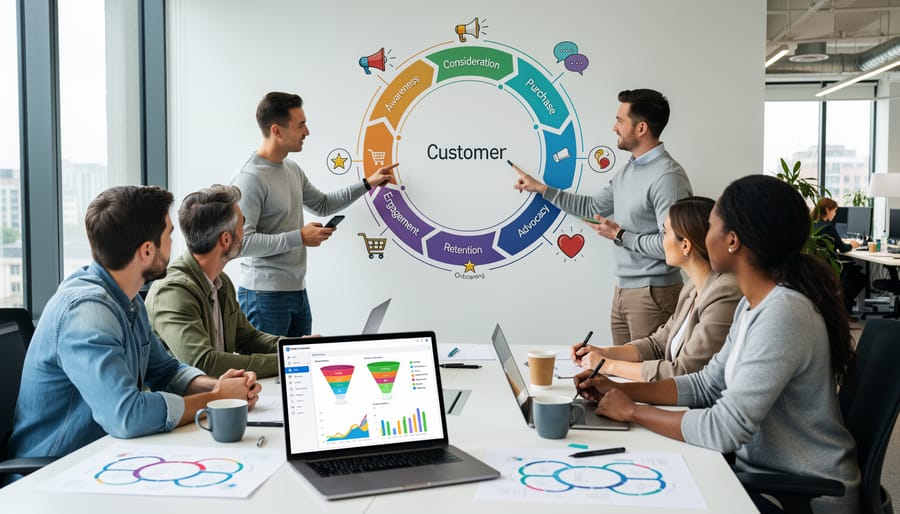
The Five Stages of Customer Lifecycle
Understanding the customer journey stages helps you implement targeted tactics at each phase. Here’s how to approach each stage with practical actions.
Awareness is where potential customers first discover your brand. Focus on content marketing, social media presence, and search engine optimization to increase visibility. Automated email sequences can nurture these early contacts without manual effort.
During the consideration stage, prospects evaluate whether your solution fits their needs. Provide comparison guides, case studies, and free trials. Set up automated follow-up emails that address common objections and highlight your unique value proposition.
The purchase stage requires removing friction from the buying process. Streamline checkout procedures, offer multiple payment options, and send automated confirmation messages that reassure buyers they made the right choice.
Retention is where many businesses lose momentum, yet it’s the most cost-effective growth opportunity. Implement automated onboarding sequences, regular check-ins, and personalized recommendations based on purchase history. Track engagement metrics to identify at-risk customers before they churn.
Advocacy transforms satisfied customers into promoters. Create referral programs with clear incentives, request reviews at optimal moments, and make sharing easy through automated prompts. These lifecycle marketing strategies work together to maximize customer lifetime value.
The key is automation. Manual processes don’t scale, but automated workflows ensure consistent communication at every stage. Start by mapping your current customer journey, identify gaps where prospects drop off, then implement targeted automation to address those specific pain points.
Where Lifecycle Marketing Excels
Lifecycle marketing delivers exceptional results when your primary objective is maximizing the value of existing customers. This approach excels in three key areas that directly impact your bottom line.
First, retention becomes significantly more efficient. By mapping customer touchpoints and automating personalized communications at each stage, you keep customers engaged long after their initial purchase. This systematic approach means fewer customers slip through the cracks, resulting in more predictable revenue streams.
Second, lifecycle marketing optimizes customer lifetime value through strategic nurturing. Rather than treating every customer interaction as a standalone event, you build progressive relationships that naturally lead to upgrades, cross-sells, and repeat purchases. Automated workflows deliver the right message at precisely the right moment, making each customer more valuable over time.
Third, this methodology reduces churn by identifying at-risk customers before they leave. By tracking behavioral signals and engagement patterns, you can trigger timely interventions that address concerns and rebuild relationships. This proactive stance is far more cost-effective than constantly replacing lost customers with new acquisitions, creating sustainable growth that compounds as your customer base matures.
The Critical Differences That Impact Your Bottom Line
Time Horizons and ROI Expectations
Growth marketing typically delivers results within weeks to months, making it ideal when you need immediate traction. You’ll see measurable outcomes like increased sign-ups, trial conversions, or campaign-specific revenue spikes relatively quickly. However, these wins often require continuous effort and budget to maintain momentum.
Lifecycle marketing operates on a longer timeline, with meaningful returns emerging over quarters and years. Building customer loyalty, increasing lifetime value, and developing retention systems take time to mature. The payoff comes through compounding returns as your automated nurture sequences and retention strategies generate predictable revenue with decreasing acquisition costs.
Set realistic expectations by allocating resources to both timeframes. Dedicate 60-70% of your marketing budget to lifecycle initiatives that build sustainable growth, while reserving 30-40% for growth marketing experiments that generate quick wins and test new channels.
Track early indicators for lifecycle marketing success, such as engagement rates in automated email sequences, repeat purchase intervals, and customer satisfaction scores. These metrics predict future revenue before it materializes in your bottom line. For growth marketing, focus on conversion rates, cost per acquisition, and campaign ROI.
The most successful businesses use growth marketing to fuel their customer acquisition engine while simultaneously building lifecycle marketing systems that maximize the value of every customer acquired.
Metrics That Matter for Each Approach
Growth marketing prioritizes acquisition metrics like customer acquisition cost (CAC), conversion rates, and new user growth. Track these through campaign performance dashboards that measure cost per lead, click-through rates, and top-of-funnel conversions. Monitor which channels deliver the lowest CAC and highest conversion velocity.
Lifecycle marketing focuses on customer lifetime value (CLV), retention rate, churn rate, and engagement scores across touchpoints. Set up automated tracking for repeat purchase frequency, email engagement progression, and customer health scores. Calculate CLV-to-CAC ratios to understand long-term profitability.
For effective measurement, implement both acquisition and retention dashboards. Use cohort analysis to see how acquisition campaigns impact long-term value. Track the customer journey from first touch through renewal, connecting early conversion metrics to downstream retention outcomes.
The most successful approach balances both: measure immediate campaign performance while monitoring how acquired customers progress through lifecycle stages. Establish clear benchmarks for tracking marketing ROI across the entire customer journey. Automated reporting tools can consolidate these metrics, showing both short-term wins and long-term relationship building in a single view that informs strategic decisions.
Resource Allocation and Team Structure
Your resource allocation should reflect your strategic priorities. Lifecycle marketing typically requires a balanced team structure with specialists in email automation, customer success, and data analysis. Budget allocation often splits 60-40 between retention activities and acquisition support. You’ll need robust CRM systems, marketing automation platforms, and customer analytics tools to track engagement across the entire customer journey.
Growth marketing demands a different approach. Allocate resources toward experimental testing, with 70% focused on acquisition channels and 30% on activation optimization. Your team needs growth hackers, data scientists, and performance marketers comfortable with rapid iteration. Technology investments should prioritize A/B testing platforms, analytics dashboards, and channel-specific tools.
For most businesses, a hybrid approach works best. Start with a core team of three to five marketers who can handle both strategies, then scale based on results. Implement automated processes wherever possible to maximize efficiency without expanding headcount. Your technology stack should integrate seamlessly—disconnected tools waste time and create data gaps. Plan to invest 15-20% of revenue in marketing initially, adjusting based on customer acquisition costs and lifetime value metrics. This pragmatic allocation ensures you can execute both strategies without overextending your budget or team capacity.
How to Integrate Both Into Your Performance Marketing Strategy
The Balanced Marketing Funnel Approach
The most effective approach combines the strengths of both strategies at different funnel stages. At the top of your funnel, deploy growth marketing tactics to maximize reach and acquisition. This means running A/B tests on landing pages, experimenting with multiple acquisition channels, and optimizing conversion rates aggressively. Your goal here is volume and velocity—getting as many qualified prospects into your funnel as possible.
Once prospects enter your funnel, transition to lifecycle marketing strategies. This shift is critical because middle and bottom-funnel stages require relationship-building, not just optimization. Implement automated email sequences that nurture leads based on their behavior and engagement level. Set up trigger-based communications that respond to specific actions, like downloading a resource or abandoning a shopping cart.
For existing customers, lifecycle marketing becomes even more valuable. Create automated onboarding sequences that guide new customers through product adoption. Build retention campaigns that check in at regular intervals and provide ongoing value. Use customer data to segment your audience and deliver personalized content that addresses their specific stage in the customer journey.
The key is automation. Set up these lifecycle marketing processes once, and they’ll continue working while you focus on growth experiments at the top of your funnel. This balanced approach ensures you’re not just acquiring customers faster than you can serve them, or investing heavily in retention while ignoring new opportunities. You get sustainable growth with strong customer relationships built in from the start.
Automation Makes Integration Possible
The good news is that you don’t need to choose between lifecycle and growth marketing—they work together when you have the right systems in place. Marketing automation serves as the bridge that makes integration practical and efficient.
Think of automation as your always-on lifecycle marketing engine. It handles the repetitive, time-sensitive tasks that keep customers engaged throughout their journey: welcome sequences for new subscribers, onboarding emails for new customers, re-engagement campaigns for inactive users, and renewal reminders. These essential touchpoints run consistently without requiring daily attention from your team.
This consistency matters because lifecycle marketing depends on timing. A welcome email needs to arrive immediately after signup. A cart abandonment message needs to reach customers within hours, not days. Automated workflows ensure these critical communications happen exactly when they should, creating reliable customer experiences that build trust and drive conversions.
Here’s where the strategic advantage becomes clear: when automation handles your lifecycle marketing foundation, your team gains bandwidth to focus on growth experiments. Instead of manually sending routine emails, your marketers can test new acquisition channels, optimize conversion funnels, analyze customer data for expansion opportunities, and develop creative campaigns that push your business forward.
This division of labor mirrors how successful businesses operate. Automation manages the predictable patterns of customer engagement, while your human expertise tackles strategic initiatives that require creativity, analysis, and adaptation. The result is a marketing operation that maintains strong customer relationships while actively pursuing new growth opportunities.
Which Strategy Should You Prioritize Right Now?
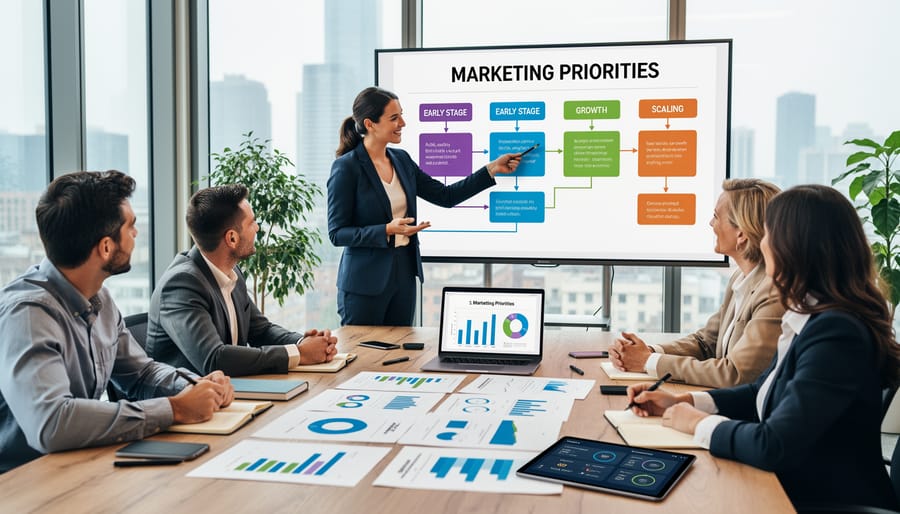
For Early-Stage Businesses
For early-stage businesses, growth marketing should be your primary focus. Your immediate challenge is achieving product-market fit and generating initial traction, which requires the experimental, data-driven approach that growth marketing provides.
Start by implementing rapid testing cycles across your acquisition channels. Run small-budget experiments on paid ads, content marketing, and referral programs to identify which channels deliver customers most efficiently. Track metrics like customer acquisition cost and conversion rates religiously.
However, don’t completely ignore lifecycle principles. Set up basic automated email sequences for onboarding new users and re-engaging inactive ones. These simple workflows prevent customer churn without requiring significant resources.
As you gain traction, gradually introduce more lifecycle marketing elements. The key is balancing aggressive growth experimentation with foundational retention practices. This hybrid approach ensures you’re not just acquiring customers but keeping enough of them to demonstrate sustainable growth to investors and stakeholders.
For Established Businesses With Customer Base
For established businesses with an active customer base, the most effective approach combines both strategies. Start by implementing lifecycle marketing automation to nurture your existing customers through personalized email sequences, loyalty programs, and re-engagement campaigns. This protects your revenue foundation while reducing churn. Simultaneously, allocate resources to growth marketing experiments that attract new customers through channels your existing base came from. Set up automated customer segmentation based on purchase history and engagement levels, allowing you to tailor communications without manual effort. Track customer lifetime value alongside acquisition costs to ensure your growth investments remain profitable. Focus 60-70% of your marketing budget on retention and expansion of current customers, with the remaining 30-40% dedicated to acquisition. This balanced approach maximizes the value of relationships you’ve already built while systematically expanding your market reach.
Warning Signs You’re Out of Balance
Your marketing strategy is likely imbalanced when you notice these warning signs. If you’re focused solely on growth marketing, watch for declining customer retention rates, increasing churn, and customers who disengage shortly after acquisition. You might also see high acquisition costs without corresponding lifetime value growth, or a disconnect between your sales team’s promises and what your product actually delivers.
Conversely, over-indexing on lifecycle marketing shows up differently. You’ll notice stagnant or declining new customer acquisition, shrinking market share despite happy existing customers, and revenue plateaus even with strong retention. Your marketing team might be spending excessive time on complex nurture sequences for a small customer base while competitors capture new market opportunities.
Both scenarios share a common red flag: your customer acquisition cost to lifetime value ratio falls out of healthy range. When automated processes work in isolation rather than supporting both strategies, you’re missing the integration needed for sustainable growth. Pay attention to these metrics monthly and adjust your approach before small imbalances become major strategic problems that impact your bottom line.
The reality is that lifecycle marketing and growth marketing aren’t opposing forces—they work best when integrated. Growth marketing excels at driving new customer acquisition through rapid experimentation and channel optimization, while lifecycle marketing focuses on nurturing those customers through each stage of their journey to maximize retention and lifetime value.
The most effective performance marketing strategies combine elements of both approaches. Use growth marketing tactics to fill your pipeline with qualified leads, then apply lifecycle marketing principles to move those prospects through consideration, purchase, and advocacy stages. This integrated approach ensures you’re not just acquiring customers at any cost, but building sustainable business growth.
To implement this combined strategy, start by mapping your current customer journey and identifying gaps in both acquisition and retention. Set up automated email sequences that nurture leads based on behavior and stage, while simultaneously testing new channels and messaging for acquisition. Track metrics across the full funnel—from cost per acquisition through customer lifetime value—to understand where each approach delivers the strongest results.
Focus on building systems that scale without constant manual intervention. Automated workflows allow your team to maintain consistent customer communication while freeing up time to test new growth initiatives.
Leave a Reply