Why Your B2B Marketing Stack Is Breaking (And How Composable CDP Fixes It)

Your marketing stack is drowning in disconnected data, and your teams are spending more time wrestling with integration issues than engaging customers. The solution isn’t another monolithic platform promising to solve everything—it’s a composable Customer Data Platform (CDP) that works with your existing infrastructure rather than replacing it.
Composable CDPs represent a fundamental shift from traditional, packaged platforms. Instead of buying an all-in-one system that dictates your entire data architecture, you’re building a flexible solution using best-of-breed components that connect through your existing data warehouse. Think of it as assembling the exact toolkit you need rather than accepting whatever comes in a pre-packaged box.
This matters because traditional CDPs often create more problems than they solve. They introduce vendor lock-in, duplicate your data storage costs, and still leave you struggling with marketing attribution challenges across multiple touchpoints. You’re essentially paying premium prices to move data into yet another silo, then paying again to get it back out.
The composable approach flips this model. Your data warehouse becomes the single source of truth—Snowflake, BigQuery, or Databricks—while specialized tools handle specific functions like identity resolution, segmentation, and activation. Your team gains complete control over data transformations, eliminates redundant storage costs, and maintains the flexibility to swap components as your needs evolve.
For B2B organizations particularly, this architecture solves the long sales cycle problem. You can track anonymous behavior, connect it across multiple stakeholders within an account, and activate that intelligence without waiting for vendor roadmaps to catch up with your business needs.
The question isn’t whether composable CDPs work—it’s whether your current approach is costing you opportunities while your competitors gain the data agility advantage.
What Makes a CDP ‘Composable’ (And Why It Matters for B2B)
Think of a traditional customer data platform like buying a complete home entertainment system in one package. You get everything together, but you’re stuck with every component whether you need it or not. A composable CDP, on the other hand, is more like building your own system by selecting individual components that work perfectly for your specific needs.
At its core, a composable CDP takes a modular approach to customer data management. Instead of one vendor providing everything in a single, pre-built package, you select best-of-breed components that integrate seamlessly. Your data warehouse serves as the foundation, while you add specialized tools for identity resolution, data activation, analytics, and customer engagement based on what your business actually requires.
The traditional packaged CDP promises simplicity through an all-in-one solution. However, this often means paying for features you’ll never use while lacking flexibility when your needs evolve. These systems typically store your data in their own proprietary database, creating another data silo that defeats the original purpose of unifying customer information.
Composable architecture flips this model. Your customer data lives in your own cloud data warehouse, giving you complete ownership and control. You then connect modular tools that handle specific functions like data transformation, audience segmentation, or campaign activation. These components communicate through standard APIs and data protocols, creating a unified system without vendor lock-in.
For B2B companies, this flexibility proves particularly valuable. Your sales cycles are longer, involving multiple stakeholders across various touchpoints. Account-based marketing requires sophisticated data models that track both individual contacts and their associated companies. Off-the-shelf CDPs often struggle with these complex B2B relationships.
With composable architecture, you can implement exactly what supports your unique sales process. Need advanced account scoring that considers company firmographics alongside individual behavior? Add that specific component. Require deep integration with your existing CRM and marketing automation platforms? Choose tools designed for those connections.
The composable approach also scales with your business. Start with essential components and add capabilities as your team grows and requirements become more sophisticated. This prevents the common scenario of investing heavily in a comprehensive platform that overwhelms your team and sits partially unused. You build incrementally, ensuring each addition delivers measurable value before moving forward.

The Core Components of a Composable CDP Architecture
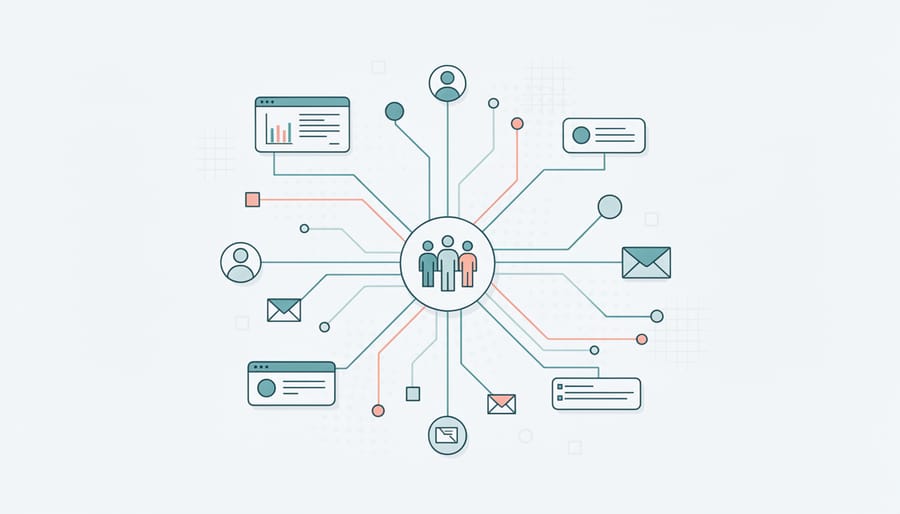
Data Collection Layer
The data collection layer serves as the foundation of your composable CDP, automatically pulling information from every customer interaction point across your B2B ecosystem. This layer connects directly to your website analytics, CRM systems like Salesforce or HubSpot, email marketing platforms, advertising channels, and customer support tools without requiring constant manual intervention.
Modern composable systems use automated connectors and APIs to continuously sync data in real-time. When a prospect downloads a whitepaper, attends a webinar, or engages with your sales team, that information flows automatically into your central data warehouse. The beauty of this automation is that your team doesn’t need to export CSV files or manually update records between systems.
For B2B organizations, this means capturing complex buying committee interactions across multiple touchpoints. The system tracks which decision-makers from the same company engage with your content, their behavior patterns, and their progression through lengthy sales cycles. Event tracking happens automatically through JavaScript tags, server-side integrations, or reverse ETL processes that keep your data fresh and actionable. This automated approach eliminates data silos and ensures your marketing and sales teams always work from the same updated information.
Unified Data Storage
In a composable CDP, your customer and account data doesn’t scatter across disconnected systems. Instead, it lives in a centralized data warehouse that serves as your single source of truth. Think of this warehouse as your company’s digital filing cabinet, where every customer interaction, purchase history, and behavioral signal gets stored in an organized, accessible format.
Unlike traditional CDPs that create yet another data silo, the composable approach leverages modern cloud data warehouses like Snowflake, Google BigQuery, or Amazon Redshift. These platforms store massive amounts of information while keeping it queryable and ready for action. Your marketing automation platform, CRM, and analytics tools all draw from this same pool of data, ensuring everyone works with identical, up-to-date customer information.
This unified storage eliminates the frustration of contradictory data sources. When your sales team views an account, they see the same engagement history your marketing team references. This consistency streamlines client communication and enables automated processes that actually work reliably. The warehouse becomes the foundation that makes your entire marketing technology stack more effective and trustworthy.
Identity Resolution Engine
The identity resolution engine serves as the brain of your composable CDP, connecting fragmented customer data across multiple platforms into unified profiles. In B2B environments where prospects interact with your brand through various channels over weeks or months, this capability becomes essential for understanding the complete customer journey.
This engine automatically matches website visits, email opens, form submissions, and CRM activities to specific accounts and contacts. When someone from ABC Corporation downloads a whitepaper, attends a webinar, and later requests a demo from different devices, the system recognizes these as the same buyer and consolidates the data. This complete view enables more accurate intelligent lead scoring and personalized outreach.
Modern identity resolution uses deterministic matching (email addresses, phone numbers) combined with probabilistic techniques (behavioral patterns, IP addresses) to achieve accuracy rates above 90 percent. The automated process eliminates manual data cleanup while maintaining data privacy compliance.
For your sales team, this means no more duplicate records or missed context during conversations. Marketing gains the insights needed to nurture leads effectively across extended decision-making cycles typical in B2B transactions.
Activation and Integration Layer
The activation layer transforms your unified customer data into action across every marketing channel you use. Once your composable CDP consolidates and organizes customer information, this layer automatically distributes it to your email platforms, advertising networks, CRM systems, and sales tools in real-time.
Think of it as your data distribution hub. When a prospect downloads a whitepaper, that behavioral signal instantly flows to your email platform to trigger nurture campaigns, updates your CRM so sales can follow up, and syncs with LinkedIn or Google Ads to adjust audience targeting. No manual exports, no spreadsheet uploads, no data delays.
Modern activation layers support pre-built connectors for popular tools like HubSpot, Salesforce, Mailchimp, and major ad platforms. These integrations enable AI-powered personalization at scale, ensuring each prospect receives relevant messages based on their actual behavior and profile.
The automation eliminates time-consuming manual processes while maintaining data accuracy. Your marketing team focuses on strategy and creative work instead of wrestling with data transfers. Sales receives enriched, up-to-date contact information automatically. Most importantly, your customers experience consistent, timely communication across all touchpoints.
Real Benefits for B2B Marketing Teams

Account-Based Marketing That Actually Works
Composable CDPs excel at powering effective account-based marketing strategies by creating a unified view of target accounts across every customer touchpoint. Instead of juggling disconnected data silos, your team accesses complete account profiles that automatically sync across your advertising platforms, email systems, and sales tools.
This architecture enables precision targeting at scale. When a buying committee member engages with your content, that activity instantly updates the account record and triggers relevant actions across channels. Your sales team sees website visits in their CRM, marketing adjusts ad campaigns based on account engagement, and customer success teams receive alerts about expansion opportunities.
The composability factor means you can connect specialized ABM tools without losing data consistency. Layer on intent data providers, enrich with firmographic information, and activate through your preferred channels while maintaining a single source of truth. This eliminates the manual work of updating multiple systems and ensures every team member works from the same accurate account intelligence.
The result is coordinated campaigns that feel personalized rather than automated, stronger alignment between marketing and sales, and measurable improvements in account engagement rates.
Stop Paying for Features You Don’t Use
Traditional CDPs often come packed with features that sound impressive in sales demos but rarely get used in practice. You’re essentially paying for enterprise-grade functionality that sits idle while your team struggles with the basics they actually need.
Composable CDPs flip this model entirely. Instead of a one-size-fits-all solution with a bloated price tag, you select and pay for only the components that solve your specific challenges. Need customer data integration and basic segmentation? Build that. Don’t need AI-powered predictive analytics or advanced attribution modeling yet? Skip them until you’re ready.
This approach delivers immediate cost savings. You avoid lengthy contracts for unused features and eliminate the overhead of training your team on complex tools they’ll never touch. More importantly, you maintain budget flexibility to invest in capabilities as your business grows and your needs evolve.
The financial advantage extends beyond licensing fees. Smaller, focused components require less maintenance, fewer integrations, and reduced technical support. Your team spends time using the platform productively rather than navigating through irrelevant features. This efficiency translates directly to lower total cost of ownership and faster time to value.
Faster Adaptation to Market Changes
Market conditions shift rapidly, and your customer data platform needs to keep pace. With a composable CDP, you’re not locked into a single vendor’s roadmap or forced to wait months for new features. Instead, you can swap individual components as your needs evolve.
Think of it like building with blocks rather than pouring concrete. When a new social media platform becomes essential for reaching your audience, you can integrate it within weeks instead of waiting for your traditional CDP vendor to add support. If your analytics tool stops meeting your needs, replace just that component while keeping everything else intact.
This flexibility proves especially valuable when entering new markets or launching experimental campaigns. You can test new customer communication channels without committing your entire technology stack. Add a chatbot integration, try a new email service provider, or experiment with SMS marketing by connecting the relevant tools directly to your data warehouse.
The modular approach also means you can respond to regulatory changes faster. When new data privacy requirements emerge in different regions, you can update specific components handling compliance without disrupting your entire customer data operation.
Your team stays agile because changes happen incrementally. There’s no need for massive migration projects or complete system overhauls that drain resources and halt marketing activities. You adapt one piece at a time, maintaining business continuity while staying competitive in changing markets.
Building vs. Buying: What Actually Makes Sense
Let’s be direct: composable CDPs aren’t for everyone, and that’s perfectly fine.
If you’re a small business with under 50 employees and a straightforward marketing stack consisting of an email platform, basic CRM, and maybe Google Analytics, a packaged CDP solution or even simpler integration tools will serve you better. The overhead of building and maintaining a composable architecture outweighs the benefits at this scale.
The composable approach starts making sense when you hit certain thresholds. First, team capacity matters. You need at least one dedicated technical resource who understands data pipelines and can manage integrations. This doesn’t mean you need a full data engineering team from day one, but someone needs to own the architecture. If you’re outsourcing all technical work, a pre-built solution offers more predictability.
Business complexity is the second factor. Are you operating across multiple business units with different customer journeys? Do you have data sources that don’t play nicely with standard CDP connectors? Are compliance requirements forcing you to keep certain data in specific locations? These scenarios favor composable architectures because they demand flexibility that packaged solutions struggle to provide.
Budget considerations cut both ways. Packaged CDPs have predictable licensing costs but can become expensive as your data volume grows. Composable solutions typically have lower software costs since many components use consumption-based pricing, but you’re trading vendor fees for internal resource time. Calculate the fully loaded cost including personnel, not just software licenses.
Timing also matters. If you need customer data unified and actionable within 60 days, buy a packaged solution. Composable architectures require planning, implementation, and iteration. Expect 3-6 months minimum to get a functional system running, depending on your starting point.
The honest middle ground works for many growing businesses: start with core packaged tools for immediate needs while building composable capabilities around them. Use a reverse ETL tool to move data from your warehouse to marketing platforms. Add a customer data infrastructure layer when specific use cases demand it. This hybrid approach lets you validate the value before committing fully to either direction.
The right choice depends on where you are today and where you’re headed, not which approach sounds more sophisticated.
Getting Started Without Overhauling Everything
Step 1: Audit Your Current Data Flows
Before selecting a composable CDP, you need a clear picture of your current data landscape. Start by documenting every system that collects customer information—your CRM, email platform, website analytics, advertising tools, and e-commerce system. Create a simple spreadsheet listing each platform, what data it captures, and how frequently it’s updated.
Next, map the connections between these systems. Which platforms share data? Are they automated integrations or manual exports? Identify gaps where data doesn’t flow smoothly or where customer information exists in silos. This audit reveals duplication, outdated processes, and broken connections that waste your team’s time.
Pay special attention to data quality issues. Note where information is incomplete, inconsistent, or requires manual cleanup. This baseline assessment helps you prioritize which data flows to tackle first and demonstrates the tangible improvements a composable CDP can deliver to stakeholders.

Step 2: Identify Your First Integration
Start with your most pressing data challenge. If your sales team constantly complains about incomplete customer information, prioritize integrating your CRM first. When email campaigns underperform due to poor segmentation, connect your email platform as your initial integration.
Review your current marketing stack and identify where data silos cause the biggest impact on revenue or efficiency. The best first integration typically falls into one of three categories: your primary customer communication channel, your main data collection point, or the system your team uses most frequently for decision-making.
Consider implementation complexity alongside business value. A straightforward integration that delivers immediate wins builds momentum and stakeholder confidence. Your marketing automation platform or CRM usually offers the highest return on effort, providing enriched customer profiles that improve personalization across channels.
Document specific outcomes you expect from this first connection. Whether it’s reducing manual data entry by 50% or improving email open rates through better segmentation, clear success metrics help you validate your approach and justify expanding to additional integrations.
Step 3: Automate and Expand
Once your composable CDP foundation is in place, focus on creating automated marketing workflows that reduce manual tasks and improve customer engagement. Start with simple automations like email triggers based on customer behavior, then progressively add complexity as your team gains confidence.
The modular nature of composable CDPs allows you to expand capabilities without disrupting existing operations. Add new components when specific business needs arise—whether that’s enhanced analytics, additional data sources, or new activation channels. This measured approach prevents overwhelming your team while ensuring your customer data platform grows alongside your business requirements.
Monitor workflow performance regularly and communicate results with stakeholders. Track metrics like time saved, improved conversion rates, and data accuracy to demonstrate value and justify future investments in additional components.
The shift to composable CDPs represents more than just a technology upgrade—it’s a strategic move that puts control back in your hands. Instead of wrestling with monolithic platforms that dictate your workflows, you gain the flexibility to build a marketing stack that adapts to your specific B2B needs. The efficiency gains from automated data orchestration and streamlined client communication translate directly to better campaign performance and stronger customer relationships.
Your current marketing stack doesn’t need to be perfect to start benefiting from a composable approach. In fact, waiting for ideal conditions often means missing opportunities to improve your data operations today. Begin by assessing where you’re experiencing the most friction—whether that’s integrating your CRM with analytics tools, syncing customer data across platforms, or automating repetitive marketing tasks. These pain points are your best starting locations for incremental improvement.
The composable CDP framework thrives on iteration. Start small by connecting two or three core systems, automate one critical workflow, and measure the impact. As you build confidence and demonstrate ROI, you can expand your data infrastructure piece by piece. This measured approach minimizes risk while delivering tangible results that justify further investment.
Take stock of your current marketing technology today. Identify one automation opportunity that would save your team time or improve client communication. That single step forward is more valuable than any theoretical perfect solution that remains perpetually on the horizon.
Leave a Reply