Why Your AI Marketing Tools Might Be Costing You Customers (And Your Reputation)

Marketing automation powered by AI in digital marketing delivers unprecedented efficiency, but it carries significant ethical responsibilities that directly impact your brand reputation and bottom line. Every automated email, personalized recommendation, and predictive campaign you deploy makes decisions about how you collect, use, and act on customer data—decisions that can either build lasting trust or trigger costly legal consequences and public backlash.
The stakes are clear: 78% of consumers will abandon brands they perceive as untrustworthy with their data, while regulatory bodies worldwide impose penalties reaching millions for privacy violations. Yet ethical AI implementation isn’t about limiting your marketing power—it’s about sustaining it. When you establish transparent data practices, maintain human oversight of automated decisions, and actively monitor for algorithmic bias, you create marketing systems that perform better and last longer.
This guide provides a practical framework for implementing AI marketing automation ethically without sacrificing effectiveness. You’ll learn how to audit your current AI tools for hidden biases, establish clear consent mechanisms that respect customer autonomy, create accountability structures for automated decisions, and communicate your AI practices in ways that strengthen rather than erode customer confidence. The goal is straightforward: leverage AI’s competitive advantages while building the sustainable trust that converts one-time buyers into long-term advocates.
What Makes AI Marketing Automation Unethical

The Privacy Problem No One Talks About
Most AI marketing tools operate on a simple exchange: free or affordable services in return for access to your customer data. The problem? Many businesses don’t realize the extent of data collection happening behind the scenes, and their customers certainly don’t either.
When you integrate AI chatbots, predictive analytics, or automated email platforms, these systems often collect conversation histories, browsing patterns, purchase behaviors, and personal preferences. This data doesn’t just power your campaigns—it frequently trains the AI provider’s algorithms, gets shared with third parties, or sits in databases with unclear retention policies.
The trust issue emerges when customers discover their information is being used in ways they never agreed to. A 2023 survey found that 78% of consumers would stop doing business with a company if they learned their data was mishandled, even unintentionally.
Your responsibility extends beyond your AI vendor’s privacy policy. Before implementing any AI tool, review exactly what data gets collected, where it’s stored, who has access, and how long it’s retained. Update your privacy policies to reflect AI usage in plain language. Most importantly, give customers genuine control over their data—not buried in fine print, but through clear communication about how automation works in your business.
When Personalization Becomes Manipulation
AI-powered personalization can significantly boost engagement and conversions, but there’s a critical difference between serving relevant content and manipulating behavior through psychological exploitation. The line blurs when automation targets emotional vulnerabilities, creates artificial urgency, or deliberately obscures user choice.
Consider how your marketing automation uses personal data. Are you helping customers make informed decisions, or engineering outcomes that primarily benefit your bottom line? Ethical personalization practices respect user autonomy while delivering value. Manipulation, however, leverages psychological triggers without regard for customer welfare.
Warning signs include using AI to identify and exploit financial stress, relationship troubles, or health anxieties. Similarly, dark patterns that make unsubscribing difficult or hide pricing information cross ethical boundaries, even when automated systems make them easy to implement.
The solution lies in transparency and intent. Ask yourself: Would customers still engage if they understood exactly how you’re personalizing their experience? If the answer is no, your automation strategy needs revision. Effective marketing automation builds trust by prioritizing customer benefit alongside business goals, creating sustainable relationships rather than short-term manipulative wins.
Real Consequences of Getting AI Ethics Wrong
The Customer Trust Factor
Customer trust isn’t just a nice-to-have—it’s the foundation of sustainable business growth. When customers discover that AI has been used to manipulate their decisions, misrepresent products, or harvest their data without consent, the damage extends far beyond a single transaction. Studies show that 86% of consumers will leave a brand after just two bad experiences, and unethical AI practices accelerate this departure.
The lifetime value of a customer depends on transparency. If your automated email campaigns use AI to generate deceptive subject lines or your chatbots mislead customers about product capabilities, you’re trading short-term gains for long-term revenue losses. Customers talk, and in the age of social media, one unethical AI interaction can become a viral reputation crisis within hours.
To maintain trust, establish clear communication protocols around your AI use. Inform customers when they’re interacting with automated systems. Ensure your AI-driven recommendations genuinely serve customer needs rather than just maximizing immediate sales. Regularly audit your automated processes to verify they align with your stated values. Remember, every AI touchpoint is an opportunity to either strengthen or damage the relationship you’ve worked hard to build.
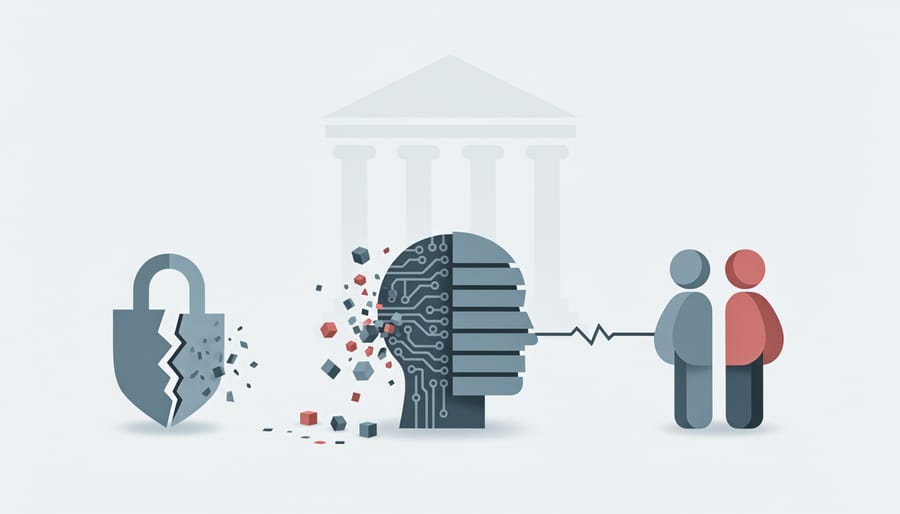
Legal and Financial Risks You Can’t Ignore
Ignoring AI ethics isn’t just a reputational risk—it’s a legal and financial minefield. Businesses using AI in marketing automation must navigate privacy regulations like GDPR and CCPA, which impose strict requirements on data collection, processing, and consent. Under GDPR, companies can face fines up to 4% of annual global turnover or €20 million, whichever is higher. CCPA violations carry penalties of up to $7,500 per intentional breach.
Beyond privacy laws, emerging AI-specific regulations are taking shape globally. The EU’s AI Act introduces risk-based compliance requirements, while other jurisdictions are developing similar frameworks. Non-compliance doesn’t just mean penalties—it can trigger lawsuits, regulatory investigations, and loss of business licenses.
The financial impact extends beyond fines. Legal battles drain resources, and mandatory audits disrupt operations. More critically, violations erode client trust, making customer acquisition significantly more expensive. For businesses relying on automated marketing processes, ensuring compliance from the start is far more cost-effective than retrofitting systems later or dealing with the aftermath of violations.
The Four Pillars of Ethical AI Marketing Automation
Transparency: Let Customers Know What You’re Doing
Being transparent about your AI usage isn’t just ethical—it’s a competitive advantage that builds trust with your audience. Start by clearly disclosing when customers are interacting with AI-powered tools, whether it’s a chatbot, automated email sequence, or personalized content recommendations. This doesn’t mean overwhelming visitors with technical details, but rather providing simple, accessible information about your automated processes.
Add a brief note in your email footers or landing pages explaining which communications are automated and how customers can reach a real person when needed. Update your privacy policy to specify what data you’re collecting, how AI systems use it, and what safeguards you’ve implemented. Make this information easy to find and written in plain language, not legal jargon.
For automated customer interactions, program your systems to identify themselves as AI-driven within the first few exchanges. Give customers an immediate option to connect with human support if they prefer. When using AI for personalization, explain the benefits customers receive in exchange for their data—better recommendations, time savings, or more relevant content.
This straightforward approach to transparency turns potential concerns into opportunities for demonstrating your commitment to ethical practices and client communication.
Consent: Build Permission-Based Marketing
Permission-based marketing isn’t just ethical—it’s essential for sustainable AI-driven campaigns. Start by implementing a clear, granular consent system that lets customers choose exactly what communications they receive. Your AI tools should only engage with contacts who have explicitly opted in, and these preferences must be documented and easily accessible.
Make your consent requests transparent. Clearly explain how AI will use customer data, what types of automated communications they’ll receive, and how often. Avoid pre-checked boxes or bundled permissions that obscure what customers are actually agreeing to.
Build automated workflows that respect opt-out requests immediately. When someone unsubscribes, ensure your AI systems remove them across all channels within 24 hours. This prevents the trust-destroying experience of receiving emails after opting out.
Regularly audit your contact lists to remove inactive or unengaged subscribers. Quality beats quantity—a smaller list of genuinely interested contacts will outperform a bloated database of reluctant recipients. Your AI algorithms will also generate better insights from engaged audiences.
Consider implementing a preference center where customers can update their communication choices anytime. This automated approach demonstrates respect for customer autonomy while maintaining valuable relationships with those who want to hear from you.
Fairness: Avoid Bias in Your Automated Systems
AI systems learn from historical data, which often contains embedded biases that can lead to unfair customer treatment. Common issues include demographic targeting that excludes certain groups, pricing algorithms that discriminate based on location or behavior patterns, and recommendation engines that reinforce stereotypes.
Start by auditing your AI tools regularly. Review campaign performance across different customer segments to identify disparities in reach, engagement, or conversion rates. If certain demographics consistently receive different messaging or offers without business justification, your system may be perpetuating bias.
Diversify your training data to ensure it represents your entire customer base. When setting up automated campaigns, establish clear parameters that prevent exclusionary practices. For example, if you’re using AI to score leads, verify that the criteria focus on genuine buying signals rather than demographic proxies.
Test your automated systems with diverse customer profiles before full deployment. Monitor ongoing results and be prepared to adjust when you spot inequitable outcomes. Remember that fair treatment isn’t just ethical—it expands your market reach and builds trust across all customer segments. Document your fairness checks as part of your regular marketing automation workflow to maintain accountability and continuous improvement.
Accountability: Own Your AI’s Actions
AI doesn’t make decisions in isolation—you do. While automation handles execution, you remain responsible for every email sent, every ad displayed, and every customer interaction your AI tools generate.
Implement regular audits of your automated campaigns. Review what your AI is creating, who it’s targeting, and how customers are responding. Schedule monthly checks to ensure your automation aligns with your brand values and ethical standards. If something goes wrong, acknowledge it quickly and transparently with affected customers.
Establish clear approval workflows for AI-generated content before it reaches your audience. Designate team members to oversee different aspects of your automated marketing—one person shouldn’t be the sole checkpoint.
Document your AI decision-making processes. When you choose certain targeting parameters or messaging strategies, record why. This creates accountability and helps you explain your marketing choices to customers, stakeholders, or regulators if questions arise.
Remember: automation amplifies your decisions. If your AI makes a mistake, it’s ultimately your mistake to own and correct.
How to Audit Your Current AI Marketing Practices
Questions Every Marketer Should Ask
Before implementing or continuing with AI-powered marketing automation, ask yourself these critical questions about your current systems:
Regarding data usage: Where is your customer data stored, and who has access to it? Are you collecting only the information necessary for your stated purposes? How long are you retaining this data, and do you have processes to delete it when no longer needed?
For automation triggers: What specific customer actions initiate automated communications? Are these triggers transparent to your customers? Could any automated responses be misinterpreted as manipulative or deceptive?
On customer communication: Are your AI-generated messages clearly identified as automated? Do customers have easy ways to reach a human when needed? Are you personalizing communications in ways that might feel invasive rather than helpful?
Concerning consent mechanisms: Have customers explicitly opted in to receive automated communications? Can they easily adjust their preferences or opt out entirely? Are you honoring these preferences across all your marketing channels?
Document your answers honestly. If you encounter gaps or uncertainties, those are your priority areas for improvement. These questions aren’t meant to discourage AI adoption but to ensure your automation builds trust rather than eroding it.
Red Flags That Demand Immediate Attention
Monitor your marketing automation systems for these critical warning signs that signal ethical boundaries are being crossed:
Lack of transparency is your first red flag. If your automated messages don’t clearly identify AI involvement or make it difficult for recipients to understand they’re interacting with automated systems, you’re operating in ethically questionable territory. Customers deserve to know when they’re communicating with a bot versus a human team member.
Watch for data collection that extends beyond what’s necessary for your stated purposes. When your automation tools gather personal information without explicit consent or track user behavior across platforms without disclosure, you’re violating trust and potentially breaking privacy laws.
Discriminatory patterns in your automated campaigns demand immediate investigation. If certain demographic groups consistently receive different messaging, pricing, or opportunities based on AI-driven segmentation, your system may be perpetuating bias.
Communication overload is another concern. Automated systems that bombard contacts with excessive messages or ignore unsubscribe requests create negative experiences and erode your brand reputation.
Finally, be alert to decision-making processes you can’t explain. If your team cannot articulate why the AI recommended specific actions or targeted particular audiences, you lack the accountability necessary for ethical operations. Address these issues immediately to maintain customer trust and avoid regulatory consequences.
Building Ethical AI Marketing Automation That Actually Works

Start With Clear Policies and Guidelines
Establishing formal guidelines is your first defense against unethical AI use. Start by documenting specific rules about data collection, customer consent, and transparency in automated communications. Your policy should explicitly state when AI is making decisions versus supporting human judgment, especially in client-facing interactions.
Create guidelines that address real scenarios your team encounters daily. For example, define when automated email responses need human review, how to handle sensitive customer data in AI systems, and what level of personalization crosses the line into invasiveness. Make these policies accessible to everyone who touches your marketing automation tools.
Include a review process for AI-generated content before it reaches customers. This ensures automated messages maintain your brand voice and meet accuracy standards. Assign clear ownership for monitoring AI systems and establish protocols for handling customer concerns about automated interactions.
Document your commitment to data privacy and transparency in customer-facing materials. When prospects ask how you use their information, your team should have consistent, honest answers based on these established policies.
Choose Tools With Built-In Ethical Features
When evaluating marketing automation tools, prioritize platforms that demonstrate a commitment to ethical AI practices. Look for providers that offer transparent data handling policies, clearly explaining how customer information is collected, processed, and stored. Essential features include granular privacy controls that let you manage consent preferences, opt-out mechanisms, and data retention settings.
Select platforms with built-in bias detection capabilities and regular algorithmic audits. The best tools provide clear documentation about how their AI makes decisions, avoiding black-box systems that can’t explain their recommendations. Verify that vendors comply with relevant regulations like GDPR and include features for data portability and deletion requests.
Ask potential providers about their AI training data sources and quality assurance processes. Platforms should offer customizable guardrails that prevent inappropriate messaging and maintain your brand values. Choose solutions that empower your team with oversight controls rather than fully autonomous systems that operate without human review.
Balance Automation With Human Touch
AI excels at handling repetitive tasks like email sequences, social media scheduling, and data analysis, freeing your team for strategic work. However, deploying automation ethically means knowing when human interaction matters most. Reserve AI for initial outreach, follow-ups, and routine inquiries, but ensure real people handle complex questions, complaints, and high-value conversations.
The key is to balance automation with personal connection by setting clear triggers for human intervention. Create workflows that escalate conversations when customers express frustration, request detailed information, or reach specific engagement thresholds. Always disclose when customers are interacting with AI, and make it easy to reach a human representative.
Monitor your automated communications regularly to ensure they align with your brand voice and values. This ongoing review helps maintain authenticity while capturing the efficiency benefits that make AI valuable for growing businesses.
The business case for ethical AI in marketing automation isn’t just about avoiding problems—it’s about building genuine competitive advantage. Companies that prioritize transparency, data privacy, and human oversight consistently see stronger customer relationships, higher engagement rates, and better long-term retention. When customers trust how you use their data and appreciate the relevance of your communications, they respond more positively to your marketing efforts.
Ethical AI practices also future-proof your business. As regulations continue to evolve and consumer awareness grows, companies with strong ethical foundations won’t need to scramble for compliance or rebuild customer trust. They’ll already be ahead of the curve, with automated processes that respect boundaries while delivering results.
The path forward is clear: evaluate your current AI marketing automation tools and practices. Ask yourself whether your systems operate with transparency, whether customers understand how their data is used, and whether human judgment plays a role in important decisions. Make adjustments where needed, document your ethical guidelines, and communicate your commitment to your customers.
Start today by auditing one automated marketing campaign. The improvements you make now will pay dividends in customer loyalty and sustainable growth for years to come.
Leave a Reply