AI-Powered Knowledge Management Makes Your Competitor Analysis Razor-Sharp

Transform your organization’s knowledge management with AI-powered business intelligence that automatically captures, organizes, and distributes critical business insights across teams. Machine learning algorithms now analyze vast amounts of unstructured data, extracting actionable patterns and recommendations that previously required weeks of manual analysis. By implementing smart knowledge bases with natural language processing capabilities, employees access precise information instantly, reducing search time by up to 60% while ensuring consistent decision-making across departments. Advanced AI systems continuously learn from user interactions, automatically updating and refining knowledge repositories to maintain relevance and accuracy without manual intervention.
Modern knowledge management transcends traditional document storage, leveraging predictive analytics to surface relevant information before teams even request it. This proactive approach enables businesses to capitalize on emerging opportunities faster, adapt to market changes more effectively, and maintain a sustainable competitive advantage through superior information management. The integration of AI-driven insights with existing workflows creates a self-improving ecosystem where institutional knowledge becomes a dynamic, living asset rather than a static resource.

How AI Transforms Traditional Competitor Intelligence
Real-Time Data Processing and Analysis
AI-powered knowledge management systems excel at processing and analyzing vast amounts of competitor data in real-time, providing businesses with immediate insights for strategic decision-making. These systems continuously monitor multiple data sources, including social media feeds, news articles, press releases, and market reports, transforming raw information into actionable intelligence.
The real-time processing capability works through sophisticated algorithms that filter, categorize, and prioritize incoming data based on relevance and importance. For example, when a competitor launches a new product or changes their pricing strategy, AI systems can instantly detect these changes and alert relevant stakeholders.
Machine learning models enhance this process by identifying patterns and trends that might be invisible to human analysts. They can track subtle market shifts, consumer sentiment changes, and emerging competitive threats before they become obvious to the market. This early warning system enables businesses to respond proactively rather than reactively to market changes.
The analysis component goes beyond simple data collection by providing context-aware insights. AI systems can correlate multiple data points to generate comprehensive competitive intelligence reports, helping businesses understand not just what their competitors are doing, but why they might be making certain strategic moves.
Pattern Recognition and Trend Prediction
AI-powered pattern recognition transforms competitor analysis by automatically processing vast amounts of market data to reveal hidden trends and strategic opportunities. By leveraging advanced algorithms, businesses can identify recurring patterns in competitor behavior, market shifts, and customer preferences that might be impossible to detect through traditional market analysis techniques.
These systems excel at predicting competitor moves by analyzing historical data, social media activity, pricing changes, and product launches. For example, AI can detect when competitors typically introduce new products, adjust their pricing strategies, or launch marketing campaigns, allowing businesses to prepare proactive responses rather than reactive measures.
The real power lies in AI’s ability to process this information in real-time, providing immediate alerts about significant changes in competitor behavior. This enables businesses to make data-driven decisions quickly and maintain their competitive edge. By combining pattern recognition with predictive analytics, companies can anticipate market trends before they become obvious, positioning themselves ahead of the curve and capitalizing on emerging opportunities before their competitors.
Key Components of AI-Powered Knowledge Management Systems
Automated Data Collection Tools
Modern AI-powered data collection tools have revolutionized how businesses gather and analyze competitor information. These sophisticated platforms leverage machine learning algorithms to automatically collect, process, and organize vast amounts of competitive data, providing businesses with real-time marketing intelligence that would be impossible to obtain manually.
Key automated tools include web scrapers that monitor competitor websites for pricing changes, product updates, and content modifications. Social media listening tools track brand mentions, sentiment analysis, and engagement metrics across multiple platforms. Market research aggregators compile industry reports, news articles, and public financial data into digestible insights.
These tools excel at identifying patterns and trends by processing structured and unstructured data from multiple sources simultaneously. They can track competitors’ digital footprints, including SEO strategies, advertising campaigns, and customer engagement tactics. Advanced features often include customizable dashboards, automated alerts for significant changes, and detailed reporting capabilities.
The automation aspect significantly reduces the time and resources traditionally required for competitive analysis, while minimizing human error and bias. This allows businesses to maintain a constant pulse on their competitive landscape and make data-driven decisions more efficiently. Most importantly, these tools can adapt and scale their data collection efforts as your business needs evolve.

Smart Classification and Organization
AI-powered knowledge management systems excel at automatically classifying and organizing vast amounts of competitor information, making it instantly accessible and actionable. These systems employ advanced algorithms to categorize data based on multiple parameters such as market segments, product features, pricing strategies, and marketing campaigns.
The organization process begins with automated data collection, where AI tools scan and extract relevant information from various sources. The system then applies natural language processing to understand context and sentiment, creating meaningful categories and subcategories. This smart classification ensures that all competitor data is properly tagged and stored in a structured format.
What makes this particularly valuable is the system’s ability to identify patterns and relationships between different pieces of information. For instance, when analyzing competitor pricing strategies, the AI can automatically group similar products, track price changes over time, and highlight promotional patterns. This organized structure allows teams to quickly access specific information without manually sorting through extensive databases.
The system also maintains dynamic organization, automatically updating categories and relationships as new information becomes available. This ensures that your competitive intelligence remains current and relevant. Teams can access this organized data through intuitive interfaces, often featuring search functions that understand natural language queries and deliver precise, contextual results.
For businesses, this means spending less time managing information and more time acting on insights. The organized structure supports faster decision-making and more efficient competitive analysis processes.
Implementing AI Knowledge Management for Better Decision Making
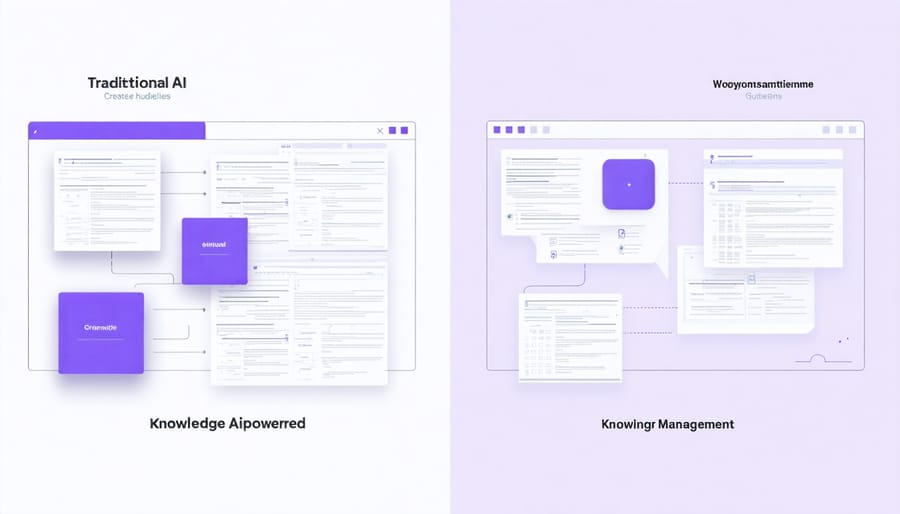
Setting Up Your AI Analysis Framework
Setting up an effective AI-powered analysis framework requires a systematic approach. Begin by identifying your core analysis objectives and the specific competitor data points you want to track. This could include pricing strategies, product features, marketing campaigns, or customer sentiment.
Next, select appropriate AI tools that align with your analysis goals. Consider platforms that offer natural language processing for social media monitoring, machine learning capabilities for pattern recognition, and automated data collection features. Popular options include comprehensive analytics suites or specialized competitor tracking tools with AI integration.
Create a structured data collection process by:
1. Setting up automated data gathering from multiple sources
2. Establishing data cleaning and validation protocols
3. Implementing regular update schedules
4. Defining key performance indicators (KPIs)
Configure your AI tools to monitor and analyze specific metrics. Start with basic tracking parameters and gradually refine them based on the insights generated. Ensure your system includes:
– Real-time monitoring capabilities
– Automated alert mechanisms
– Regular reporting features
– Data visualization options
Finally, establish a feedback loop to continuously improve your analysis framework. Regular reviews of the system’s performance will help identify areas for refinement and ensure your AI tools are delivering actionable insights that drive business decisions.
Remember to maintain data privacy compliance and regularly update your security protocols as you collect and analyze competitor information.
Measuring and Optimizing Performance
To ensure your AI-powered knowledge management system delivers optimal results, implementing robust performance metrics is essential. Start by establishing clear key performance indicators (KPIs) that align with your business objectives, such as response accuracy, processing speed, and user adoption rates.
Regular monitoring of these metrics enables data-driven decision making and continuous system improvement. Track metrics such as:
– Query resolution time
– Information retrieval accuracy
– User engagement levels
– System usage patterns
– Knowledge base coverage
– Content freshness scores
Implement A/B testing to compare different AI algorithms and configurations, helping identify the most effective approaches for your specific needs. Consider using automated feedback loops where system performance data automatically triggers optimization protocols.
To maximize effectiveness, regularly gather user feedback through surveys and interviews. This qualitative data complements quantitative metrics and provides valuable insights into real-world system usage and pain points.
Create monthly performance reports that highlight trends, improvements, and areas requiring attention. Use these insights to fine-tune AI models, update knowledge base content, and enhance user interfaces. Remember to benchmark your system’s performance against industry standards to maintain competitive advantage.
Consider implementing predictive analytics to anticipate potential performance issues before they impact operations, ensuring consistent system reliability and user satisfaction.
Overcoming Common Challenges
While AI-powered knowledge management offers significant benefits, organizations often encounter several challenges during implementation and operation. Understanding these obstacles and their solutions is crucial for successful adoption.
Data quality and consistency remain primary concerns. Many organizations struggle with fragmented, outdated, or inconsistent information across different systems. To address this, implement regular data audits and establish standardized data entry protocols. Consider using AI-powered data validation tools to maintain data integrity and automatically flag inconsistencies.
Integration with existing systems poses another significant challenge. Legacy systems may not readily connect with new AI solutions, creating information silos. Combat this by choosing AI platforms with robust API capabilities and working with vendors who offer comprehensive integration support. Start with small-scale integrations before expanding to enterprise-wide implementation.
Employee resistance and adoption issues can hinder success. Some staff members may feel threatened by AI technology or struggle to adapt to new workflows. Address these concerns through comprehensive training programs, clear communication about AI’s role in supporting (not replacing) human work, and showcasing early wins to build confidence.
Privacy and security concerns must be carefully managed. Ensure compliance with data protection regulations by implementing strong security measures, establishing clear data governance policies, and regularly updating security protocols. Choose AI solutions that offer built-in security features and maintain transparent data handling practices.
Resource allocation and cost management can be challenging. Start with pilot programs to demonstrate ROI before scaling up. Focus on high-impact areas first and gradually expand based on successful outcomes and organizational readiness. Consider cloud-based solutions to manage costs more effectively and scale as needed.
AI-powered knowledge management is revolutionizing how businesses approach competitor analysis, offering unprecedented efficiency and accuracy in market intelligence gathering. By automating data collection and analysis processes, companies can now make faster, more informed decisions while maintaining a competitive edge. The future of this technology looks promising, with advancements in machine learning and natural language processing set to deliver even more sophisticated insights and predictive capabilities.
As businesses continue to embrace digital transformation, AI-powered knowledge management systems will become increasingly essential for staying competitive. These tools will evolve to offer more personalized insights, real-time analysis, and automated action recommendations. Organizations that adopt these technologies early will be better positioned to identify market opportunities, anticipate competitor moves, and adapt their strategies proactively.
The key to success lies in combining AI capabilities with human expertise, creating a balanced approach that leverages both technological efficiency and strategic thinking. This synthesis will define the next generation of competitive intelligence practices.
Leave a Reply