Java AI Chatbot: Build Smarter B2B Automation That Actually Works

Java AI chatbots transform how businesses automate customer interactions, combining the reliability of Java’s enterprise-grade ecosystem with modern artificial intelligence capabilities. Choose established frameworks like Spring Boot paired with natural language processing libraries such as Apache OpenNLP or Stanford CoreNLP to build conversational interfaces that handle customer inquiries, qualify leads, and streamline support operations without requiring massive development teams.
Start by selecting the right architecture for your business needs. Integrate Java-based AI engines like Deeplearning4j or leverage cloud APIs from providers like Google Dialogflow and IBM Watson through Java SDKs to access pre-trained models that understand customer intent immediately. This approach lets you deploy functional chatbots in weeks rather than months, focusing development resources on customizing responses to your specific business processes rather than building language models from scratch.
Connect your Java AI chatbot directly to existing business systems through JDBC database connections, REST APIs, and CRM integrations. Modern Advanced Chatbot Integration enables your virtual assistant to pull customer data, update records, and trigger workflows across your technology stack automatically. This seamless integration means your chatbot becomes an active participant in your sales and support processes, not just a standalone tool.
Implement conversation flows that mirror your actual business processes using state management libraries and decision trees coded in Java. Map common customer journeys from initial contact through purchase or resolution, building intelligent routing that escalates complex issues to human agents while handling routine inquiries automatically. The result is faster response times, reduced workload on your team, and consistent customer experiences that operate 24/7 across multiple channels including websites, messaging platforms, and mobile applications.
Why Java Powers the Most Reliable AI Chatbots for Business
Java has emerged as a cornerstone technology for businesses building reliable AI chatbots, and the reasons extend far beyond its long-standing reputation in enterprise software. When you’re investing in automation technology that will handle customer interactions at scale, the platform you choose matters significantly.
The most compelling advantage Java brings to AI chatbot development is platform independence. Your chatbot built with Java runs seamlessly across Windows, Linux, and macOS environments without modification. This means you can deploy the same solution across different departments, cloud providers, or on-premises servers without rebuilding your system. For businesses managing complex IT infrastructures, this flexibility translates directly into reduced development costs and faster deployment timelines.
Security stands as another critical factor. Java’s built-in security features, including automatic memory management and strong type checking, protect your business from vulnerabilities that could compromise sensitive customer data. When your chatbot processes payment information, personal details, or confidential business inquiries, Java’s enterprise-grade security framework provides the protection your compliance requirements demand.
Scalability addresses the reality that successful chatbots grow with your business. Conversational AI systems built with Java handle increased conversation volumes smoothly. Whether you’re managing 100 or 100,000 concurrent conversations, Java’s robust concurrency model and memory management ensure consistent performance. The multithreading capabilities allow your chatbot to process multiple customer requests simultaneously without degradation in response time.
The extensive library ecosystem accelerates development significantly. Java offers mature frameworks specifically designed for AI and natural language processing, including Stanford NLP, Apache OpenNLP, and DeepLearning4j. These pre-built components mean your development team spends less time writing code from scratch and more time customizing solutions for your specific business needs.
Integration capabilities deserve special attention. Most businesses already run critical systems on Java-based platforms. Your chatbot can connect directly with existing CRM systems, databases, and business applications without complex middleware. This native integration streamlines automated processes, enabling your chatbot to pull customer history, update records, and trigger workflows in real-time.
For businesses prioritizing long-term stability, Java’s backward compatibility ensures your chatbot investment remains protected as technology evolves. Updates to the Java platform rarely break existing code, meaning your chatbot continues functioning reliably through system updates and infrastructure changes.
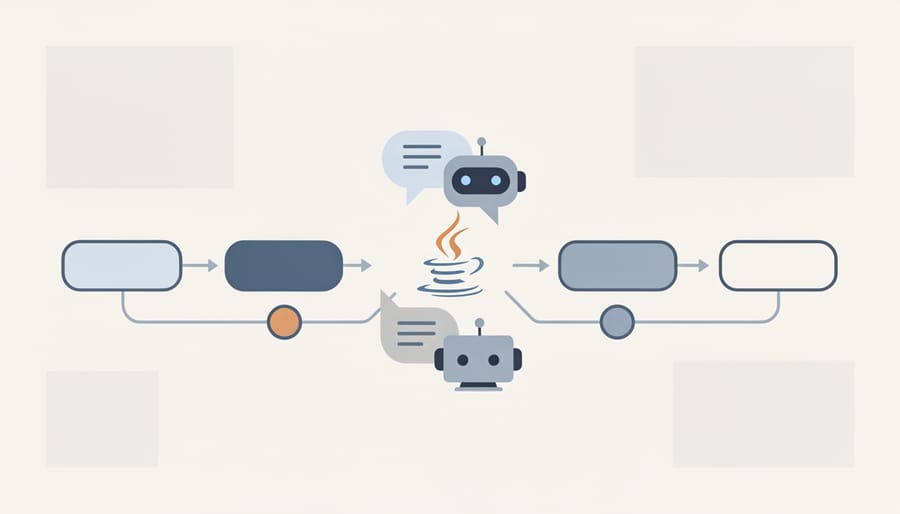
Essential Components of a Java AI Chatbot System
Natural Language Processing Frameworks
Building a Java AI chatbot requires robust natural language processing frameworks that can accurately interpret customer queries and deliver meaningful responses. Several Java-compatible NLP tools provide the foundation for understanding human language in your automated communication systems.
Apache OpenNLP is a machine learning-based toolkit that handles common NLP tasks like tokenization, sentence detection, part-of-speech tagging, and named entity recognition. It’s particularly valuable for business applications because it processes customer inquiries efficiently while maintaining low resource consumption. The framework includes pre-trained models for multiple languages, making it suitable for companies serving international markets.
Stanford NLP offers comprehensive linguistic analysis capabilities through its CoreNLP library. This framework excels at dependency parsing and sentiment analysis, helping your chatbot understand not just what customers are asking, but the intent and emotion behind their messages. While more resource-intensive than OpenNLP, Stanford NLP delivers higher accuracy for complex query interpretation, which is critical when handling detailed customer service scenarios. Developers often evaluate OpenNLP vs Stanford CoreNLP based on their specific performance and accuracy requirements.
For businesses seeking lighter-weight solutions, LingPipe provides text processing capabilities specifically designed for commercial applications. It handles tasks like entity extraction and classification with minimal configuration, allowing faster implementation of your Java AI chatbot.
When selecting an NLP framework, consider your specific use case. Customer support chatbots handling straightforward inquiries work well with Apache OpenNLP, while sophisticated conversational systems requiring deep semantic understanding benefit from Stanford NLP’s advanced capabilities. Most frameworks integrate seamlessly with popular Java development environments, enabling your team to build automated client communication systems that genuinely understand and respond to customer needs.
Machine Learning Integration Options
Building a Java AI chatbot requires connecting powerful machine learning frameworks to your chat infrastructure. The good news? Several robust options integrate seamlessly with Java applications, allowing you to automate customer interactions while maintaining full control over your technology stack.
TensorFlow offers Java bindings that let you deploy pre-trained models directly within your chatbot. This approach works well when you need to process natural language at scale. You can train models in Python, export them, and load them into your Java environment—giving your team flexibility without sacrificing performance.
Deeplearning4j stands out as a native Java solution designed specifically for business applications. It handles neural networks, natural language processing, and model training entirely within the Java ecosystem. This means simpler deployment, better integration with existing Java systems, and fewer compatibility headaches. For companies already invested in Java infrastructure, this machine learning integration streamlines development significantly.
Apache OpenNLP provides another practical option, particularly for text processing tasks like intent recognition and entity extraction. It requires less computational overhead than deep learning frameworks, making it ideal for straightforward chatbot applications where speed matters more than complex reasoning.
The key is matching the framework to your specific needs. Simple FAQ bots might only need OpenNLP, while sophisticated sales assistants handling nuanced conversations benefit from TensorFlow or Deeplearning4j. Consider your team’s expertise, existing infrastructure, and the complexity of conversations you’re automating. Most successful implementations start simple—basic intent recognition and entity extraction—then expand capabilities as business requirements evolve and your team gains experience with the chosen framework.
Building Your First Java AI Chatbot: Practical Implementation
Setting Up Your Development Environment
Building a Java AI chatbot requires the right foundation to ensure smooth development and deployment. Start with Java Development Kit (JDK) version 11 or higher, which provides the necessary performance and features for modern chatbot applications. The JDK 11 release notes highlight improvements in garbage collection and performance that benefit AI-driven applications.
For your integrated development environment (IDE), IntelliJ IDEA or Eclipse are excellent choices that streamline Java development with built-in debugging and code completion. These tools help you build faster without getting bogged down in technical complexities.
You’ll need to configure essential dependencies through Maven or Gradle. Key libraries include OpenAI’s Java client or similar AI API connectors, plus web frameworks like Spring Boot for creating REST endpoints that handle client communication. Add Jackson for JSON processing to manage conversation data efficiently.
Create your initial project structure with separate packages for controllers (handling user inputs), services (processing AI logic), and models (storing conversation data). This organization keeps your chatbot maintainable as it scales.
For automated processes, include logging frameworks like SLF4J to track chatbot interactions and identify improvement opportunities. Also set up environment variables to securely store API keys for your chosen AI service provider.
This setup creates a professional foundation that supports reliable client communication while allowing your chatbot to grow with your business needs.
Setting up a robust development environment is the foundation for building enterprise-grade Java AI chatbots.
Training Your Chatbot for B2B Conversations
Training your Java AI chatbot effectively requires a strategic approach to data preparation and intent recognition. Start by collecting real B2B conversations from your sales and support teams to create authentic training datasets. These conversations should represent common client inquiries, product questions, and service requests specific to your industry.
Implement intent recognition by categorizing customer queries into distinct business scenarios. For example, create intents for “pricing inquiries,” “product specifications,” “appointment scheduling,” and “technical support.” Your Java chatbot should use natural language processing libraries like Apache OpenNLP or Stanford CoreNLP to identify these intents accurately. Structure your training data with at least 10-15 variations of each query type to improve recognition accuracy.
Optimize responses by focusing on business outcomes rather than generic answers. Each response should guide prospects toward actionable next steps, whether that’s scheduling a demo, downloading a resource, or connecting with your sales team. Leverage AI personalization to tailor responses based on visitor behavior, company size, or industry.
Test your chatbot extensively with real scenarios before deployment. Monitor conversation logs to identify gaps in intent recognition and continuously refine your training data. Automate the process by implementing feedback loops where successful conversations strengthen the model. This iterative approach ensures your Java AI chatbot becomes increasingly effective at handling complex B2B interactions while maintaining consistent, professional communication that reflects your brand values.
Automating Recurring Tasks Through Chatbot Integration
Java AI chatbots excel at automating routine business operations when integrated with your existing technology stack. By connecting your chatbot to CRM platforms, calendar applications, and task management systems, you eliminate manual data entry and reduce response times significantly.
Start by integrating your Java chatbot with your CRM system to automatically log customer interactions, update contact information, and track conversation history. This ensures your sales and support teams have complete visibility into client communications without manual updates. The chatbot can instantly retrieve customer data, purchase history, and previous support tickets to provide personalized responses.
For scheduling automation, connect your chatbot to calendar tools like Google Calendar or Microsoft Outlook. This enables the bot to check availability, book appointments, send meeting reminders, and handle rescheduling requests without human intervention. Your team saves hours previously spent coordinating schedules through email chains.
Configure your Java chatbot to trigger workflows in business applications based on specific conversation triggers. When a customer requests product information, the bot can automatically create a lead in your CRM, assign it to the appropriate sales representative, and send follow-up email sequences. Similarly, support-related inquiries can generate tickets in your helpdesk system with proper categorization and priority levels.
These integrations transform your Java AI chatbot from a simple conversation tool into a comprehensive automation hub that streamlines operations and improves client communication efficiency.
Seamless Integration with Your B2B Tech Stack
CRM and Sales Platform Connections
Connecting your Java AI chatbot to CRM and sales platforms creates a powerful automation engine that qualifies leads and manages customer communications without manual intervention. The integration process typically involves using REST APIs provided by platforms like Salesforce, HubSpot, and Pipedrive to exchange data between your chatbot and sales tools.
For Salesforce integration, leverage the Salesforce REST API with Java libraries like Force.com Web Service Connector. Your chatbot can automatically create or update lead records based on conversation data, capturing essential qualification information like budget, timeline, and decision-making authority. When a prospect expresses interest, the chatbot instantly logs the interaction in Salesforce and assigns it to the appropriate sales representative.
HubSpot offers similarly straightforward integration through its Java SDK. Your chatbot can add contacts to specific lists, trigger email sequences, and update deal stages based on customer responses. This automation ensures no lead falls through the cracks while freeing your sales team to focus on high-value conversations.
Implementation requires mapping chatbot conversation fields to CRM properties. For example, when a user indicates they’re ready for a demo, your Java chatbot can create a meeting request in the CRM, send calendar invitations, and notify the sales team simultaneously.
The key benefit is real-time synchronization. Customer data flows directly from conversations into your sales pipeline, eliminating manual data entry and reducing response times from hours to seconds. This automated approach improves lead qualification accuracy while providing sales teams with conversation context before their first human interaction.
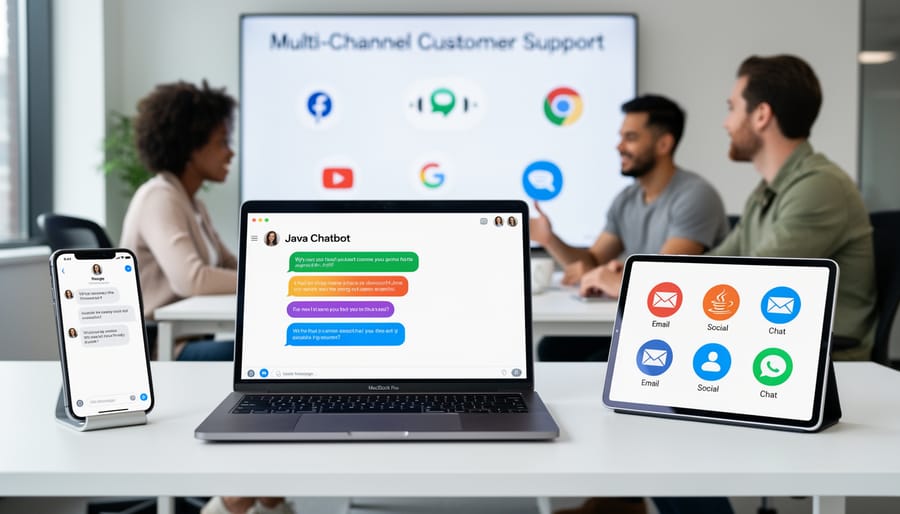
Multi-Channel Deployment Strategies
Once you’ve built your Java AI chatbot, the next step is making it accessible wherever your customers are. Modern businesses need their automated communication tools working seamlessly across multiple platforms to maximize client engagement and response rates.
Start with your website as the primary deployment channel. Embed your Java chatbot directly into your site using JavaScript widgets or iframe integration. This provides immediate support to visitors and captures leads 24/7 without requiring additional staff.
Email integration transforms your chatbot into an intelligent assistant that can handle customer inquiries sent to support addresses. Configure your Java application to monitor specific email accounts, process incoming messages, and send automated responses based on the AI’s understanding of customer intent.
For team collaboration platforms like Slack and Microsoft Teams, leverage their respective APIs to deploy your chatbot as a bot user. This allows employees to access information, automate workflows, and streamline internal communications directly within tools they already use daily. Your Java chatbot can answer HR questions, retrieve data, or trigger business processes without leaving the conversation.
Mobile messaging apps including WhatsApp Business API and Facebook Messenger represent critical channels for customer communication. These platforms require webhook configurations and API authentication, but your Java framework can handle multiple simultaneous connections efficiently.
The key to successful multi-channel deployment is maintaining a single codebase that adapts responses based on channel-specific formatting requirements. This approach ensures consistent messaging while reducing maintenance overhead and allowing you to scale your automated client communication across all relevant business channels.
Real-World Applications That Drive B2B Results
Java AI chatbots deliver tangible improvements across B2B operations by automating time-intensive processes while maintaining personalized customer interactions. Here’s how businesses are implementing them to achieve measurable results.
Lead qualification stands out as a primary application. Java AI chatbots engage website visitors instantly, asking relevant questions to determine their fit and purchase intent. Instead of sales teams manually sorting through hundreds of inquiries, these chatbots score leads based on predefined criteria and route qualified prospects directly to appropriate team members. Companies report 40-60% reductions in time spent on initial lead screening.
Customer support automation represents another high-impact use case. Java-based chatbots handle common technical questions, troubleshoot basic issues, and provide instant access to documentation. They work around the clock, ensuring customers receive immediate assistance regardless of time zones. This automation typically resolves 60-70% of tier-one support tickets without human intervention, freeing support teams to focus on complex problems requiring specialized expertise.
Sales process acceleration occurs when Java AI chatbots schedule demos, answer product questions, and provide pricing information on demand. Rather than waiting days for email responses, prospects receive immediate answers during their research phase. This responsiveness shortens sales cycles by eliminating unnecessary delays in the buying journey.
Integration with predictive analytics enhances chatbot effectiveness further. By analyzing conversation patterns and customer behavior data, businesses identify which prospects are most likely to convert, enabling more strategic resource allocation.
Internal process automation extends chatbot value beyond customer-facing applications. Teams use Java AI chatbots for employee onboarding, answering HR policy questions, and providing quick access to internal knowledge bases. This reduces repetitive inquiries to internal support teams and improves employee productivity.
The key to successful implementation lies in starting with a specific, measurable use case rather than attempting to automate everything simultaneously. Choose one process where response time directly impacts business outcomes, deploy your Java AI chatbot, measure results, then expand to additional applications based on proven ROI.
Overcoming Common Java AI Chatbot Challenges
Building Java AI chatbots comes with distinct challenges that can impact your client communication automation. Understanding these obstacles and their solutions helps you deploy effective chatbot systems faster.
Response accuracy remains the most common hurdle when implementing Java AI chatbots. Your bot might provide irrelevant answers or misinterpret customer questions. To address this, implement a feedback loop where users can flag incorrect responses. Use this data to continuously refine your natural language processing models. Start with a limited domain of questions your chatbot can answer confidently, then expand gradually as accuracy improves.
Training data quality directly affects your chatbot’s performance. Many businesses struggle with insufficient or poorly labeled conversation data. Gather real customer interactions from your existing communication channels like email and live chat. Clean this data by removing duplicates and correcting inconsistencies. Consider augmenting limited datasets with synthetic conversations that mirror typical customer scenarios your business handles.
| Challenge | Solution | Prevention Strategy |
|---|---|---|
| Poor response accuracy | Implement user feedback loops | Start with narrow question scope |
| Low-quality training data | Clean and label existing conversations | Collect diverse customer interactions |
| Integration complexity | Use established Java frameworks | Plan architecture before coding |
| Lost conversation context | Store session state in databases | Design context management upfront |
Integration complexity often derails Java AI chatbot projects. Rather than building everything from scratch, leverage established frameworks like Spring Boot for your application structure and existing Java NLP libraries. This approach reduces development time and provides proven solutions for common integration tasks.
Maintaining conversation context presents technical challenges specific to Java implementations. When chatbots lose track of previous exchanges, conversations feel disjointed and frustrate customers. Store session state using Redis or similar in-memory databases. Structure your conversation flow to reference earlier messages, creating natural dialogue that mirrors human interaction. This context awareness transforms basic automated responses into meaningful client communication that builds relationships and drives business results.
Implementing a Java AI chatbot delivers measurable business value for B2B operations by automating routine customer interactions and freeing your team to focus on high-value client communication. Companies that deploy these solutions typically see a 40-60% reduction in time spent on repetitive inquiries, allowing sales and support teams to dedicate more resources to relationship building and strategic conversations.
The automation capabilities of Java-based chatbots handle frequently asked questions, qualify leads, schedule appointments, and provide instant responses 24/7. This means your business maintains continuous client engagement without requiring additional staff hours. Your team can redirect their energy toward personalized outreach, complex problem-solving, and closing deals rather than answering the same questions repeatedly.
To get started with your Java AI chatbot implementation, begin by identifying the top 10-15 questions your team answers most frequently. These become your chatbot’s initial knowledge base. Next, choose a Java framework that aligns with your technical capabilities and business requirements. Start with a minimum viable product focused on one specific use case, then expand functionality based on real user feedback.
The path forward is straightforward: audit your current communication bottlenecks, select appropriate Java tools and libraries, develop a pilot program, and measure the time savings. Most businesses see positive returns within the first quarter of deployment. Your investment in a Java AI chatbot today positions your company for scalable growth while improving both team productivity and client satisfaction.
Leave a Reply