Social Media AR Transforms Digital Ads: What Smart Marketers Need to Know

Social media augmented reality revolutionizes how brands transform customer experience through immersive digital interactions. By overlaying virtual elements onto real-world environments through popular platforms like Instagram, Snapchat, and Facebook, businesses now engage customers in unprecedented ways. Recent data shows AR-enhanced social media campaigns driving 94% higher conversion rates compared to traditional posts.
The convergence of AR technology with social platforms creates powerful opportunities for marketers: virtual product try-ons enable instant purchasing decisions, location-based AR filters boost local business visibility, and interactive brand experiences generate valuable user-generated content. For forward-thinking businesses, social AR represents not just a technological advancement, but a fundamental shift in customer engagement strategy.
Industry leaders implementing social AR report average engagement increases of 75% and customer retention improvements of 40%. As mobile devices become more sophisticated and AR development tools more accessible, businesses failing to integrate these technologies risk falling behind competitors who are already crafting memorable, shareable AR experiences for their audiences.
This practical guide demonstrates how to leverage social media AR to drive measurable business results through strategic implementation and creative execution.

How Social Media AR is Revolutionizing Digital Advertising
Current AR Features Across Major Social Platforms
Each major social platform offers unique AR features that businesses can leverage for enhanced user engagement and marketing campaigns. Here’s what’s currently available across the leading platforms:
Instagram’s AR capabilities center around Stories and Reels, featuring customizable face filters, background effects, and interactive AR shopping experiences. Businesses can create branded AR filters through Spark AR Studio, allowing customers to virtually try on products or transform their surroundings with branded elements.
Snapchat leads the AR space with advanced features including full-body tracking, landmark manipulation, and sky filters. Their Lens Studio enables businesses to create sophisticated AR experiences, from product visualization to interactive games. The platform’s “Scan” feature helps users discover AR content relevant to their surroundings.
Facebook maintains a robust AR ecosystem through its Portal devices and mobile app. The platform offers AR ads in the news feed, allowing customers to interact with products in 3D. Businesses can implement AR-powered try-ons for cosmetics, eyewear, and furniture placement in real spaces.
TikTok’s AR features focus on entertainment and creative expression, with effects that can be used in short-form videos. The platform’s AR development platform enables brands to create branded effects that users can incorporate into their content. Recent updates include AR-powered shopping features and interactive branded effects.
All platforms provide analytics tools to track AR feature engagement, helping businesses measure campaign success. While features vary across platforms, the trend shows increasing investment in AR capabilities, particularly in shopping and brand experience applications. For optimal results, businesses should align their AR strategy with platform-specific strengths and user behaviors.

Real-World Success Stories
Several successful brand campaigns have demonstrated the transformative power of AR in social media marketing. IKEA’s AR app, which allows customers to visualize furniture in their homes before purchase, resulted in a 35% increase in sales and reduced product returns by 25%. Similarly, Sephora’s Virtual Artist feature on their mobile app enabled customers to try makeup virtually, leading to a 50% boost in mobile app engagement and a significant rise in conversion rates.
MAC Cosmetics leveraged Instagram’s AR filters for their lipstick line, generating over 1.6 million impressions in just one month. The campaign achieved a remarkable 2.4x higher conversion rate compared to traditional advertising methods. Nike’s SNKRS app utilized AR treasure hunts for limited edition sneaker releases, resulting in record-breaking sales with products selling out within minutes.
Pepsi’s AR campaign in London transformed bus shelters into immersive entertainment zones, creating viral social media moments that reached over 8 million viewers. The campaign increased brand awareness by 30% and drove a 12% uptick in sales within the target demographic.
These success stories share common elements: they solved real customer problems, provided genuine value, and created shareable experiences. The key metrics across these campaigns show that AR-enhanced social media content typically achieves 10-15 times more engagement than traditional posts and converts at rates 30-40% higher than standard digital advertising formats.
Implementing AR in Your Social Media Ad Strategy
Planning Your First AR Ad Campaign
Launching your first AR ad campaign might seem daunting, but breaking it down into manageable steps makes the process straightforward and achievable. Start by defining clear campaign objectives – whether it’s increasing brand awareness, driving product sales, or boosting engagement rates.
Next, identify your target audience and the social platforms they frequent most. Instagram and Snapchat currently lead the AR advertising space, but Facebook and TikTok are rapidly expanding their AR capabilities. Choose the platform that best aligns with your audience demographics and campaign goals.
Create your AR concept by considering what will resonate with your audience. Popular options include virtual try-ons for products, branded face filters, or interactive 3D objects. Keep the experience simple yet engaging – complicated AR features might deter user participation.
Work with an experienced AR developer or use platform-specific creation tools like Spark AR Studio (Facebook/Instagram) or Lens Studio (Snapchat). Test your AR filter extensively before launch to ensure smooth performance across different devices.
Set a realistic budget that accounts for both development costs and ad spend. Start with a smaller test campaign to gauge performance and user reception before scaling up. Establish key performance indicators (KPIs) like engagement rate, interaction time, and conversion metrics.
Finally, prepare your promotional strategy. Create supporting content that demonstrates how to use your AR feature and highlight its value proposition. Consider influencer partnerships to maximize reach and demonstrate the AR experience authentically.
Measuring AR Ad Performance
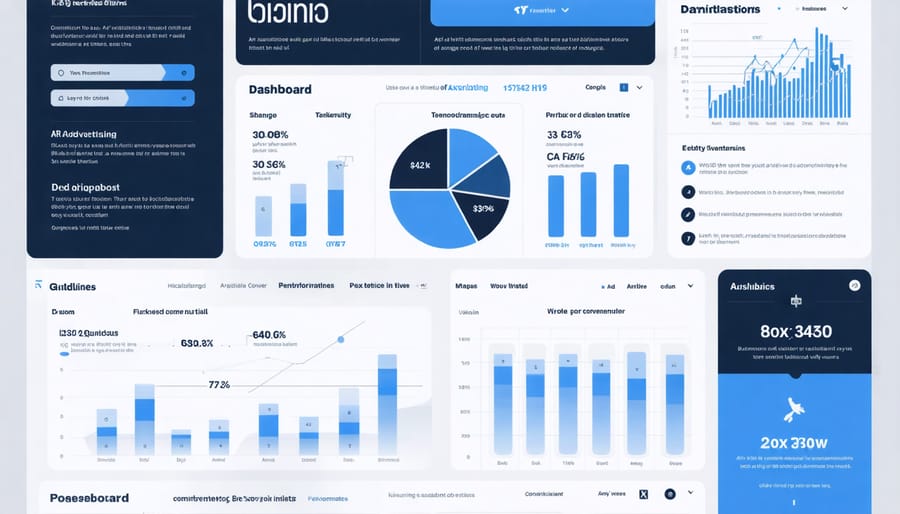
Measuring the success of AR advertising campaigns requires a comprehensive understanding of both traditional marketing metrics and AR-specific key performance indicators (KPIs). When tracking AR campaign performance, businesses should focus on several essential metrics:
Engagement Metrics:
– Time spent interacting with AR features
– Number of AR effect activations
– Share and save rates of AR content
– User-generated content created using AR filters
Conversion Metrics:
– Click-through rates from AR experiences
– Direct purchases through AR shopping features
– Lead generation from AR-enhanced content
– Cart abandonment rates for AR product previews
Technical Performance:
– AR effect load times
– Feature activation success rate
– Device compatibility rates
– User experience scores
ROI Indicators:
– Cost per AR interaction
– Customer acquisition cost through AR
– Revenue generated from AR-enhanced campaigns
– Brand lift metrics
To effectively measure these metrics, utilize platform-specific analytics tools provided by social media networks, along with third-party tracking solutions. Regular monitoring and analysis of these metrics enable businesses to optimize their AR campaigns, improve user experience, and maximize return on investment. Remember to establish baseline measurements before launching AR campaigns to accurately assess their impact on overall marketing objectives.
Future Trends and Opportunities
The landscape of social media AR is rapidly evolving, with several transformative trends poised to reshape the advertising industry. One of the most significant developments is the integration of AI-powered facial recognition with AR filters, enabling more sophisticated and personalized user experiences. This convergence allows brands to create highly targeted campaigns that adapt in real-time based on user interactions and preferences.
Location-based AR experiences are gaining momentum, with social platforms introducing features that allow businesses to overlay digital content in specific physical locations. This advancement creates opportunities for retailers to bridge the gap between online and offline shopping experiences, offering virtual product trials and immersive brand storytifications at specific geographical points.
The rise of gamification in AR marketing continues to show promising results, with brands incorporating interactive elements that drive user engagement and retention. These gamified experiences are becoming more sophisticated, offering rewards, challenges, and social sharing capabilities that amplify campaign reach organically.
5G technology is set to revolutionize AR capabilities on social media platforms, enabling more complex and detailed AR experiences with minimal latency. This advancement will support real-time AR collaborations, virtual shopping experiences, and interactive brand storytelling at unprecedented scales.
Upcoming developments in AR wearables, particularly smart glasses, will create new opportunities for social media marketing. These devices will enable seamless integration of AR content into daily life, offering brands novel ways to engage with consumers through always-on AR experiences.
For businesses looking to stay ahead, investing in AR technology and expertise now will be crucial. Focus on developing scalable AR campaigns that can adapt to these emerging technologies while maintaining clear business objectives and measurable outcomes. Consider partnering with AR specialists or platforms that offer turnkey solutions to reduce implementation barriers and accelerate time-to-market.
Social media AR represents a powerful frontier in digital marketing, offering businesses unprecedented opportunities to engage audiences and drive conversions. By implementing AR filters, interactive product previews, and immersive brand experiences, companies can significantly enhance their social media presence and create memorable customer interactions. Start by identifying your key marketing objectives, then select appropriate AR tools and platforms that align with your target audience. Focus on creating authentic, value-driven experiences that encourage user participation and sharing. Monitor performance metrics closely and adjust your strategy based on user engagement data. As AR technology continues to evolve, staying informed about new features and best practices will be crucial for maintaining a competitive edge in the social media landscape. Consider partnering with AR developers or investing in user-friendly AR creation tools to begin your journey into this transformative marketing channel.
Leave a Reply