Why Your AI Content Models Fail After 90 Days (And How to Keep Them Working)

Track your AI model’s performance weekly using specific metrics like output quality scores, response accuracy rates, and generation time. Set baseline measurements during your first month of implementation, then monitor for degradation patterns that signal when retraining or adjustments become necessary.
Create a documented review schedule that assigns team members to evaluate AI-generated content against your brand standards every two weeks. This systematic approach catches quality drift before it impacts customer communications and ensures your automation continues delivering the professional results that justify your investment.
Establish version control for your AI models by maintaining records of configuration changes, training data updates, and performance benchmarks. When you notice declining output quality, this documentation allows you to pinpoint exactly when degradation began and quickly roll back to stable versions while investigating root causes.
Build automated alerts that notify your team when model performance drops below predetermined thresholds. Rather than discovering problems after customers complain, proactive monitoring lets you address issues during normal business hours with minimal disruption to your marketing operations.
Your AI content systems aren’t set-and-forget solutions. Like any business asset, they require structured maintenance to deliver consistent value. The difference between companies that succeed with AI automation and those that abandon it often comes down to implementing proper lifecycle management from day one. Without it, you’ll watch your initially impressive results slowly deteriorate, wasting the time and resources you invested in automation. With it, you maintain the efficiency gains that free your team to focus on meaningful client relationships instead of repetitive content tasks.
What Model Lifecycle Management Actually Means for Your Content Operations
If you’ve been using AI tools to generate blog posts, social media content, or email campaigns, you’re already working with AI models—whether you realize it or not. Model lifecycle management is simply the systematic approach to keeping those AI systems running smoothly over time.
Think of it like maintaining any automated system in your business. Just as your email marketing platform needs occasional updates and monitoring to stay effective, AI models that power your content operations require ongoing attention. Without proper management, they gradually produce content that feels off-brand, misses the mark with your audience, or becomes outdated.
Here’s what makes model lifecycle management different from your typical AI content strategy: it’s not about what content you create, but about maintaining the systems that create it. The lifecycle covers everything from initially deploying an AI model, to monitoring its performance, updating it as your business evolves, and eventually replacing it when something better comes along.
For marketing teams, this translates to practical activities you probably already understand. It means checking that your AI-generated headlines still match your brand voice. It involves monitoring whether automated content recommendations stay relevant to your customers. It requires updating training data when you launch new products or shift messaging.
The goal is simple: ensure your AI tools consistently deliver the quality and relevance that your audience expects. When done right, model lifecycle management protects your investment in automation while freeing your team to focus on strategic work and meaningful client conversations rather than constantly fixing broken automated processes.

The Four Critical Stages Every Content AI Model Goes Through
Deployment: Getting Your Model Into Production
Deploying your AI content model marks the transition from testing to real-world application. This critical phase requires careful integration with your existing content workflows to avoid disruption while maximizing efficiency gains.
Start by implementing the model alongside your current processes rather than replacing them entirely. This parallel approach lets your team adapt gradually while you monitor performance against established benchmarks. Connect the AI system to your content management platform, ensuring data flows smoothly between systems without manual intervention wherever possible.
Establish clear performance metrics before launch. Track output quality, production speed, and accuracy rates to create baseline measurements. These benchmarks become your reference points for future optimization and help identify when model performance begins to drift.
Communicate the deployment plan to your team explicitly. Define who reviews AI-generated content, how feedback gets documented, and what approval processes apply. Automated content generation works best when human oversight remains structured and consistent.
During the initial weeks, expect a learning curve. Your team needs time to understand the model’s capabilities and limitations, while the system requires sufficient real-world data to refine its outputs. Document unexpected behaviors and quality issues immediately—this early feedback proves invaluable for maintaining model performance over time.
Monitoring: Catching Problems Before They Cost You
Effective AI performance management requires tracking specific metrics that reveal model health before issues impact your business. Focus on three core areas: content quality scores, audience engagement rates, and brand alignment.
Content quality scores measure accuracy, relevance, and readability. Set up automated alerts when scores drop below your baseline thresholds. Track engagement metrics like click-through rates, time on page, and conversion rates to identify declining performance patterns. Brand alignment ensures your AI outputs maintain your company’s voice and values across all communications.
Implement automated monitoring dashboards that flag anomalies in real-time. This eliminates the need for constant manual reviews while catching problems early. Most platforms offer built-in analytics that compare current performance against historical data, making it easy to spot trends without technical expertise.
Schedule weekly automated reports that summarize key metrics and highlight any concerning patterns. This approach reduces oversight time by 70% while maintaining quality control. When metrics dip, you’ll receive immediate notifications, allowing quick corrections before customers notice problems or brand reputation suffers.

Maintenance: When and How to Retrain Your Models
Your AI model won’t alert you when it starts failing—but your metrics will. Watch for three key warning signs that signal it’s time to retrain: conversion rates dropping despite consistent traffic, customer feedback indicating irrelevant or outdated content recommendations, and performance discrepancies when you launch new products or services that your model hasn’t encountered before.
Establish a proactive maintenance schedule rather than waiting for problems to emerge. For most business applications, quarterly performance reviews provide a solid baseline. During these reviews, compare your model’s output quality against your original benchmarks and assess whether it accurately reflects current customer behavior patterns.
When audience preferences shift—seasonal trends, market changes, or evolving buyer personas—your model needs fresh training data to stay relevant. The same applies when you expand your product catalog or modify service offerings. Your AI can’t learn about what it hasn’t seen.
For practical implementation, automate performance tracking wherever possible. Set up dashboards that monitor accuracy rates, engagement metrics, and conversion patterns. This automation frees your team to focus on strategic decisions and client communication rather than manual data analysis.
Consider implementing incremental retraining—updating your model with new data batches monthly while conducting comprehensive retraining quarterly. This balanced approach maintains model relevance without requiring constant oversight or excessive resource allocation.
Retirement: Knowing When to Replace or Sunset a Model
Knowing when to retire a model is crucial for maintaining content quality. Establish clear performance thresholds before degradation impacts your business. If your model’s accuracy drops below 85%, response quality declines noticeably, or customer complaints increase, it’s time to consider retirement.
Create a structured transition plan that minimizes disruption. Run your new model alongside the existing one for at least two weeks, comparing outputs and gathering feedback. This parallel testing period helps identify potential issues before full deployment.
Automate the transition process wherever possible. Set up monitoring alerts that trigger when performance metrics fall below acceptable levels, giving you advance warning rather than reactive scrambling. Document the changeover steps so your team can execute transitions smoothly without extensive manual oversight.
Communicate proactively with stakeholders about planned model updates. Brief your team on what changes to expect in content output and adjust any dependent workflows accordingly. Archive the retiring model’s documentation and performance data for future reference—these insights prove valuable when training subsequent models or troubleshooting similar issues.
Most importantly, schedule regular retirement reviews rather than waiting for catastrophic failure. Quarterly assessments keep you ahead of degradation, ensuring your content operations remain consistent and your team maintains confidence in the automated systems supporting their work.
The Business Cost of Ignoring Model Lifecycle Management
Without proper model lifecycle management, businesses face tangible consequences that directly impact their bottom line. Consider a marketing agency that initially launches an AI content generator producing excellent social media posts. Six months later, clients start complaining that the content feels repetitive and outdated. The model hasn’t adapted to evolving brand guidelines or new product launches, creating a disconnect between automated content and current business reality. This brand inconsistency forces the team to manually review and rewrite nearly every piece, defeating the purpose of automation.
A boutique e-commerce company experiences a different problem. Their AI-powered product descriptions initially drove strong conversions, but engagement metrics steadily decline over three months. The model continues using seasonal language from its training period, promoting “summer essentials” in November. Customer responses shift, but the model doesn’t. The result is wasted ad spend directing traffic to descriptions that no longer resonate, while the marketing team scrambles to identify why conversion rates dropped 40 percent.
Small marketing teams particularly feel the strain of increased manual intervention. One startup founder reports spending eight hours weekly correcting AI-generated email campaigns that once required minimal oversight. The model gradually drifted from the company’s voice, mixing formal and casual tones inconsistently. What began as a time-saving solution became a time sink, with staff performing quality control instead of focusing on client communication and strategy.
These scenarios share a common thread: models deployed without ongoing management become liabilities rather than assets. The initial efficiency gains disappear as teams spend more time fixing problems than they save through automation. For businesses operating on tight margins, this operational drag compounds quickly, turning a competitive advantage into a resource drain that slows growth and frustrates teams.
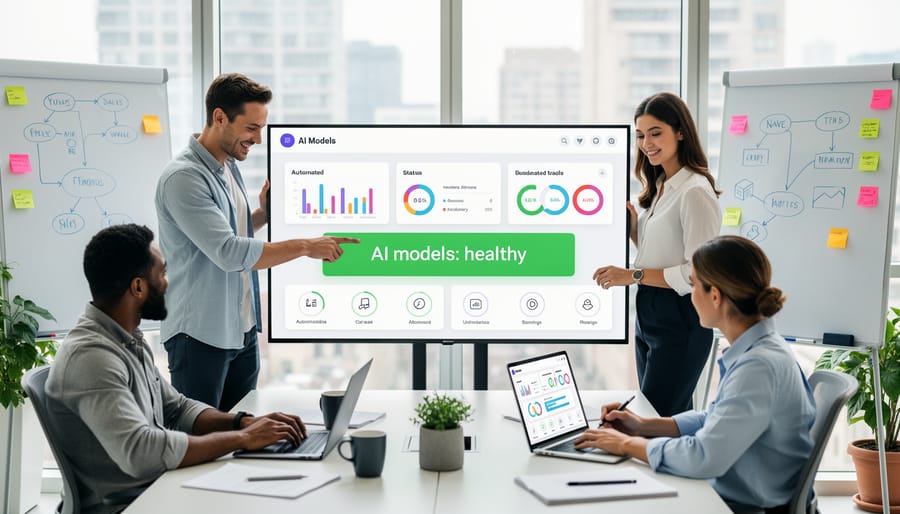
How to Set Up Simple Model Management Without a Data Science Team
Establish Performance Baselines From Day One
Before deploying any AI model, establish clear performance metrics to monitor system health over time. Start with three essential categories: output quality, business impact, and operational efficiency.
For output quality, measure accuracy against your brand guidelines, readability scores, and factual correctness. Create a simple scoring rubric where human reviewers rate outputs on a 1-5 scale across dimensions like relevance, tone consistency, and formatting compliance. Sample 10-15 outputs weekly rather than reviewing everything—this provides sufficient data without overwhelming your team.
Track business metrics that matter to your bottom line. Monitor engagement rates, conversion percentages, and time-to-publish compared to manual processes. tracking content quality becomes straightforward when you connect it directly to revenue outcomes.
Document operational baselines including processing speed, error rates, and manual intervention frequency. A healthy model should require minimal human correction over time.
Create a simple dashboard that displays these metrics weekly. Use spreadsheets or basic analytics tools—sophisticated software isn’t necessary initially. The goal is consistent measurement, not perfect measurement. These baselines become your reference point for detecting model drift and justifying system improvements to stakeholders.
Automate Your Monitoring Process
Manual monitoring eats up valuable time that could be spent on client relationships and strategic work. The solution is implementing automated systems that work around the clock to catch performance issues before they impact your content quality.
Start with automated alert systems that notify you when key metrics fall below acceptable thresholds. Set up notifications for accuracy drops, response time delays, or unusual output patterns. These alerts should reach the right team members immediately through email or messaging platforms you already use.
Dashboard tools provide real-time visibility into your AI model’s health without requiring constant manual checks. Configure dashboards to display essential metrics like output quality scores, processing speed, and error rates in a single view. Most platforms allow you to customize these displays based on what matters most to your business.
The goal is creating a system that runs independently while keeping you informed. Schedule automated performance reports weekly or monthly to review trends without daily oversight. This approach frees your team to focus on creative tasks and client communication rather than babysitting AI systems. When issues arise, automated alerts ensure rapid response, minimizing potential disruptions to your content workflow and maintaining consistent quality for your audience.
Create a Maintenance Schedule That Works
The best maintenance schedule depends on your content volume and model complexity. For businesses publishing 50+ pieces of content monthly, implement a monthly review cycle. This allows you to catch performance issues quickly and make incremental adjustments before problems compound. If you’re producing fewer than 50 pieces monthly, quarterly reviews typically provide sufficient oversight while reducing administrative burden.
Start by designating specific calendar dates for model reviews. Block these times in your team’s schedule just like client meetings—they’re equally important for maintaining service quality. During each review, examine three key metrics: content accuracy rates, engagement performance, and client feedback trends.
Build automated alerts into your workflow to flag urgent issues between scheduled reviews. Set thresholds for accuracy drops or unusual output patterns that trigger immediate attention. This hybrid approach combines proactive scheduled maintenance with reactive problem-solving.
Document every review in a shared log accessible to your entire team. Record what you checked, what you changed, and why. This creates accountability and helps new team members understand your model’s evolution. Most importantly, it prevents you from repeating past mistakes or undoing improvements that worked.
Common Mistakes That Waste Time and Money
Even with the best intentions, businesses often stumble into costly traps when managing their AI models. Here are the most common mistakes and how to sidestep them.
Over-monitoring creates analysis paralysis. Some teams check model performance so frequently that they react to normal fluctuations rather than genuine trends. This leads to unnecessary tweaking that destabilizes your system. Instead, establish reasonable check-in intervals—weekly or bi-weekly for most content models—and only act when metrics consistently move outside acceptable ranges.
Under-monitoring is equally problematic. Businesses deploy a model and assume it will work indefinitely without oversight. By the time they notice problems, customer satisfaction has already suffered. Set up automated feedback loops that alert you when key metrics drop below thresholds, ensuring you catch issues before they impact your bottom line.
Ignoring feedback loops means missing valuable signals from your audience. Your customers tell you what’s working through their engagement, but many businesses fail to connect this data back to model performance. Create simple processes where customer responses directly inform your model adjustments.
Trying to salvage failed models too long drains resources. Sometimes a model simply can’t adapt to new requirements, yet teams keep investing time in fixes. If retraining and adjustment efforts span beyond two revision cycles without improvement, consider starting fresh with a better-suited approach.
Not documenting what works forces you to relearn lessons repeatedly. When you discover effective prompts, successful parameters, or useful data sources, record them immediately. This knowledge base becomes invaluable for training new team members and scaling your operations efficiently.
Model lifecycle management isn’t a complex undertaking reserved for data scientists and large enterprises. The reality is straightforward: implementing proper management practices delivers measurable returns that directly impact your bottom line.
Consider what proper model lifecycle management unlocks for your business. You’ll maintain consistent content quality across all client touchpoints without the constant worry of degrading outputs. Manual intervention drops significantly when you have automated monitoring in place, freeing your team from firefighting mode. Most importantly, the time you reclaim from babysitting AI systems goes directly back into meaningful client communication and strategic work that grows your business.
The question isn’t whether you can afford to implement model lifecycle management. It’s whether you can afford not to. Inconsistent AI outputs damage client relationships. Manual fixes drain resources. Poor performance goes unnoticed until it’s too late.
Start by assessing where you are today. Review your current AI content systems. Ask yourself: Do I have visibility into model performance? Am I tracking quality systematically? What’s my process when outputs degrade? Your honest answers will reveal exactly where to begin your lifecycle management journey.
Leave a Reply