Why Your Mobile App Isn’t Growing (And How App Store Optimization Fixes It)

Optimize your app’s metadata by conducting keyword research to identify high-volume, low-competition search terms, then strategically place them in your app title, subtitle, and description to maximize discoverability in app stores. Focus on your app’s first 30 characters in the title field, as these carry the most weight for search rankings and appear prominently in search results.
Leverage app store optimization to test multiple versions of your app icon, screenshots, and preview videos through A/B testing, measuring which creative assets drive the highest conversion rates from impressions to downloads. Data shows that well-designed visual assets can improve conversion rates by 25-30%.
Build a systematic review generation process by prompting satisfied users at key engagement moments within your app, such as after completing a transaction or achieving a milestone. Higher ratings and recent positive reviews directly impact your search ranking position and convince potential users to download.
Create a localized presence in multiple markets by translating your app metadata and screenshots into languages where your target audience lives. Apps optimized for local markets see up to 128% more downloads per country compared to English-only versions.
Monitor your competitors’ keyword strategies and ranking positions weekly, identifying gaps in their approach that you can exploit. Track your own keyword rankings, conversion rates, and download velocity to measure the direct impact of your optimization efforts and adjust your strategy based on performance data rather than assumptions.
What App Store Optimization Really Means for Your Mobile App
App Store Optimization is the process of improving your mobile app’s visibility within app store search results and top charts. Think of it as your app’s gateway to discovery—when executed properly, ASO ensures that potential users can actually find your app among millions of competing options.
While ASO shares some similarities with traditional SEO, the fundamental differences are significant. SEO focuses on optimizing web content for search engines like Google, using factors such as backlinks, domain authority, and page load speeds. ASO, however, operates within the closed ecosystems of the Apple App Store and Google Play Store, where the ranking algorithms prioritize different signals entirely. Your app’s title, keyword field, download velocity, user ratings, and engagement metrics carry far more weight than traditional SEO factors.
The practical impact of ASO on your app’s success cannot be overstated. Approximately 65% of app downloads come directly from app store searches, making your optimization efforts the most direct path to organic growth. When your app ranks higher for relevant search terms, you naturally attract more qualified users who are actively looking for solutions like yours—these users typically demonstrate higher retention rates and lifetime value compared to users acquired through paid advertising.
Beyond immediate visibility, effective ASO creates a compounding growth effect. Higher rankings lead to more downloads, which signal quality to the app store algorithms, resulting in even better rankings. This positive feedback loop reduces your dependency on costly paid acquisition channels and builds a sustainable foundation for long-term growth.
The key to successful ASO lies in understanding that it’s not a one-time setup task. App store algorithms continuously evolve, competitor landscapes shift, and user search behaviors change. Regular optimization and testing of your app’s metadata, visuals, and keyword strategy ensure you maintain competitive visibility. For businesses serious about mobile app growth, implementing systematic ASO processes isn’t optional—it’s the difference between obscurity and discoverability in today’s crowded app marketplace.
The Five Core Elements That Drive App Store Rankings
App Title and Subtitle Optimization
Your app’s title is the first element potential users see in search results, making it crucial for both discoverability and conversion. The most effective titles combine your primary keyword with your brand name, keeping the total character count under 30 characters to avoid truncation in search results.
Start by identifying the exact search terms your target audience uses. Your title should immediately communicate what your app does while incorporating high-volume keywords naturally. For example, “TaskFlow: Project Management” clearly signals functionality while optimizing for relevant searches.
The subtitle offers an additional 30 characters to reinforce value propositions and include secondary keywords. Use this space to highlight your app’s unique benefits or specific features that differentiate you from competitors. Think “Track team tasks, boost productivity” rather than generic phrases.
Avoid keyword stuffing, which damages user experience and can trigger app store penalties. Each word should serve a purpose, whether for search optimization or user clarity. Test different variations systematically, monitoring how title changes impact your conversion rate and search rankings. This data-driven approach ensures your optimization efforts directly contribute to sustainable growth rather than relying on guesswork.
Keyword Strategy That Actually Works
Start by analyzing what your competitors rank for and identify gaps in their keyword strategies. Use tools like App Annie, Sensor Tower, or even the App Store’s own search suggestions to discover relevant keywords with high search volume but manageable competition.
Focus on long-tail keywords that match specific user intent. Instead of targeting “fitness app,” consider “30-day workout plan for beginners” or “calorie counter with barcode scanner.” These specific phrases attract users who know exactly what they want and are more likely to convert.
Build your keyword list strategically by categorizing terms into primary, secondary, and tertiary keywords. Your app title should contain your most important keyword, while the subtitle and description can incorporate supporting terms naturally. Avoid keyword stuffing, which both app stores penalize and users find off-putting.
Implement a testing schedule to rotate keywords in your metadata every 30 days. Track ranking changes and conversion rates for each keyword to identify which terms drive actual downloads versus mere impressions. This data-driven approach allows you to refine your strategy continuously rather than making assumptions about what works.
Remember that keyword optimization isn’t a one-time task. Market trends shift, competitor strategies evolve, and user search behavior changes. Set up automated tracking systems to monitor your keyword performance and receive alerts when significant ranking changes occur.

Visual Assets That Convert Browsers to Downloaders
Your app’s visual assets serve as your storefront in the app marketplace, directly influencing whether browsers become downloaders. Start with your app icon—it should be simple, memorable, and recognizable even at thumbnail size. Test different color schemes and designs to see which resonates best with your target audience.
Screenshots are your primary selling tool. Prioritize the first three images, as many users won’t scroll further. Show your app solving real problems rather than just displaying features. Add brief text overlays highlighting key benefits, but keep them concise—three to five words maximum per screenshot.
Preview videos can boost conversion rates by up to 25 percent when done right. Keep them under 30 seconds, start with your strongest feature, and ensure the first three seconds grab attention. Show the app in action rather than using abstract animations.
Automate your testing process by running A/B tests on different visual combinations. Track which assets drive the highest conversion rates, then replicate those elements across your app store presence. Update your visuals quarterly to reflect new features and maintain freshness in the marketplace.
Ratings and Reviews Management
Your app’s ratings and reviews directly impact your ranking in app stores and influence download decisions. Implement automated in-app prompts that ask satisfied users to leave reviews at optimal moments—after completing a successful action or reaching a milestone within your app.
Timing is critical. Request reviews when users demonstrate engagement, not immediately after download. This approach increases the likelihood of receiving positive feedback from users who’ve experienced your app’s value.
Responding to reviews shows potential users you’re actively listening. Set up automated alerts to notify your team of new reviews, enabling quick responses to both positive and negative feedback. Address negative reviews professionally by acknowledging concerns and offering solutions, which can transform dissatisfied users into loyal advocates.
Managing app reviews should be part of your regular workflow. Create response templates for common feedback themes while personalizing each reply. This systematic approach maintains consistency while demonstrating genuine care for user experience, ultimately improving your app’s reputation and search visibility.
Download Velocity and User Engagement Signals
App stores heavily weight download velocity and user engagement signals when determining rankings. A sudden spike in downloads signals relevance and quality, boosting your visibility in search results and category rankings.
Key metrics app stores monitor include retention rates (day 1, day 7, day 30), session length, frequency of app opens, and in-app actions. Apps with strong engagement patterns consistently outrank competitors with higher download volumes but poor retention.
To optimize these signals, focus on acquiring quality users who match your target audience rather than chasing vanity metrics. Implement automated push notification campaigns to re-engage users during critical retention windows. Track user behavior within the first 72 hours to identify friction points that cause abandonment.
Consider running limited-time promotional campaigns to create download velocity spikes around major updates or feature launches. This concentrated activity signals momentum to app store algorithms. Monitor your crash rates and loading times closely, as technical issues directly impact engagement metrics and can trigger ranking penalties.
Building Your ASO Strategy: A Step-by-Step Approach
Conducting Your ASO Audit
A comprehensive ASO audit starts with evaluating your current app store presence across all key elements. Begin by examining your app title, subtitle, and keyword field to identify which terms you’re currently targeting and whether they align with high-volume search queries in your category.
Next, assess your visual assets. Review your app icon, screenshots, and preview videos with fresh eyes. Ask yourself whether these elements immediately communicate your app’s value proposition and stand out among competitors. Download competitor apps in your category to understand what works in your space.
Analyze your app description to ensure it’s compelling, benefit-focused, and includes relevant keywords naturally. Check your ratings and reviews, noting common themes in both positive and negative feedback. This user insight often reveals improvement opportunities you hadn’t considered.
Use automated ASO tools to track your current keyword rankings, visibility score, and conversion rates. These platforms can identify gaps in your strategy and benchmark your performance against competitors. Document your findings in a simple spreadsheet, noting priority areas for improvement. This baseline assessment becomes your roadmap, helping you focus resources on changes that will deliver the most significant impact on your app’s discoverability and download rates.
Competitor Analysis Made Simple
Studying your competitors provides valuable insights without requiring you to reinvent the wheel. Start by identifying the top five apps in your category and examine their app store presence systematically. Look at their keyword strategies by analyzing which search terms they rank for, but focus on understanding the intent behind their choices rather than copying their exact approach.
Pay attention to how successful apps structure their visual assets. Note the messaging hierarchy in their screenshots, the problems they emphasize solving, and how they demonstrate value within seconds. Review their update frequency and changelog descriptions to understand how they maintain user engagement and communicate improvements.
Monitor their user reviews to identify common pain points and desired features. This intelligence helps you position your app’s unique strengths where competitors fall short. Use automated tracking tools to receive notifications when competitors update their listings or rankings change, saving you hours of manual research.
The goal isn’t imitation but differentiation. Identify gaps in how competitors serve your target audience, then craft your messaging to fill those spaces. This strategic approach transforms competitor research from a copying exercise into a positioning advantage that highlights what makes your app the better choice for specific user needs.

Testing and Iterating for Better Results
Growth doesn’t happen by guessing—it requires systematic testing and measurement. A/B testing lets you compare different versions of your app store elements to identify what drives more downloads. Start with high-impact variables like your app icon, screenshots, or primary subtitle. Test one element at a time to isolate what actually moves the needle.
Set up automated tracking systems to monitor key metrics throughout your tests. Focus on conversion rate (visitors to downloads), click-through rate on screenshots, and cost per install if you’re running paid campaigns. Most app store platforms provide built-in analytics, but consider integrating third-party tools for deeper insights into user behavior patterns.
Run tests for at least two weeks to account for daily fluctuations and gather statistically significant data. Small sample sizes lead to false conclusions, so ensure you’re collecting enough traffic before making decisions. When you identify a winner, implement it immediately—then start your next test.
Create a testing calendar that prioritizes elements based on potential impact. Your app icon typically has the highest impact on conversion, followed by your first screenshot and primary description text. Document every test result in a shared dashboard so your team can track progress and learn from both successes and failures.
Remember that user preferences evolve. What works today might underperform in six months. Schedule quarterly reviews of your ASO elements and refresh underperforming assets based on accumulated data and emerging design trends in your category.
Common ASO Mistakes That Kill Mobile App Growth
Even the most promising apps can fail to gain traction when businesses overlook critical ASO fundamentals. Understanding these common mistakes helps you avoid wasted resources and accelerate your growth trajectory.
One of the most damaging errors is keyword stuffing in app titles and descriptions. While keywords are essential, cramming too many into your metadata makes your app appear spammy and unprofessional. App stores penalize this behavior, and potential users quickly lose trust. Instead, focus on a strategic selection of 5-7 highly relevant keywords that naturally fit your app’s value proposition.
Many businesses also make the mistake of neglecting their visual assets. Your app icon, screenshots, and preview videos are the first things users notice. Low-quality images, unclear messaging, or screenshots that don’t showcase your app’s core features will tank your conversion rate regardless of how well you rank. Invest in professional visuals that clearly communicate your app’s benefits within the first few seconds of viewing.
Another frequent pitfall is the “set it and forget it” mentality. ASO requires ongoing optimization based on performance data. Markets shift, competitors evolve, and user preferences change. Businesses that fail to regularly review their keyword rankings, conversion rates, and user feedback miss opportunities to refine their strategy. Establish automated processes to monitor key metrics weekly and schedule monthly reviews to adjust your approach.
Ignoring localization represents a significant missed opportunity, especially for apps targeting multiple regions. Simply translating your app description isn’t enough. You need to research region-specific keywords, cultural preferences, and local competitors. A keyword that performs well in the United States might be completely irrelevant in Germany or Japan.
Finally, many businesses underestimate the importance of managing app reviews and ratings. Negative reviews left unaddressed signal poor customer service and directly impact your app store ranking. Create a system for promptly responding to user feedback, both positive and negative. This shows potential users you’re committed to improvement and strengthens trust in your brand.
By avoiding these common mistakes and implementing a systematic approach to ASO, you position your app for sustainable, measurable growth in an increasingly competitive marketplace.
Measuring ASO Success: Metrics That Matter
Tracking the right metrics transforms ASO from guesswork into a data-driven growth strategy. Start by monitoring your conversion rate, which measures the percentage of store visitors who download your app. A healthy conversion rate typically ranges from 25% to 35%, though this varies by category and market. If yours falls below 20%, your store listing likely needs optimization.
Focus on organic download velocity as your primary growth indicator. Track how many downloads you receive from unpaid sources daily and weekly. Consistent upward trends signal that your ASO efforts are working. Most successful apps see 10% to 20% month-over-month growth during active optimization periods.
Keyword rankings deserve daily attention. Monitor your position for target keywords using ASO tools that automate this tracking process. Aim to rank in the top 10 for your primary keywords and top 25 for secondary terms. Movement in rankings often precedes changes in download volume by several days.
Retention rate tells whether your ASO attracts the right users. If people download but quickly delete your app, your messaging may promise something you don’t deliver. Healthy apps retain 25% to 40% of users after 30 days.
Set up automated reporting to track these metrics weekly. Compare performance against your own baseline rather than competitors, as every app operates in unique market conditions. Establish monthly review sessions with your team to identify trends and adjust strategy accordingly.
Remember that ASO metrics interconnect. Improving keyword rankings should increase visibility, which boosts downloads, which can further improve rankings. Monitor how changes in one metric influence others to understand your app’s complete performance picture. This systematic approach keeps your growth trajectory measurable and manageable.
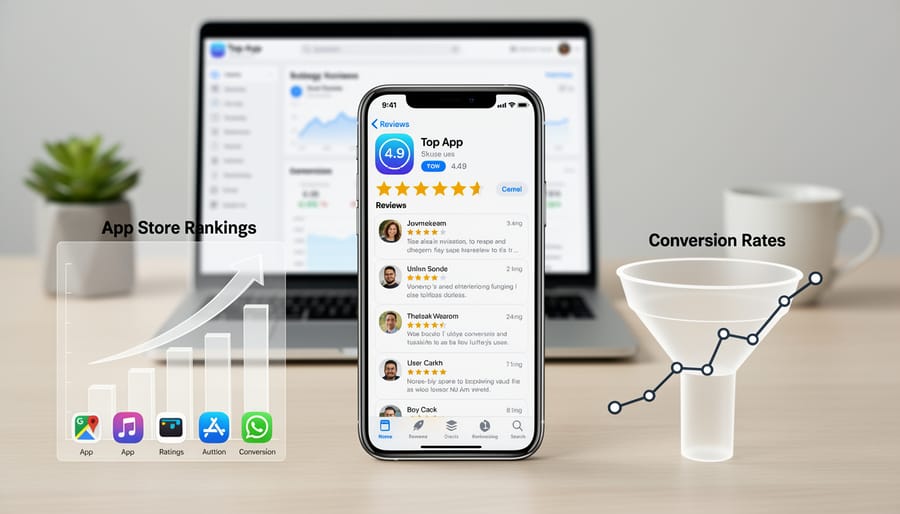
ASO isn’t a one-time project—it’s an ongoing commitment that drives sustained mobile app growth. The businesses that see the greatest success treat optimization as a continuous cycle of testing, measuring, and refining. Start with the foundational elements: craft compelling app titles and descriptions, select relevant keywords, and create eye-catching visuals. As you gather data, refine your approach based on what resonates with your target audience. The compounding effect of consistent optimization compounds over time, gradually improving your visibility and conversion rates. While ASO forms the backbone of organic growth, consider complementing it with paid user acquisition strategies for faster results. Begin today with small, manageable improvements, and commit to regular reviews of your app’s performance metrics. The investment you make in ASO now will continue delivering returns long into the future.
Leave a Reply