The Advertising Strategy That Actually Drives Sales (And How to Pick Yours)

Advertising strategies determine whether your marketing budget drives measurable growth or disappears without results. Every dollar you invest needs a clear purpose, a defined audience, and a method to track performance—yet most businesses struggle to match their goals with the right approach.
The advertising landscape divides into two fundamental categories: traditional strategies that build broad awareness through channels like television, radio, and print, and digital strategies that enable precise targeting through social media, search engines, and email campaigns. Within these categories, push strategies interrupt audiences with your message, while pull strategies attract customers actively seeking solutions you provide.
Your choice between these approaches depends on three critical factors. First, your target audience’s behavior—where they spend time and how they consume information. Second, your budget constraints and timeline for seeing returns. Third, your ability to measure results and adjust campaigns based on performance data.
Modern advertising success requires automation to scale your efforts without proportional cost increases. Automated bidding optimizes ad spend across platforms, email sequences nurture leads without manual intervention, and performance dashboards consolidate metrics for faster decision-making. These systems free your team to focus on strategy and creative development rather than repetitive tasks.
The strategies outlined ahead provide frameworks for selecting approaches that align with your business objectives. Understanding each option’s strengths, limitations, and ideal use cases empowers you to build campaigns that convert prospects into customers while maximizing return on investment.
Why Your Advertising Strategy Choice Matters More Than Your Budget
Many business owners operate under a costly misconception: throwing more money at advertising will automatically deliver better results. The reality is far different. Your advertising strategy acts as a multiplier for your budget, meaning the wrong approach can waste even substantial investments, while the right strategy can generate impressive returns from modest spending.
Consider two businesses with identical $5,000 monthly advertising budgets. The first spreads its spending across multiple channels without clear targeting or measurement, hoping something will stick. The second develops a focused strategy based on customer research, selects two complementary channels, and implements automated tracking to optimize performance. Within three months, the strategic business typically sees three to five times better ROI, not because it spent more, but because it spent smarter.
The difference lies in alignment. An effective strategy ensures your message reaches the right audience, at the right time, through channels they actually use. It establishes clear objectives, defines success metrics, and creates feedback loops for continuous improvement. Without this foundation, you’re essentially gambling with your marketing budget.
Strategy also determines scalability. Random advertising efforts rarely scale profitably because you can’t reliably replicate what you don’t understand. A well-documented strategy, however, identifies what works and why, allowing you to confidently increase spending on proven approaches while cutting underperformers.
Most importantly, your strategy choice affects how efficiently you can communicate with potential clients throughout their buying journey. Modern automated processes make it possible to nurture relationships systematically, but only when integrated into a coherent strategic framework. The businesses that thrive aren’t necessarily those that spend the most, they’re the ones that match the right strategy to their specific goals and market conditions.

Traditional Advertising Strategies That Still Work
Print and Broadcast Advertising
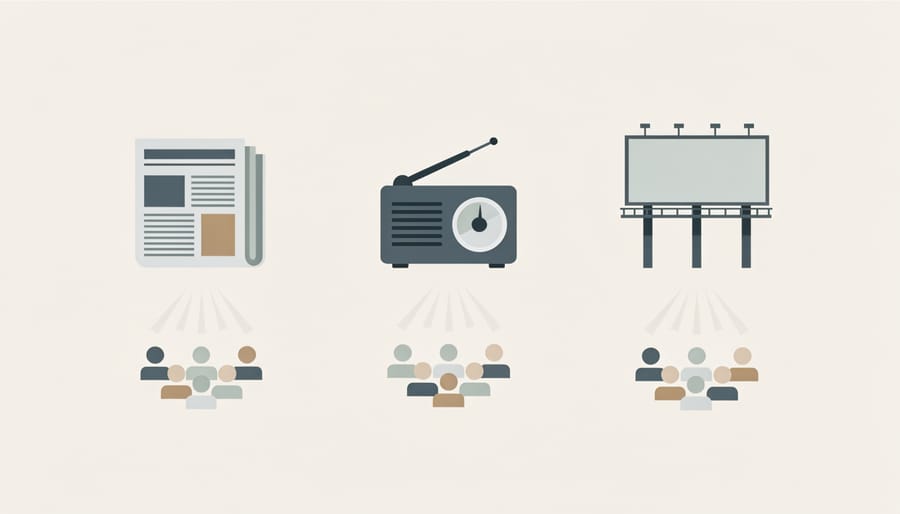
Traditional print and broadcast advertising remains effective for specific audiences and objectives, despite the digital shift. Understanding when these channels deliver the best return helps you allocate your budget strategically.
Newspaper advertising works well for local businesses targeting older demographics and specific geographic areas. Daily newspapers reach readers during their morning routine, making them ideal for time-sensitive promotions. Costs vary significantly based on circulation size and ad placement, with local papers offering more accessible entry points than national publications.
Magazine advertising provides longer shelf life and better targeting through specialized publications. Industry-specific magazines connect you with engaged audiences already interested in your sector. While production costs are higher and lead times longer, the visual quality and reader engagement often justify the investment for premium products and B2B services.
Radio advertising offers cost-effective reach for local markets and commuters. The medium excels at building brand awareness through repetition and reaches audiences during predictable times like morning and evening drives. Production costs are relatively low, making it accessible for small businesses testing traditional media.
Television advertising delivers the widest reach and strongest impact through sight, sound, and motion. While production and airtime costs are substantial, local cable spots provide more affordable options for regional businesses. TV works best for products requiring demonstration and brands seeking mass-market awareness. Consider that younger demographics increasingly consume content through streaming services, making traditional TV more effective for audiences over 35.
Cost considerations across these channels depend heavily on market size, timing, and frequency. Start with smaller tests to measure response before committing to extended campaigns.
Direct Mail and Outdoor Advertising
Despite the digital revolution, physical advertising still delivers impressive results when strategically deployed. Direct mail, billboards, and transit advertising excel at creating tangible brand experiences that digital channels can’t replicate.
Direct mail campaigns remain effective for targeted local marketing and high-value customer acquisition. Personalized mailers with clear calls-to-action typically generate response rates between 4-9%, significantly higher than email marketing. Success depends on precise audience segmentation and compelling design. Track effectiveness using unique promotional codes, personalized URLs, or QR codes that connect physical mail to digital tracking systems.
Billboards and outdoor signage work best for brand awareness in high-traffic areas. They’re particularly valuable for businesses with physical locations or those targeting commuters. The key is simple, memorable messaging—people typically view billboards for just 3-7 seconds. Digital billboards offer rotation capabilities and dayparting options, allowing you to adjust messages based on time and traffic patterns.
Transit advertising, including bus wraps and subway posters, captures attention during daily commutes when audiences are more receptive. This format works well for both local businesses and mobile services.
Measuring outdoor advertising effectiveness requires creative approaches. Use unique landing pages, dedicated phone numbers, or promotion codes exclusive to specific locations. Track foot traffic increases, website visits from targeted zip codes, and brand awareness surveys in display areas. Modern technology enables geofencing around billboard locations to measure mobile engagement and store visits, connecting physical impressions to measurable actions.

Digital Advertising Strategies for Modern Businesses
Search Engine Marketing (SEM) and Pay-Per-Click
Search engine marketing (SEM) and pay-per-click (PPC) advertising put your business directly in front of customers actively searching for your products or services. Unlike traditional advertising that interrupts audiences, paid search captures intent-driven traffic at the exact moment potential customers need what you offer.
Google Ads dominates the PPC landscape, allowing you to bid on keywords relevant to your business. When someone searches for those terms, your ad appears above organic results. You only pay when someone clicks, making it a cost-effective way to generate qualified leads. The key advantage is intent-based targeting—these aren’t random viewers but people actively seeking solutions you provide.
Successful PPC campaigns require continuous monitoring and optimization. This is where automation transforms results. Automated bidding strategies adjust bids in real-time based on conversion likelihood, while automated rules pause underperforming ads and scale successful ones. Smart campaigns use machine learning to optimize ad placement, targeting, and budget allocation without constant manual intervention.
For businesses managing multiple client campaigns, automation streamlines daily management tasks like bid adjustments, budget pacing, and performance reporting. This efficiency allows you to focus on strategy and client communication rather than routine optimizations.
The measurable nature of PPC makes it ideal for demonstrating ROI to stakeholders. Every click, conversion, and dollar spent is trackable, providing clear insights into campaign performance and opportunities for improvement.
Social Media Advertising
Social media advertising offers unmatched precision in reaching your ideal customers where they spend most of their time online. Each platform serves distinct audiences and purposes, making platform selection crucial for campaign success.
Facebook remains the most versatile option, with 2.9 billion active users spanning all demographics. Its robust targeting capabilities let you reach audiences based on interests, behaviors, job titles, and life events. Facebook works best for B2C companies, local businesses, and brands targeting audiences over 25. The platform supports various ad formats, from carousel ads to video content, with relatively straightforward creative requirements.
Instagram excels for visual brands targeting younger demographics, particularly those aged 18-34. Fashion, food, fitness, and lifestyle businesses see strong engagement here. Instagram Stories and Reels offer authentic, less-polished creative opportunities that resonate with mobile-first audiences.
LinkedIn is your go-to platform for B2B advertising and professional services. While cost-per-click runs higher than other platforms, the ability to target by job title, company size, industry, and seniority makes it invaluable for reaching decision-makers. Professional, value-driven content performs best here.
TikTok captures Gen Z and younger Millennials through entertaining, trend-driven content. Brands willing to embrace authentic, creative storytelling rather than traditional advertising approaches can achieve remarkable reach and engagement at competitive costs.
Each platform provides detailed analytics and automated bidding options, letting you optimize campaigns efficiently while maintaining clear communication with stakeholders about performance metrics.
Display and Retargeting Campaigns
Display and retargeting campaigns keep your brand visible as potential customers move through their decision-making process. Banner ads appear across websites, apps, and social media platforms, placing your message in front of targeted audiences based on their demographics, interests, and online behavior.
Programmatic advertising automates the buying and placement of these ads in real-time, using algorithms to bid on ad space and serve your content to the right people at the right moment. This automated approach eliminates manual negotiations and optimizes your budget by focusing spend where it’s most effective.
Retargeting takes this further by showing ads specifically to people who’ve already interacted with your business—whether they visited your website, added items to their cart, or engaged with previous content. These campaigns typically achieve higher conversion rates because they’re reaching warm leads who’ve demonstrated interest.
The key advantage is staying top-of-mind throughout the extended buying journey many customers experience today. By serving relevant messages at different touchpoints, you guide prospects toward conversion while gathering data on which placements and creative assets perform best. Most platforms provide detailed analytics, making it straightforward to track performance and adjust campaigns based on measurable results.
Content Marketing and Native Advertising
Content marketing flips traditional advertising on its head by providing genuine value before asking for the sale. Instead of interrupting potential customers, you attract them with educational blog posts, helpful guides, videos, or infographics that solve their problems. This approach builds trust and positions your business as an industry authority.
Native advertising takes this concept further by blending promotional content seamlessly into the platforms where it appears. Sponsored posts on social media, paid search results, and promoted articles match the look and feel of organic content, making them less intrusive and more engaging. The key is transparency—clearly label sponsored content while ensuring it delivers real value to your audience.
Effective content marketing strategies focus on consistency and relevance. Automated content scheduling tools help maintain regular publishing without overwhelming your team. Track metrics like time on page, shares, and conversion rates to measure impact. When done right, content marketing generates qualified leads who already understand and trust your expertise, significantly shortening the sales cycle and reducing acquisition costs.
Strategic Approaches: Push vs. Pull Advertising
Understanding the difference between push and pull advertising helps you allocate your marketing budget more effectively and reach customers at the right moment in their buying journey.
Push advertising is an interruption-based approach where you proactively put your message in front of potential customers, regardless of whether they’re actively seeking your product. Think of traditional TV commercials, display ads, or cold emails. You’re pushing your message out to a broad audience, hoping to capture attention and create demand. This strategy works well for new product launches, building brand awareness quickly, or reaching audiences who may not yet know they need your solution. The downside is higher costs per conversion and potential customer resistance to unsolicited messages.
Pull advertising takes an attraction-based approach, positioning your business where customers can find you when they’re already looking for solutions. Search engine marketing, content marketing, and SEO fall into this category. You’re pulling interested prospects toward your business by providing valuable information or appearing in their search results. This method typically generates higher-quality leads because people are actively seeking what you offer, resulting in better conversion rates and lower acquisition costs.
Most successful businesses use both strategies in combination. For example, you might use push advertising through social media ads to build initial awareness, then implement pull tactics like blog content and search ads to capture prospects when they’re ready to buy. Automated marketing platforms make it easier to coordinate these efforts, tracking which prospects came from push channels and nurturing them with pull content until they convert.
The key is matching your approach to your business stage and goals. Early-stage companies often need push advertising to generate awareness, while established businesses benefit more from pull strategies that capture existing demand. Monitor your cost per acquisition from each channel to determine the right balance for your specific situation.
How to Match Your Advertising Strategy to Your Business Goals
Choosing the right advertising strategy starts with clearly defining what you want to achieve. Each business goal requires a different approach, and the most successful campaigns often combine multiple strategies working together.
For brand awareness goals, your priority is reaching as many relevant people as possible. Focus on content marketing to establish thought leadership, social media advertising to expand your reach, and display advertising to maintain visibility. Native advertising works particularly well here because it introduces your brand in a non-intrusive way. Automated social media scheduling tools can help you maintain consistent presence without overwhelming your team. Track metrics like impressions, reach, and brand recall rather than immediate conversions.
When lead generation is your objective, pull marketing strategies become essential. Search engine marketing captures people actively looking for solutions, while content marketing with gated resources (whitepapers, webinars, toolkits) exchanges value for contact information. Retargeting keeps your brand visible to prospects who’ve shown interest. Set up automated email sequences to nurture these leads efficiently, and measure success through cost per lead and lead quality scores.
For direct sales conversion, combine search engine marketing with conversion-focused landing pages, influencer partnerships that include promotional codes, and email marketing campaigns with clear calls-to-action. Time-sensitive offers through social media advertising can create urgency. Automation platforms can trigger personalized product recommendations based on browsing behavior, significantly improving conversion rates. Monitor return on ad spend and customer acquisition costs closely.
Customer retention requires a different approach entirely. Email marketing excels here, particularly automated sequences for onboarding, re-engagement, and loyalty programs. Referral marketing turns satisfied customers into advocates. Regular communication through content marketing keeps your brand top-of-mind without constant selling.
The key to success lies in alignment and measurement. Start with one primary goal, select two to three complementary strategies, implement tracking from day one, and regularly communicate results with your team. Most businesses benefit from a foundation of content marketing and search engine marketing, then layer additional strategies based on specific goals. This focused approach prevents budget waste and delivers measurable results.
Building an Integrated Multi-Channel Approach
While individual advertising strategies deliver results, combining them creates exponential impact. An integrated multi-channel approach ensures your message reaches prospects wherever they spend time, reinforcing your brand through multiple touchpoints.
The challenge many businesses face isn’t choosing between channels—it’s coordinating them effectively. When social media, email, content marketing, and traditional advertising work in isolation, you risk message inconsistency and wasted budget. The solution lies in strategic integration.
Start by establishing a unified brand message that adapts to each channel while maintaining core positioning. A prospect might see your LinkedIn ad, receive a follow-up email, and encounter your content on industry websites—each touchpoint should feel connected, not random.
This is where marketing automation becomes invaluable. Automated systems track prospect interactions across channels, triggering appropriate follow-ups based on behavior. When someone clicks your Facebook ad but doesn’t convert, automation can schedule a personalized email sequence without manual intervention. This maintains consistent client communication while freeing your team for strategic work.
To coordinate messaging effectively, implement these practical steps. First, map your customer journey to identify key touchpoints where prospects engage with your brand. Second, create channel-specific content variations that share common themes and calls-to-action. Third, establish tracking mechanisms to measure how channels work together—not just individually.
Consider timing coordination carefully. Launch social media campaigns that drive traffic to landing pages optimized for conversion. Follow up with email sequences that address common objections. Retarget website visitors with display ads reinforcing your value proposition.
The payoff is substantial. Multi-channel campaigns typically generate 24% higher response rates than single-channel efforts. More importantly, integrated approaches build trust through repeated, consistent exposure—turning cold prospects into qualified leads ready for meaningful conversations.

Success in advertising isn’t about implementing every strategy available—it’s about selecting the right ones for your specific business goals and audience. Random execution wastes resources and dilutes your message, while strategic selection creates focused campaigns that deliver measurable results.
If you’re just starting out, resist the temptation to try everything at once. Begin with one or two strategies that align closely with your objectives and target audience. For example, if you’re a local service business, local SEO combined with targeted social media advertising might yield better returns than a broad national campaign. This focused approach allows you to allocate resources effectively and learn what resonates with your customers.
Once you’ve implemented your chosen strategies, measurement becomes critical. Track key performance indicators consistently—whether that’s website traffic, conversion rates, cost per acquisition, or return on ad spend. These metrics tell you what’s working and what needs adjustment. Regular analysis enables you to refine your approach, double down on successful tactics, and eliminate underperforming ones.
Remember that effective advertising strategies evolve. Consumer behaviors shift, platforms introduce new features, and market conditions change. Stay informed about trends in your industry, but always filter new opportunities through the lens of your specific goals.
For businesses seeking optimal results without the learning curve, professional guidance can accelerate success. Experienced marketing professionals bring expertise in strategy selection, campaign execution, and performance optimization—helping you avoid costly mistakes while maximizing your advertising investment.
Leave a Reply