Why Inconsistent Business Listings Are Costing You Customers (And How to Fix It)
Your business name, address, and phone number must appear identically across every online platform where your company is listed. This fundamental principle, known as NAP consistency, directly influences whether potential customers can find you in local search results and whether search engines trust your business information enough to rank you prominently. When Google encounters conflicting information about your business location across different directories, it cannot confidently display your listing to searchers, meaning you lose customers to competitors with cleaner data.
The stakes are higher than most business owners realize. Inconsistent NAP information costs you visibility in the local map pack, reduces your credibility with both search engines and customers, and creates confusion that sends potential clients elsewhere. A single discrepancy, whether it’s “Street” versus “St.” or a outdated phone number on one directory, can cascade into significant ranking penalties and lost revenue.
Understanding and maintaining NAP consistency requires systematic auditing of your current listings, implementing corrections across all platforms, and establishing processes to prevent future inconsistencies as your business evolves.
What NAP Consistency Actually Means for Your Business
The Three Components Explained
NAP stands for three critical pieces of business information that must appear identically across all online platforms:
Name refers to your business name exactly as registered. This includes proper capitalization, punctuation, and any legal designators. For example, “Smith & Sons Plumbing LLC” differs from “Smith and Sons Plumbing” or “Smith & Son’s Plumbing, LLC.” Even minor variations like using an ampersand versus spelling out “and” create inconsistency.
Address means your complete physical location, formatted the same way everywhere. Write “123 Main Street, Suite 200” consistently rather than mixing “123 Main St., Ste 200” or “123 Main Street #200.” Building numbers, street abbreviations, unit designators, and ZIP codes must match precisely.
Phone number should use one format across all listings. Choose either (555) 123-4567, 555-123-4567, or 555.123.4567 and stick with it. Including country codes inconsistently or alternating between local and toll-free numbers creates confusion.
The most problematic variations include abbreviated words, different punctuation, reordered address components, and outdated information remaining on old platforms. Search engines interpret these variations as potentially different businesses, diluting your local search authority and confusing potential customers trying to contact you.
Where Your NAP Information Lives Online
Your NAP information appears across dozens of online platforms, each playing a distinct role in local search visibility. Your Google Business Profile serves as your primary listing, directly influencing map pack rankings and local search results. Yelp remains crucial for service-based businesses, as consumers trust its reviews when making purchase decisions. Facebook functions as both a social platform and business directory, often appearing in search results when people look up your company. Industry-specific directories like Healthgrades for medical practices or Avvo for attorneys carry significant weight in their respective sectors. Data aggregators such as Neustar Localeze and Factual distribute your information to hundreds of smaller directories automatically. Each citation source validates your business legitimacy to search engines. Inconsistencies across these platforms create conflicting signals that confuse algorithms and dilute your ranking potential.

The Real Cost of NAP Inconsistencies
How Search Engines Handle Conflicting Information
When search engines crawl the web, they collect information about your business from hundreds of sources: directories, social media profiles, review sites, and your website. When they encounter different phone numbers, addresses, or business names across these platforms, they face a credibility problem. Which version is correct?
Search engines like Google prioritize accuracy and user experience. If they can’t determine your legitimate contact information with confidence, they’re less likely to prominently display your business in search results. This directly impacts your local SEO rankings and visibility to potential customers.
Think of it from Google’s perspective: inconsistent data signals either a poorly managed business or outdated information. Neither inspires confidence. When competing businesses have clean, consistent listings, search algorithms naturally favor them over businesses with conflicting information.
The result is straightforward. Inconsistent NAP data creates friction in how search engines verify and rank your business, pushing you lower in local search results while your competitors with accurate listings climb higher. This isn’t a minor technical issue—it’s a fundamental trust signal that affects how easily customers can find you online.
Customer Trust and Conversion Impact
Inconsistent NAP information directly undermines customer trust and sabotages your conversion funnel. When potential customers find conflicting phone numbers across different platforms, they face an immediate decision point: which number is correct? Many won’t take the time to investigate further—they’ll simply move on to a competitor with clear, reliable contact information.
Consider the customer journey: someone discovers your business on Google Maps, sees a phone number, then visits your website only to find a different number listed. This discrepancy immediately raises red flags. Is this business legitimate? Are they still operating? The uncertainty alone is enough to kill a sale before it starts.
Outdated addresses create even more damaging scenarios. Customers who navigate to a closed location waste their time and associate that frustration directly with your brand. First impressions matter, and showing up to an empty storefront isn’t one you recover from easily.
Mismatched business names compound the confusion. If your Google Business Profile says one thing and your Facebook page says another, customers question whether they’re even looking at the same company. This confusion erodes confidence precisely when you need it most—at the point of conversion. Clean, consistent NAP data removes friction from the buying process and signals professionalism that converts browsers into customers.
Common NAP Consistency Mistakes That Sabotage Local Search
Formatting Variations That Confuse Search Engines
Search engines treat formatting variations as completely different information, which directly impacts your local search rankings. Even minor inconsistencies can prevent search algorithms from confidently matching your business across different platforms.
Common formatting issues include address abbreviations where one listing shows “123 Main Street” while another displays “123 Main St.” The same problem occurs with directional indicators like “North” versus “N” or building details such as “Suite 100” versus “Ste 100” or “#100”. Phone numbers present similar challenges—formats like (555) 123-4567, 555-123-4567, and 555.123.4567 all represent the same number but appear different to search algorithms.
Business name variations cause particular confusion. Your legal name might be “ABC Company, Incorporated” but you market as “ABC Company” or “ABC Co.” Each version creates a separate data point that search engines must reconcile. The situation worsens when some listings include taglines or service descriptions within the business name field itself.
These inconsistencies force search engines to decide which version is correct, often resulting in reduced visibility for all your listings. The solution requires choosing one standardized format for each element and applying it universally across every platform where your business appears.
Outdated Information and Old Listings
One of the most persistent challenges in maintaining NAP consistency is dealing with outdated information that refuses to disappear from the internet. When businesses relocate, change phone numbers, or rebrand, previous listings often remain active on old directories and citation sites. These obsolete entries compete with your current information, confusing both search engines and potential customers.
The problem compounds because many directory sites scrape data from each other. One outdated listing can replicate across dozens of platforms, creating a web of conflicting information. Former business locations may still appear in map results, disconnected phone numbers continue to receive calls, and old business names persist years after rebranding efforts.
This situation directly impacts your local search rankings and customer trust. Search engines struggle to determine which version of your information is accurate, often defaulting to older, more established listings. Meanwhile, customers attempting to visit your business using outdated addresses or contact numbers face frustration that damages your reputation before any interaction occurs.
Regular audits are essential to identify and suppress these zombie listings, ensuring your current business information takes precedence across all platforms.
Multiple Location Challenges
Managing NAP consistency across multiple locations presents unique obstacles that can significantly impact your local search visibility. Each branch requires its own accurate listings, yet many businesses struggle to maintain control when information is spread across dozens of directories. Common pitfalls include using a corporate phone number instead of location-specific lines, inconsistent formatting between branches, and outdated information when locations close or relocate. These multiple location challenges multiply as your business grows, making manual management increasingly impractical. The solution lies in implementing automated monitoring systems that track all locations simultaneously, flag discrepancies immediately, and enable bulk updates when necessary. Centralized management tools allow you to maintain brand consistency while ensuring each location’s unique details remain accurate. Without proper systems in place, even minor inconsistencies can prevent potential customers from finding your nearest branch.
Your Step-by-Step NAP Consistency Audit
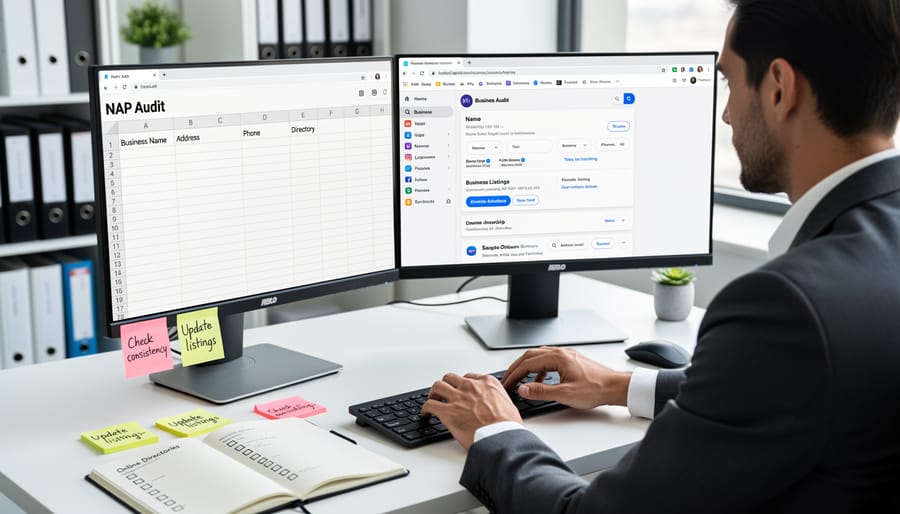
Creating Your Master NAP Record
Before fixing inconsistencies across the web, establish your official business information as the single source of truth. Start by documenting your exact business name as it appears on your legal documents and signage. For your address, use the format recognized by your local postal service, including suite numbers or floor designations if applicable. Your phone number should be the primary customer-facing line you want customers to call.
Create a simple document or spreadsheet containing this master NAP record, including your website URL, business hours, and categories. This becomes your reference guide for all future listings, citations, and marketing materials. Share this master record with your team, marketing agencies, and anyone who manages your online presence to prevent new inconsistencies from being created. Update this document immediately whenever legitimate business changes occur, such as moving locations or changing phone systems, then systematically update all existing citations to match.
Finding All Your Online Citations
Before fixing NAP inconsistencies, you need to know where your business appears online. Start with a Google search of your business name in quotes, then search for your phone number and address separately. This reveals listings you may have forgotten about.
Use free tools like Google Business Profile Manager, Bing Places, and Apple Maps Connect to check major platforms first. Social media profiles on Facebook, LinkedIn, and Instagram should also be on your audit list.
For comprehensive coverage, consider using citation tracking tools like Moz Local, BrightLocal, or Yext. These platforms scan hundreds of directories simultaneously and compile reports showing where your business is listed and which citations need attention.
Don’t overlook industry-specific directories relevant to your business type. A restaurant will appear on different sites than a law firm. Create a spreadsheet documenting every listing you find, including the URL, current NAP information, and login credentials for future updates.
Documenting Discrepancies
Create a simple spreadsheet to document every NAP inconsistency you discover during your audit. Record the platform name, current listing information, correct information, and the domain authority of each site. This systematic approach prevents you from missing corrections and helps you track progress over time.
Prioritize fixes based on platform authority and traffic potential. Start with high-authority sites like Google Business Profile, major data aggregators, and industry-specific directories that send actual customers your way. These corrections deliver the most immediate impact on your local search rankings and customer trust.
Include a status column to mark listings as pending, in progress, or completed. This transparency makes it easier to report progress to stakeholders and identify platforms that require follow-up. Regular documentation also reveals patterns in where inconsistencies originate, helping you prevent future issues.
Fixing and Maintaining NAP Consistency Efficiently
Manual Correction Strategy
Start with the directories that deliver the most value to your business. Google Business Profile should be your first priority—it’s the most visible platform for local searches and directly impacts your rankings. Next, tackle major data aggregators like Data Axle, Factual, and Localeze, since corrections here cascade to hundreds of smaller directories automatically.
Focus on industry-specific directories next. A restaurant should prioritize Yelp and OpenTable, while professional services need Avvo or Healthgrades. Check your Google Analytics to identify which directories actually send traffic and convert customers.
For businesses with limited resources, fix your top 10-15 citations first rather than attempting to correct everything at once. This targeted approach delivers measurable results quickly. Document each correction with screenshots and dates to track your progress and prevent future discrepancies.
Consider the manual correction phase as temporary. Once you’ve addressed high-priority listings, transition to automated monitoring tools that catch inconsistencies before they damage your local search visibility.
Automated Citation Management Solutions
Managing NAP consistency across dozens or even hundreds of online platforms manually is time-consuming and prone to errors. Automated citation management solutions solve this challenge by connecting to multiple directories simultaneously, allowing you to update your business information from a single dashboard.
These tools work by syncing your business data across major platforms like Google Business Profile, Yelp, Facebook, and industry-specific directories. When you need to change your phone number or update your address, you make the edit once, and the system propagates it across all connected listings. This eliminates the need to log into each platform individually and significantly reduces the risk of typos or missed updates.
Beyond basic updates, automation platforms provide real-time monitoring to detect inconsistencies as they occur. Many business owners discover that third-party data aggregators or user-submitted edits create discrepancies without their knowledge. Automated systems flag these issues immediately, allowing you to correct them before they impact your search rankings.
The time savings translate directly to cost savings. What might take your team hours or days to accomplish manually happens in minutes, freeing your resources to focus on customer service and business growth.

Ongoing Monitoring and Updates
NAP consistency requires ongoing attention, not just a one-time fix. Set up a quarterly review schedule to verify your business information across all platforms. Create a simple spreadsheet tracking every location where your NAP appears, making future audits faster and more systematic.
Implement an internal protocol requiring your team to report any business information changes immediately. When you move locations, change phone numbers, or rebrand, update all listings within 24 hours to minimize the window of inconsistency. Designate one person as the owner of this process to avoid confusion about responsibilities.
Consider using automated monitoring tools that alert you when discrepancies appear across directories. These systems can catch unauthorized edits or outdated information before they impact your search rankings. Many platforms offer bulk update features, allowing you to push changes across multiple directories simultaneously rather than manually updating each one.
Document your current NAP details in a central location accessible to your marketing team, ensuring everyone references the same standardized format when creating new listings or marketing materials.
Maintaining NAP consistency isn’t just about checking boxes for search engines. It’s a competitive advantage that directly impacts your visibility, customer trust, and revenue. When your business information appears accurately across every platform, you’re making it easier for customers to find and contact you while signaling credibility to both search engines and potential clients.
The key to sustainable NAP consistency lies in balancing critical manual work with smart automation. Conduct your initial audit thoroughly, prioritize fixing high-impact listings first, and then implement systems that maintain accuracy without requiring constant oversight. This approach frees your team to focus on growth while ensuring your local presence stays strong.
Start your NAP audit today. Export your current listings, compare them against your official business information, and identify discrepancies. Document every citation you find in a spreadsheet, noting which ones need corrections. Once you’ve completed your audit, prioritize fixing listings on major platforms like Google Business Profile, Bing Places, and industry-specific directories. Consider implementing automated monitoring tools to catch future inconsistencies before they impact your rankings. Your investment in NAP consistency will pay dividends through improved local search performance and increased customer conversions.
Leave a Reply