How Zero-Knowledge Proofs Protect Customer Privacy While Proving Your Ads Work

Zero-knowledge proofs solve a critical problem in digital advertising: proving your marketing campaigns drove conversions without exposing sensitive customer data or proprietary attribution methods. Think of it like proving you know the password to a vault without revealing the password itself—you demonstrate knowledge without transferring the actual information.
For marketing professionals, this matters because third-party cookies are disappearing and privacy regulations are tightening. Zero-knowledge proofs let you verify ad performance across platforms while keeping customer data encrypted and private. A practical example: when a customer clicks your ad and makes a purchase, zero-knowledge cryptography can confirm the attribution path to your advertising platform without revealing the customer’s identity, browsing history, or purchase details.
The technology works through mathematical proofs where one party (the prover) convinces another party (the verifier) that a statement is true without revealing any information beyond the validity of that statement. In ad attribution, your business becomes the prover, demonstrating to advertising platforms that conversions occurred from their traffic without exposing your customer database or conversion tracking methodology.
This approach protects your competitive advantage by keeping attribution logic proprietary while still enabling accurate campaign measurement. It also builds customer trust by limiting data exposure and maintains compliance with privacy laws that restrict data sharing between businesses. Understanding how zero-knowledge proofs function in real attribution scenarios helps you evaluate whether this emerging technology fits your marketing stack and privacy requirements.
What Zero-Knowledge Proofs Actually Mean for Your Ad Campaigns
Think of zero-knowledge proofs like this: imagine you need to prove to an advertiser that their campaign reached 10,000 qualified customers in their target demographic, but you can’t share individual customer data due to privacy regulations. A zero-knowledge proof lets you verify the campaign’s success without exposing any personal information about those customers.
In traditional ad attribution, platforms track users across websites, collecting detailed behavioral data to prove ad effectiveness. This approach creates privacy concerns and increasingly conflicts with regulations like GDPR and CCPA. Zero-knowledge proofs flip this model entirely.
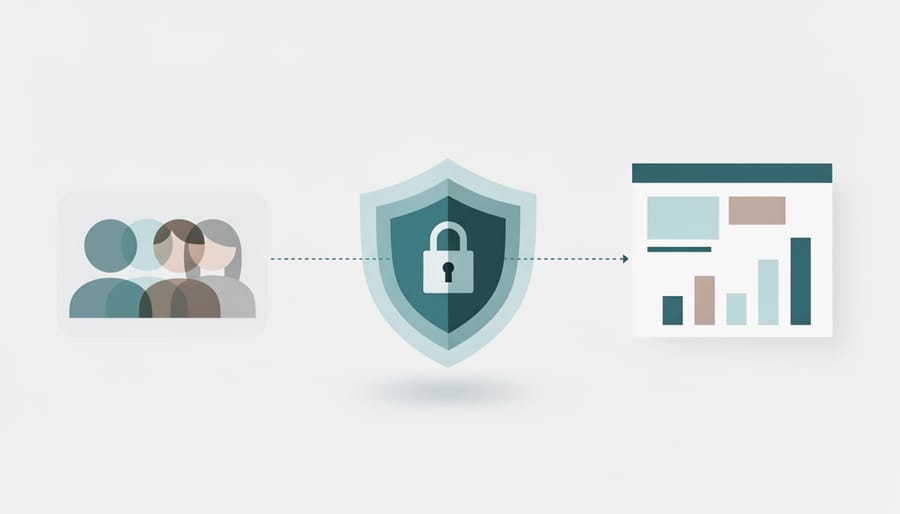
Here’s how it works in practice: when someone clicks your ad and makes a purchase, the system creates a mathematical proof that this conversion happened and meets specific criteria (right location, age range, purchase value) without revealing who that person is, what they bought, or where they live. The advertiser receives verified confirmation that their targeting worked, but the actual customer data remains encrypted and private.
This technology matters for your campaigns because it solves a growing problem. As third-party cookies disappear and privacy laws tighten, traditional tracking methods become less viable. Zero-knowledge proofs offer a path forward where you can still measure campaign performance, optimize your ad spend, and demonstrate ROI to stakeholders.
The practical benefit is straightforward: you maintain the ability to prove your marketing works while automatically staying compliant with privacy regulations. Your reporting stays accurate, your optimization continues, and your customer relationships remain trust-based. The verification happens through automated cryptographic processes, meaning you don’t need to understand the technical complexity to benefit from the protection it provides.
A Real-World Example: Proving Ad Conversions Without Exposing Customer Data
The Traditional Ad Attribution Problem
Traditional ad attribution systems require collecting and sharing detailed customer information across multiple platforms to track conversions. When a customer clicks your ad and makes a purchase, that journey typically involves cookies, tracking pixels, and third-party data brokers who compile comprehensive profiles of individual users.
This approach creates significant vulnerabilities. Customer browsing habits, purchase history, and personal information move between your website, advertising platforms, analytics tools, and numerous intermediaries. Each handoff represents a potential data breach point and privacy concern.
For your business, this means navigating increasingly strict regulations like GDPR and CCPA, which impose hefty fines for data mishandling. You’re also dealing with customer trust issues—studies show that 81% of consumers feel they’ve lost control over their personal data collected by companies.
The current system puts you in a difficult position: you need attribution data to optimize your marketing spend, but gathering that data exposes you to regulatory penalties and damages customer relationships. The more third parties involved in your attribution chain, the higher your risk and the less control you maintain over sensitive business intelligence.
The Zero-Knowledge Solution in Action
Let’s walk through how this technology works in a real customer journey. When someone clicks your Facebook ad and later purchases from your website, the process unfolds in three automated steps.
First, the proof generation occurs. The user’s browser creates a cryptographic commitment when they interact with your ad. Think of this as sealing their activity in an envelope that can’t be opened but can be mathematically verified. This happens instantly through AI-powered attribution systems running in the background, requiring zero effort from your customer or team.
Next comes the verification stage. When that same user completes a purchase, your attribution platform receives the sealed commitment. Rather than examining the user’s private browsing data, the system uses mathematical validation to confirm the customer encountered your ad before converting. The platform verifies the proof is legitimate without accessing personal information.
Finally, the attribution report generates automatically. Your dashboard displays that Facebook drove the conversion, giving you the insights needed for budget decisions. The customer’s privacy remains intact throughout this entire process.
This automated workflow eliminates the traditional trade-off between accuracy and privacy. Your marketing team receives reliable attribution data while customers maintain complete control over their information. The system handles the complex cryptographic operations behind the scenes, delivering clear, actionable insights without requiring technical expertise from your staff.
Why This Matters for Your Marketing ROI
Accurate Measurement Without Compromise
Zero-knowledge proofs solve a critical challenge that has plagued digital advertising for years: measuring campaign performance without exposing sensitive customer data. This technology enables your business to track conversions, attribute sales to specific ads, and optimize campaigns while keeping individual user information completely private.
Here’s how it works in practice. When a customer clicks your ad and makes a purchase, the zero-knowledge proof system confirms the conversion occurred without revealing the customer’s identity, browsing history, or personal details. Your analytics dashboard still shows which campaigns drive results, your return on ad spend calculations remain accurate, and you can make data-driven decisions about budget allocation.
The beauty of this approach is automation. Once implemented, these privacy-preserving measurement systems run continuously in the background, generating reliable attribution reports without manual intervention. You maintain the same level of insight you need to grow your business while building trust with customers who increasingly value their privacy. This isn’t about sacrificing data quality for compliance; it’s about achieving both simultaneously through smarter technology.

Building Trust That Converts
When customers know their privacy is protected, they’re more likely to engage with your ads and complete purchases. Research shows that 86% of consumers care about data privacy, and businesses that demonstrate genuine privacy protection see measurable improvements in conversion rates.
Zero-knowledge proof advertising builds this trust automatically. Unlike traditional tracking methods that collect and store personal data, ZKP systems verify user actions without exposing sensitive information. This means you can show customers relevant ads based on their behavior while proving you never accessed their private details.
The business impact is clear: privacy-first marketing approaches consistently outperform invasive tracking methods. Customers complete transactions 23% more often when they trust how their data is handled. They’re also more likely to opt into your marketing communications and become repeat buyers.
The automated nature of ZKP systems means this trust-building happens without additional effort from your team. The cryptographic proofs work behind the scenes, verifying attribution while maintaining privacy standards. You focus on creating compelling offers while the technology handles privacy compliance and verification, creating a seamless experience that converts browsers into buyers.
Current Platforms Using Zero-Knowledge Ad Attribution
Several forward-thinking platforms have already integrated zero-knowledge proofs into their ad attribution systems, demonstrating the practical viability of this technology for businesses of all sizes.
NYIAX, a financial technology platform for advertising, uses blockchain technology in advertising combined with zero-knowledge proofs to verify campaign performance without exposing sensitive user data. Their system allows advertisers to confirm conversion events occurred without accessing individual customer information, making it particularly valuable for industries with strict privacy requirements like healthcare and finance.
Brave Browser has implemented zero-knowledge proofs in its Basic Attention Token (BAT) advertising ecosystem. Advertisers can verify that users viewed their ads and engaged with content while users maintain complete anonymity. The platform automatically processes attribution without requiring manual data handling, significantly reducing administrative overhead for marketing teams.
AdEx Network offers a decentralized advertising platform where zero-knowledge proofs validate impressions and clicks without revealing user identities or browsing patterns. Their solution provides real-time attribution reports that businesses can integrate directly into existing marketing dashboards, eliminating the need for complex technical implementation.
For businesses exploring these options, start by evaluating which platform aligns with your current advertising channels. Most of these solutions offer trial periods or pilot programs that let you test the technology on a portion of your ad spend before full commitment.
The key advantage across all these platforms is automation. Once configured, zero-knowledge attribution runs continuously without requiring constant oversight, freeing your team to focus on strategy rather than data management. Additionally, these platforms typically provide clear client-facing reports that explain attribution results in business terms, making it easier to communicate ROI to stakeholders without technical complexity.
How to Prepare Your Marketing Stack for Privacy-First Attribution

Audit Your Current Attribution Methods
Before implementing zero-knowledge proofs, you need to understand what data you’re currently collecting and where privacy gaps exist. Start by documenting every tracking pixel, cookie, and analytics tool your business uses. List which customer behaviors each tool monitors—clicks, purchases, page views, email opens—and note what personal identifiers you’re capturing.
Next, map how this data flows through your systems. Which third parties receive customer information? Where does it get stored? Many businesses discover they’re sharing more data than necessary, creating compliance risks and eroding customer trust.
Check your attribution reports to identify gaps where user privacy settings block tracking. If you’re missing conversion data for 20-30% of users due to cookie restrictions, you’re likely making decisions with incomplete information. This directly impacts your ROI calculations and future campaign planning.
Review your current privacy policies against what you actually collect. Discrepancies here create legal exposure. Also examine how your tracking affects predictive customer modeling—incomplete data undermines forecasting accuracy.
Document these findings in a simple spreadsheet. You’ll use this audit to determine which attribution processes would benefit most from zero-knowledge proof implementation.
Identify Compatible Tools and Partners
When implementing privacy-preserving attribution, start by evaluating advertising platforms that natively support zero-knowledge proof technology. Major platforms like Google and Facebook are gradually integrating privacy-focused measurement tools, though you’ll need to verify their specific ZKP capabilities with your account representative.
For advanced marketing analytics, look for attribution software that explicitly mentions privacy-preserving computation or cryptographic attribution in their feature sets. Solutions like Clean Insights, Private Attribution API implementations, and enterprise platforms with differential privacy options are good starting points.
Key selection criteria include automated data processing capabilities that minimize manual intervention, transparent reporting that helps you communicate results to stakeholders, and compliance with current privacy regulations like GDPR and CCPA. Request proof-of-concept demonstrations focused on your specific use cases before committing.
Consider partnering with privacy-focused data cooperatives or attribution networks that aggregate anonymized data across multiple advertisers. This approach gives you benchmark insights while maintaining user privacy. Ensure any partner provides clear documentation on how their zero-knowledge systems work and offers dedicated support during implementation.
Implement Gradually Without Losing Data
Start by running zero-knowledge proof systems alongside your existing attribution platform rather than replacing everything at once. This parallel approach lets you verify accuracy while maintaining your current reporting structure. Begin with a single marketing channel or campaign to test the technology, comparing results between traditional and privacy-preserving methods.
Document your current attribution data format and establish clear mapping protocols before migration. Your team needs to understand how zero-knowledge proofs validate conversions without exposing individual user data, ensuring stakeholders recognize that aggregate insights remain intact even as the underlying technology changes.
Set up automated alerts to monitor discrepancies during the transition period. If your zero-knowledge system shows significantly different conversion counts, investigate immediately rather than assuming one system is wrong. Most differences stem from implementation details, not fundamental flaws.
Communicate timeline expectations with clients and internal teams. Zero-knowledge proof adoption typically requires 60-90 days for full deployment, giving everyone time to adjust to new reporting formats while maintaining confidence in your data accuracy throughout the process.
Zero-knowledge proofs aren’t just a theoretical concept or a distant future possibility. They represent the present and future of digital advertising, where protecting customer privacy and maintaining campaign performance work hand-in-hand rather than in opposition. As regulations continue to tighten globally and consumers become increasingly aware of their data rights, businesses that adopt privacy-preserving technologies now will have a significant competitive advantage.
The choice is straightforward: wait for regulations to force your hand, or proactively implement solutions that build customer trust while improving your attribution accuracy. Zero-knowledge proofs allow you to demonstrate compliance without sacrificing the insights you need to optimize your marketing spend and grow your business.
The good news is that you don’t need to become a cryptography expert or hire a team of developers to benefit from this technology. Automated implementation approaches make it possible to integrate zero-knowledge proof systems into your existing marketing infrastructure with minimal disruption. These solutions handle the complex technical details behind the scenes, allowing you to focus on what matters most: understanding your customers and refining your campaigns.
Start exploring zero-knowledge proof solutions today. Evaluate providers who offer automated setup and clear communication about how the technology protects your customers while delivering the attribution data you need. The businesses that embrace privacy-first advertising technologies now will be the ones leading their industries tomorrow.
Leave a Reply