What Is Machine Learning in Digital Marketing (and How Does It Work)?

Machine learning digital marketing refers to the application of artificial intelligence algorithms that analyze data, identify patterns, and make automated decisions to optimize marketing campaigns without constant human intervention. These systems learn from historical performance data to predict customer behavior, personalize content, and allocate budget more efficiently than manual methods.
Marketing teams that implement machine learning see measurable improvements in campaign performance because the technology processes volumes of data impossible for humans to analyze in real time. A retail brand running hundreds of ad variations across multiple platforms can use machine learning to automatically pause underperforming ads, increase spend on high-converting audiences, and adjust messaging based on customer segments, all while the marketing team focuses on strategy rather than spreadsheet management.
The practical value extends beyond automation. Machine learning identifies customer patterns you wouldn’t spot manually, like the subtle connection between browsing behavior on Tuesday afternoons and weekend purchases, or which email subject lines convert specific demographic groups. This insight turns into revenue when systems adjust targeting parameters, content recommendations, and bidding strategies automatically.
This article explains how machine learning functions within marketing operations, breaks down the main types of machine learning relevant to marketing teams, and provides specific use cases you can implement. You’ll understand which marketing challenges machine learning solves most effectively and how to evaluate whether your business is ready to adopt these tools. The focus stays on practical applications rather than technical complexity, helping you make informed decisions about integrating machine learning into your marketing operations in 2026.
What Is Machine Learning in Digital Marketing?
Machine learning in digital marketing is a branch of artificial intelligence that enables marketing systems to learn without explicit programming by analyzing historical data, identifying patterns, and making increasingly accurate predictions about customer behavior and campaign performance. Instead of following rigid, manually-coded rules, ML algorithms adapt and improve as they process more marketing data from your website traffic, ad campaigns, email sends, and social media interactions.
- Machine Learning
- The process by which computer systems automatically improve their performance on marketing tasks through experience and data analysis, without being explicitly programmed for every scenario.
- Training Data
- Historical marketing information that ML algorithms study to identify patterns, such as past campaign results, customer interactions, conversion rates, and engagement metrics.
- Predictive Analytics
- The use of ML models to forecast future marketing outcomes, including which leads are most likely to convert, what content will resonate with specific audiences, and when customers might churn.
- Algorithm Optimization
- The continuous process through which ML systems refine their decision-making rules based on actual results, automatically adjusting bidding strategies, content recommendations, and targeting parameters.
In practical terms, this means your marketing systems can automatically spot which ad creatives perform best with different audience segments, predict which email subject lines will drive opens, and adjust campaign spending in real-time based on conversion likelihood. The key difference from traditional marketing automation is that ML systems don’t just execute predefined workflows, they actively learn what works and what doesn’t, then apply those insights to optimize future decisions. This learning capability powers AI-enhanced performance tracking, where the system not only reports on metrics but interprets patterns, flags anomalies, and recommends specific actions to improve results.

How Machine Learning Works in Digital Marketing
Data Collection and Processing
Marketing data lives scattered across dozens of platforms, your website analytics, social media accounts, email service, CRM, ad networks, and customer databases all collect information independently. Machine learning systems start by connecting these disparate sources through APIs and integrations, pulling raw data into a centralized location where algorithms can actually work with it.
Once collected, ML preprocesses this information to make it usable. That means cleaning out duplicates, standardizing formats (so “New York” and “NY” are recognized as the same location), filling gaps in incomplete records, and tagging data points with relevant attributes. A single customer interaction might generate dozens of data points, timestamp, device type, referral source, pages viewed, time spent, actions taken.
The system then structures this processed data into formats algorithms can analyze: numerical values for metrics like engagement rates, categorical labels for audience segments, time-series sequences for behavior patterns. This organized dataset becomes the foundation for everything that follows, pattern recognition, predictions, and optimization decisions. Without proper collection and processing, even sophisticated ML models produce unreliable results.
Pattern Recognition and Prediction
Once your ML system has collected and organized marketing data, it begins identifying patterns that would be impossible for humans to spot manually. The algorithms analyze thousands of variables simultaneously, looking for correlations between customer actions, campaign elements, and conversion outcomes. For instance, an ML model might discover that users who view three specific blog posts within 48 hours are 4.2 times more likely to request a demo, or that social media engagement peaks exactly 19 hours after email opens for a particular segment.
This pattern recognition fuels predictive analytics enabling your marketing systems to forecast future behavior with increasing accuracy. The algorithms build models that predict which prospects will convert, which customers risk churning, and which campaigns will deliver the strongest ROI before you spend the budget. These predictions improve continuously as the system processes more data and validates its forecasts against actual outcomes.
ML also identifies emerging market opportunities by detecting shifts in search behavior, competitive positioning, and audience sentiment before they become obvious. This gives you a strategic advantage, allowing you to adjust messaging, reallocate budget, and refine targeting while competitors are still reacting to last month’s data.
Automated Optimization and Learning
Machine learning systems operate on continuous improvement cycles that require minimal human intervention. After analyzing campaign data and identifying patterns, ML algorithms automatically adjust bidding strategies, audience targeting parameters, and content delivery timing based on performance outcomes. Each adjustment creates new data points that feed back into the system, refining future decisions with increasing accuracy.
This feedback loop means your campaigns become more effective over time without constant manual tweaking. When an ML system detects that certain ad creatives perform better with specific audience segments at particular times, it automatically allocates more budget to those winning combinations. Poor-performing elements get reduced exposure or eliminated entirely. The system learns from both successes and failures, building a knowledge base that improves campaign efficiency while reducing wasted ad spend and freeing your team to focus on strategy and client relationships.
Types of Machine Learning in Digital Marketing
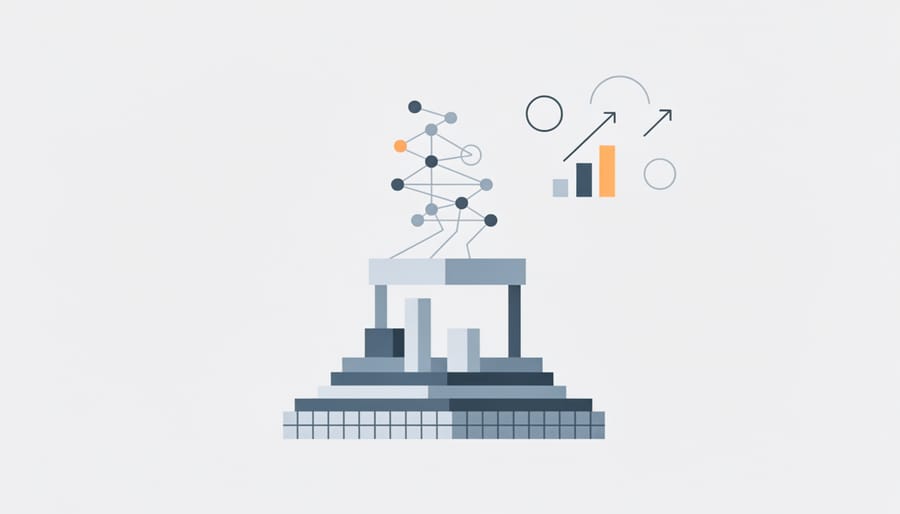
Supervised Learning Applications
Supervised learning powers many of digital marketing’s most valuable predictive tools by training algorithms on labeled historical data. When you feed an ML model thousands of past customer transactions tagged with conversion outcomes, it learns which characteristics predict purchases, allowing it to score new leads automatically.
Customer segmentation becomes far more sophisticated with supervised learning than traditional demographic grouping. The algorithm analyzes hundreds of behavioral signals, page visits, content engagement, session duration, purchase history, to classify customers into distinct value tiers or intent categories. This lets you allocate ad spend and personalize messaging for high-value segments without manually reviewing every customer profile.
Conversion prediction models examine past campaign data to forecast which landing page variations, ad creative, or email subject lines will drive the most conversions. You’re essentially automating the pattern recognition that experienced marketers develop over years, but at a scale that processes millions of data points instantly.
Email performance optimization uses supervised learning to predict open rates and click-through rates based on factors like send time, subject line structure, and recipient history. The system learns from each campaign, continuously refining its recommendations for subject lines, content length, and optimal delivery windows for different subscriber segments.
Unsupervised Learning Applications
Unsupervised learning excels at finding hidden patterns in marketing data without predefined labels or outcomes. Unlike supervised methods that need training examples, these algorithms explore data independently to reveal insights you might never have discovered manually.
Audience discovery represents one of the most powerful applications. The algorithm analyzes customer behavior, demographics, and engagement patterns to identify natural groupings within your audience. You might discover a segment of mobile-first users who engage primarily on weekends or a group that consistently abandons carts at a specific price point. These unexpected segments often become your most profitable targeting opportunities.
Content clustering helps organize large content libraries automatically. The system groups similar articles, products, or campaigns based on themes, performance characteristics, or user engagement patterns. This reveals which content types resonate with different audiences and highlights gaps in your content strategy.
Anomaly detection monitors campaign performance in real-time, flagging unusual patterns that deserve immediate attention. A sudden drop in conversion rates, unexpected traffic spikes from specific sources, or abnormal engagement patterns all trigger alerts. This early warning system prevents small issues from becoming costly problems while identifying positive anomalies worth replicating across other campaigns.
Reinforcement Learning Applications
Reinforcement learning operates through a trial-and-error system where algorithms learn optimal marketing actions by testing different approaches and measuring their outcomes. This continuous feedback loop makes it particularly effective for situations requiring real-time decisions and ongoing strategy adjustment.
In dynamic bidding, reinforcement learning algorithms adjust bid amounts across advertising platforms based on conversion probability, competition levels, and campaign budget constraints. Rather than following fixed rules, these systems learn which bid adjustments yield the best return on ad spend under changing market conditions. The algorithm tests various bid strategies, observes performance results, and refines its approach to maximize conversions while controlling costs.
Real-time ad placement optimization uses similar principles to determine the most effective channels, formats, and timing for displaying ads to specific users. The system evaluates placement performance across multiple touchpoints and shifts budget toward opportunities with the highest predicted engagement rates.
For personalized content delivery, reinforcement learning determines which messages, offers, or product recommendations resonate with individual users based on their browsing patterns and past interactions. The algorithm continuously tests content variations, measures engagement responses, and adapts its recommendations to improve click-through rates and conversions over time.
Practical Uses of Machine Learning in Digital Marketing
AI-Enhanced Performance Tracking
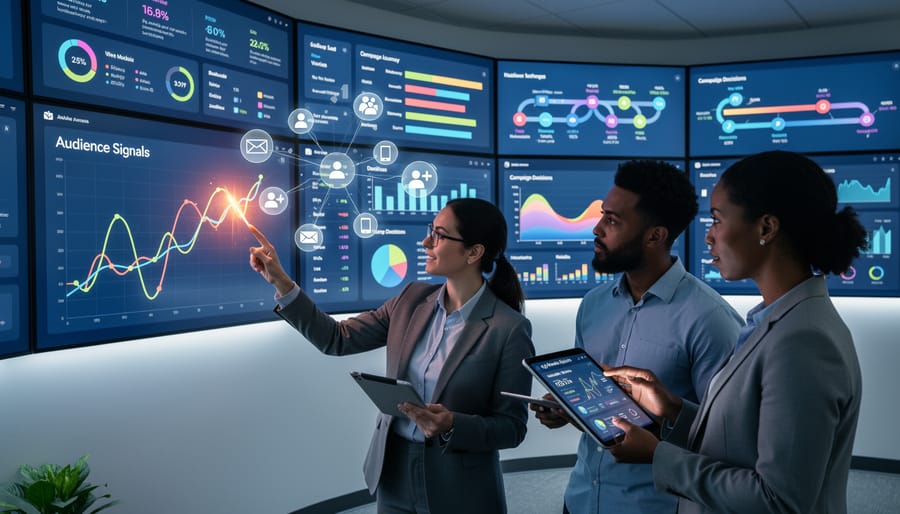
Machine learning transforms raw marketing data into strategic intelligence through real-time analytics dashboards that monitor performance across every channel simultaneously. Instead of manually compiling reports from Google Analytics, social platforms, and email tools, ML systems aggregate metrics automatically and identify patterns human marketers might miss.
These systems track AI-powered KPIs that matter most to your business goals, from conversion rates and customer acquisition costs to engagement metrics and revenue attribution. When campaign performance dips or spikes, ML algorithms flag the change immediately and correlate it with specific variables like audience segments, content types, or timing.
The real advantage comes from predictive trend analysis. ML doesn’t just report what happened last week; it forecasts where your campaigns are headed based on historical patterns and current trajectory. This allows you to adjust budgets, messaging, or targeting before underperformance becomes costly.
AI journey mapping takes this further by connecting touchpoint data to reveal how customers actually move through your funnel. You’ll see which content drives conversions, where prospects drop off, and what sequence of interactions leads to sales. This visibility turns guesswork into data-backed decisions, letting you allocate resources to the channels and tactics that demonstrably work.
Automated Campaign Optimization
Machine learning excels at handling the repetitive optimization tasks that consume hours of a marketer’s day. Instead of manually adjusting bids, testing ad copy variations, or reallocating budgets across channels, ML algorithms perform these adjustments continuously based on performance data. The system monitors campaign metrics in real-time, identifies underperforming elements, and implements corrections without human intervention.
For PPC optimization ML analyzes thousands of data points, click-through rates, conversion patterns, audience demographics, time-of-day performance, to adjust bids automatically and maximize return on ad spend. Email campaigns benefit similarly: algorithms determine optimal send times, subject line variations, and content formats for different subscriber segments. Social media scheduling tools use ML to identify when your audience is most engaged, posting content at peak moments.
This automation doesn’t replace strategic thinking; it enhances it. By eliminating manual, time-intensive tasks, marketers gain capacity for high-value activities: developing creative campaigns, analyzing market opportunities, refining messaging strategy, and strengthening client relationships. The machine handles the grunt work while you focus on the decisions that actually move the needle.
Personalization at Scale
Machine learning makes it possible to deliver personalized experiences to thousands of customers simultaneously, something impossible with manual segmentation alone. ML algorithms analyze individual user behavior, purchase history, browsing patterns, and engagement data to create dynamic customer profiles that evolve in real time.
This technology powers personalized email subject lines that adapt to each recipient’s interests, product recommendation engines that suggest items based on similar customer purchases, and website content that adjusts according to visitor behavior. Rather than creating separate campaigns for broad demographic groups, ML identifies micro-segments and delivers relevant messaging automatically.
The result is higher engagement rates, improved conversion metrics, and stronger customer relationships. ML handles the complexity of matching the right message to the right person at the right moment, allowing your team to focus on creative strategy and overall campaign direction rather than manual personalization tasks.
Predictive Customer Insights
Machine learning excels at predicting which customers are likely to convert, when they might leave, and what their long-term value could be. ML models analyze past purchase patterns, browsing behavior, and engagement history to forecast future actions with surprising accuracy. These predictions let you intervene before a valuable customer churns, allocate marketing spend to high-lifetime-value prospects, and time your outreach when customers are most receptive. Instead of treating everyone the same, you can prioritize resources where they’ll have the greatest impact. This data-driven foresight transforms guesswork into strategic decisions, helping you build campaigns around what customers will do next rather than just what they’ve done before.
Implementing Machine Learning in Your Marketing Strategy
Start by auditing your existing marketing data. Machine learning performs only as well as the information you feed it, so identify which channels generate clean, consistent data streams, website analytics, email engagement metrics, CRM records, and ad platform performance. If your data sits in disconnected silos or lacks basic hygiene (duplicate contacts, incomplete tracking), fix those issues before investing in ML tools.
Choose one specific problem to solve first rather than attempting a full-scale transformation. Struggling with email send-time optimization? Pick an ML-powered email platform that handles that task. Need better ad spend allocation across channels? Test a bidding automation tool for a single campaign. Small wins build internal confidence and reveal how ML fits your workflow without overwhelming your team.
Set realistic timelines, most ML systems need at least three to six months of data to produce reliable patterns and meaningful improvements. During this learning period, monitor results weekly but avoid making judgments based on short-term fluctuations. Communicate these expectations to clients upfront, explaining that automated optimization builds momentum over time rather than delivering instant transformation.
Balance automation with human judgment throughout implementation. ML excels at processing data and executing repetitive optimization tasks, freeing your team to focus on strategy, creative development, and client relationships. Schedule regular reviews where you examine ML recommendations before they deploy, especially for budget shifts or messaging changes that affect brand perception. This oversight ensures the technology serves your marketing goals rather than dictating them.
Prioritize tools that offer transparency into their decision-making process. Black-box systems that automate without explanation make it impossible to learn from their actions or explain results to clients. Look for platforms that show which data points influenced their recommendations and allow manual overrides when needed. This approach also aligns with ethical AI practices, ensuring your marketing automation respects customer privacy and maintains accountability.
Measure specific outcomes tied to business goals, conversion rate improvements, cost per acquisition reductions, customer lifetime value increases, rather than just tracking that your ML tools are running. Share these concrete results with clients in your regular performance reports, connecting automated optimizations to the outcomes that matter for their business growth.
Types or components
Machine learning in digital marketing consists of three fundamental components that work together to power intelligent automation and optimization.
Algorithms form the mathematical foundation, processing marketing data to identify patterns and make predictions. Common algorithms include decision trees for customer segmentation, neural networks for image recognition in social campaigns, and regression models for conversion forecasting. The algorithm you choose depends on your specific marketing challenge and available data.
Training Data fuels the learning process. This includes historical campaign performance, customer behavior metrics, transaction records, website interactions, and engagement patterns. Quality matters more than quantity, clean, relevant data produces more accurate predictions than massive datasets filled with noise or inconsistencies.
Feedback Loops enable continuous improvement. As ML systems make predictions and recommendations, they monitor actual outcomes against expected results. When predictions miss the mark, the system adjusts its parameters to improve future accuracy. This self-correcting mechanism means your marketing intelligence grows stronger over time, automatically adapting to changing customer preferences and market conditions without constant manual recalibration.
Machine learning has fundamentally changed how businesses approach digital marketing, moving beyond basic automation to deliver truly intelligent, data-driven campaigns. By continuously analyzing performance data and optimizing strategies in real time, ML empowers marketers to achieve results that manual processes simply cannot match. The technology handles repetitive analytical tasks with speed and precision, freeing your team to focus on creative strategy, client relationships, and high-level decision-making.
The most successful implementations strike a careful balance. While ML excels at processing vast amounts of data and identifying optimization opportunities, the human element remains essential. Your expertise in understanding client goals, interpreting context, and communicating insights creates value that no algorithm can replicate. Use machine learning as a powerful tool to enhance your capabilities, not as a replacement for the strategic thinking and personal touch that build lasting client partnerships.
Do I need technical expertise to use machine learning in marketing?
No, most modern ML-powered marketing tools are designed for non-technical users with intuitive interfaces. You can leverage powerful algorithms through platforms like Google Ads, Meta Ads Manager, and marketing automation software without writing code or understanding complex mathematics. These tools are particularly effective for implementing B2B marketing strategies at scale.
How much data is needed to start using machine learning?
The minimum varies by application, but many ML tools can provide value with a few thousand data points. For basic optimization tasks like email send-time prediction, you might see results within weeks, while more complex applications benefit from several months of historical data.
What’s the typical ROI timeline for machine learning investments?
Most businesses see measurable improvements within three to six months of implementation. Initial gains often come from automated bid optimization and audience targeting, with compounding benefits as the algorithms learn from more data over time.
Can small businesses benefit from machine learning tools?
Absolutely. Many affordable and even free ML-powered tools exist specifically for small businesses, from email marketing platforms with predictive analytics to social media management tools with automated content optimization.
Looking ahead, machine learning will only become more integral to marketing success. As algorithms grow more sophisticated and accessible, businesses that embrace this technology while maintaining their focus on authentic client communication will gain a significant competitive advantage. Start small, measure your results, and scale your ML investments as you see tangible improvements in performance and efficiency.
Leave a Reply