What Is AI-Powered Email Marketing (and How Does It Work)?

AI-powered email marketing uses machine learning and automation to personalize, optimize, and send email campaigns based on customer behavior, preferences, and predicted actions, with minimal manual intervention.
For most businesses in 2026, email remains one of the highest-ROI marketing channels. But the traditional approach of crafting a single message, segmenting a list manually, and hitting send no longer cuts it. Customers expect personalized experiences, not batch-and-blast campaigns. AI bridges this gap by analyzing patterns in customer data that would take a human team weeks to uncover, then automatically adjusting subject lines, send times, content, and audience segments to match what each recipient is most likely to engage with.
The difference between traditional email automation and AI-powered email marketing comes down to adaptability. Standard automation follows the rules you set: if a customer clicks this link, send that email. AI goes further by learning which rules work best, predicting what a customer will do next, and refining its approach with each campaign. This means your email program improves over time without requiring constant manual tweaks.
This article explains how AI-powered email marketing actually works under the hood, breaks down the key capabilities you’ll encounter in most platforms, shows real-world applications across different business types, and walks you through what to evaluate when choosing a solution. Whether you’re a small business owner looking to automate client communication or a marketing professional tasked with improving campaign performance, understanding these fundamentals will help you decide if AI belongs in your email strategy.
What AI-Powered Email Marketing Means for Your Business
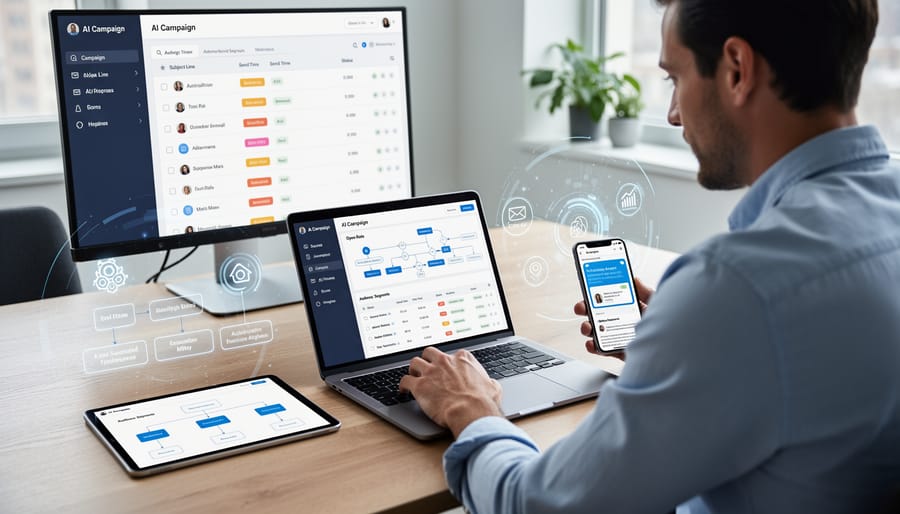
AI-powered email marketing uses artificial intelligence to analyze customer data, predict behaviors, and personalize email campaigns automatically. Unlike traditional email automation, which sends pre-written messages based on simple triggers like “three days after signup”, AI systems actively learn from how recipients interact with your emails and adjust content, timing, and targeting in real time.
- AI-Powered Email Marketing
- Email campaigns that use artificial intelligence to analyze customer behavior, predict preferences, and automatically optimize content, timing, and targeting for each recipient.
- Machine Learning
- A type of AI that improves automatically through experience, learning from data patterns to make increasingly accurate predictions without being explicitly programmed for each scenario.
- Predictive Analytics
- The use of historical data and AI algorithms to forecast future customer actions, such as likelihood to purchase, unsubscribe, or engage with specific content.
- Dynamic Personalization
- Automatically customizing email content for each recipient based on their behavior, preferences, and predicted interests rather than sending identical messages to everyone.
For your business, this means machine learning handles the repetitive work of segmenting audiences, testing subject lines, and determining optimal send times. Instead of manually creating dozens of email variations or guessing when customers want to hear from you, the AI analyzes patterns across thousands of interactions. It identifies which customers respond to discount offers versus educational content, who prefers morning emails versus evening ones, and which products a customer is likely to purchase next based on their browsing history.
This frees your team to focus on strategic decisions and building genuine client relationships. You set the goals and brand voice; AI ensures each recipient gets the most relevant version of your message at the right moment.
How AI-Powered Email Marketing Works
Data Collection and Analysis
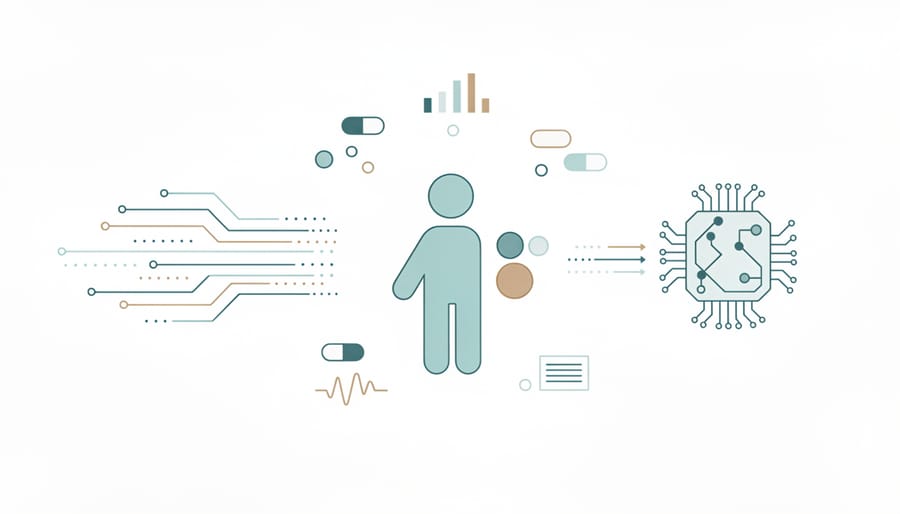
AI email marketing platforms continuously collect data from every interaction a subscriber has with your business. When someone opens an email, clicks a link, abandons a cart, or completes a purchase, the system logs that behavior and adds it to their profile.
This data comes from multiple sources: email engagement metrics, website activity tracked through cookies or pixels, purchase records from your e-commerce platform, and CRM interactions. The AI doesn’t just store this information, it analyzes patterns across thousands of data points to identify what content, products, and timing resonate with each person.
For example, if a customer consistently opens emails about accounting software on Tuesday mornings and clicks pricing links but never purchases, the AI recognizes this as a high-intent research pattern. It assigns behavioral tags and adjusts future messaging accordingly, perhaps triggering a case study or customer testimonial rather than another product feature list.
The system updates these profiles in real time. Each new interaction refines what the AI knows about preferences, purchase stage, and engagement likelihood, creating an increasingly accurate picture of how to communicate with that specific customer.
Automated Personalization and Optimization
Once AI has built those detailed customer profiles, it puts them to work through sophisticated personalization engines that operate continuously without manual intervention.
The system starts by customizing subject lines based on what has historically worked for each recipient. If a customer responds better to questions, they get questions. If another prefers direct statements about discounts, that’s what they see. The same logic applies to email body content, AI adjusts messaging tone, product focus, and imagery based on individual engagement patterns.
Product recommendations work similarly. The algorithms analyze purchase history, browsing behavior, and similar customer segments to suggest items each person is most likely to buy. This goes beyond basic “you might also like” suggestions to predict needs before customers actively search.
Send-time optimization ensures emails arrive when each recipient is most likely to open them. AI tracks when individuals typically engage with emails and schedules delivery accordingly, morning for some, evening for others.
The real power emerges in the feedback loop. After every campaign, AI measures what worked and what didn’t for each segment, then applies those lessons to the next send. Click-through rates improve, conversion rates climb, and the system gets smarter with every interaction, all while you focus on broader strategy rather than manual adjustments.
Core AI Email Marketing Capabilities
Modern AI email platforms pack several powerful capabilities that work together to automate routine tasks while sharpening your marketing results. Here’s what these tools actually do for your business:
- Predictive segmentation: Groups contacts based on behavior patterns and predicted actions rather than static demographics, identifying who’s likely to buy, churn, or engage.
- Dynamic content blocks: Swaps in personalized product images, copy, and offers for each recipient based on their profile and preferences, all within a single email template.
- Behavioral triggers: Automatically sends targeted messages when customers take specific actions like abandoning a cart, browsing a category, or reaching a milestone.
- Send-time optimization: Analyzes when individual subscribers typically open emails and schedules delivery to hit their inbox at peak engagement moments.
- A/B testing automation: Continuously tests subject lines, content variations, and calls-to-action, then automatically sends the winning version to your full list.
- AI copywriting assistance: Generates subject line options, body copy variations, and calls-to-action based on your campaign goals and past performance data.
These capabilities work in combination. Predictive analytics might identify that a segment of customers typically purchases within 48 hours of browsing your site. The platform then triggers a behavioral email with dynamic content showing the exact products they viewed, sent at their optimal engagement time, with a subject line the system already tested and validated.
The real value comes from layering these features. A single campaign can use predictive segmentation to identify high-intent prospects, behavioral triggers to send at the right moment, dynamic content to personalize the offer, and send-time optimization to maximize opens, all running without manual intervention.
Most platforms let you deploy these capabilities incrementally. Start with behavioral triggers for abandoned carts or welcome sequences, then add predictive segmentation once you have baseline data. As your comfort grows, layer in dynamic content and copywriting assistance. This staged approach through AI analytics and automation lets you measure impact at each step rather than overwhelming your team with too many changes at once.
The key is that these aren’t separate tools, they’re interconnected systems that learn from every campaign, constantly refining their predictions and improving performance without requiring you to manually analyze reports or adjust settings.
Practical Applications: How Businesses Use AI Email Marketing

Customer Retention and Re-engagement
AI email marketing systems monitor customer activity patterns to spot warning signs before you lose them. When someone who typically opens emails weekly goes silent for two weeks, or a regular buyer hasn’t purchased in their usual timeframe, the AI flags them as at-risk and triggers a personalized re-engagement sequence.
These automated win-back campaigns adapt to each customer’s history. A lapsed subscriber might receive content highlighting features they previously engaged with, while an inactive buyer gets product recommendations based on past purchases with a limited-time incentive. The AI tests different subject lines, timing, and offers to determine what resonates with each segment.
The system learns from responses, refining its approach for future campaigns. If discount codes work better than educational content for one customer group, it adjusts automatically. This means your retention efforts improve continuously without manual campaign management, recovering revenue that would otherwise walk away.
Product Recommendations and Upselling
AI analyzes what customers buy, browse, and click to predict what they’ll want next. Instead of sending the same product suggestions to everyone, the system generates personalized recommendations for each recipient based on their unique behavior patterns.
When a customer purchases running shoes, AI might suggest compression socks or fitness trackers in a follow-up email. For someone who browsed winter coats but didn’t buy, the system can trigger an email featuring similar styles at different price points or complementary accessories.
The technology tracks timing patterns too, sending supplement restock reminders before customers run out, or suggesting seasonal upgrades at optimal intervals. It identifies cross-sell opportunities automatically: customers who bought a camera receive lens recommendations; buyers of skincare products see complete routine suggestions.
This behavioral targeting increases average order value without manual segmentation work. The AI continuously tests which product combinations convert best, refining recommendations as it learns from customer responses across thousands of interactions.
Lead Nurturing and Scoring
Lead nurturing used to mean manually tracking which prospects opened emails and guessing when to follow up. AI changes that completely. Modern systems monitor every interaction, email opens, link clicks, content downloads, website visits, and assign numerical scores based on buying signals. When a prospect downloads a pricing guide and visits your testimonials page twice in one week, the AI recognizes high intent and automatically moves them into a more sales-focused sequence.
The real advantage comes from timing and relevance. Instead of sending the same five-email sequence to everyone, AI adapts the content path based on behavior. A prospect who engages with technical documentation gets implementation guides, while someone focused on case studies receives customer success stories. The system adjusts send frequency too, backing off when engagement drops and accelerating when interest peaks. This keeps leads warm without overwhelming them, and it happens automatically while your team focuses on closing the deals AI surfaces as sales-ready.
Benefits of Automating Your Email Marketing with AI
The most compelling reason to automate your email marketing with AI isn’t technological sophistication, it’s the measurable impact on your business outcomes and daily operations. When you shift from manual email campaigns to AI-powered automation, you’re not just adopting new software; you’re fundamentally changing how efficiently you communicate with customers while improving the quality of those interactions.
- Time savings of 5-15 hours per week on campaign setup, segmentation, and scheduling tasks that AI handles automatically
- Engagement rate improvements of 20-40% through optimized send times and personalized subject lines
- Conversion rate increases of 10-25% from behavioral triggers and relevant product recommendations
- Deliverability improvements as AI learns which content and sending patterns avoid spam filters
- Error elimination in segmentation, personalization tags, and send timing that commonly plague manual campaigns
- Scalability to personalize thousands of emails without hiring additional team members
These improvements directly affect your bottom line. Businesses tracking AI marketing ROI consistently report that email automation delivers some of the highest returns of any marketing technology investment, typically paying for itself within 90 days through increased revenue and reduced labor costs.
Beyond the numbers, AI automation frees your team to focus on strategic work, developing compelling offers, refining your brand voice, analyzing customer feedback, rather than manually segmenting lists or scheduling sends. You gain deeper customer insights from AI analytics that reveal patterns human analysis would miss, allowing you to make smarter decisions about product development, pricing, and messaging. The combination of efficiency gains and performance improvements makes AI-powered email marketing one of the most practical automation investments for businesses of any size.
Getting Started: What to Look for in AI Email Marketing Tools
Choosing an AI email marketing platform doesn’t require technical expertise, you need tools that integrate smoothly with your existing systems and deliver results without adding complexity to your workflow.
Start by checking compatibility. The best platform connects seamlessly with your CRM, e-commerce system, and other marketing tools you already use. Look for native integrations rather than workarround solutions that create data silos or require constant manual updates.
Ease of use matters more than feature count. A platform with dozens of AI capabilities won’t help if your team can’t navigate it. Test the interface during a trial period: Can you build an automated sequence in under ten minutes? Are the AI recommendations clear and actionable? Does the dashboard show you what matters without requiring a data science degree to interpret?
Evaluate automation features against your actual needs. Predictive segmentation and send-time optimization deliver immediate value for most businesses. Advanced copywriting assistance and dynamic content generation are powerful but may be overkill if you’re just starting out. Choose a platform that lets you activate features as you grow.
Reporting quality separates useful tools from vanity metric generators. You need clear attribution showing which AI-powered campaigns drove conversions, not just open rates. The platform should explain why it made specific recommendations and what happened when you followed them.
Scalability ensures you won’t outgrow the system in six months. Check pricing tiers, contact limits, and whether advanced features become available as your list expands. Confirm the vendor follows ethical AI practices around data handling and customer privacy.
Support matters during implementation and beyond. Look for platforms offering onboarding assistance, template libraries to accelerate your first campaigns, and responsive customer service when questions arise.
Common Questions About AI Email Marketing
AI email marketing raises practical questions for business owners evaluating whether to adopt these tools. Here are answers to the most common concerns.
Is AI email marketing suitable for small businesses?
Yes, AI email marketing works for businesses of any size. Most platforms offer tiered pricing that scales with your subscriber list, and the time savings from automation often justify the investment even for small teams.
How much does AI email marketing typically cost?
Pricing varies widely from $15-50 per month for basic AI features on small lists to $300+ monthly for advanced platforms serving larger audiences. Many tools include AI capabilities in their standard plans rather than charging separately for automation.
Does AI replace human creativity in email marketing?
No, AI handles data analysis and repetitive optimization tasks while humans control strategy, brand voice, and creative direction. The technology enhances rather than replaces human judgment and creativity.
How long does it take to see results from AI email marketing?
Most businesses notice improved open rates and engagement within 2-4 weeks as the AI learns from initial campaigns. Significant revenue impact typically appears after 2-3 months once the system accumulates enough behavioral data.
What data privacy considerations apply to AI email marketing?
You must comply with regulations like GDPR and CAN-SPAM, obtaining proper consent before collecting data and providing clear opt-out options. Reputable platforms include built-in compliance features and data protection safeguards.
Beyond these specific questions, consider that AI email marketing requires an initial learning period. The system needs time to gather behavioral data and identify patterns before it can deliver optimal personalization. Starting with a single AI feature, such as send-time optimization or predictive segmentation, allows you to measure impact before expanding to more advanced capabilities.
The technical barrier is lower than many business owners expect. Modern platforms handle the complex mathematics behind the scenes, presenting results through intuitive dashboards that focus on actionable insights rather than raw data. You don’t need a data science background to benefit from AI-powered automation.
AI-powered email marketing isn’t about replacing your marketing team or removing the human touch from customer relationships. It’s about removing the grunt work, data analysis, manual segmentation, send-time guesswork, so you can focus on strategy, creativity, and building genuine connections with your customers.
The results speak for themselves: higher open rates, better engagement, increased conversions, and more time for the work that actually grows your business. You’re not just sending more emails; you’re sending smarter emails that arrive at the right moment with content that resonates.
Start small. Pick one AI capability, maybe predictive send-time optimization or automated product recommendations, and test it against your current approach. Measure the difference. Learn what works for your audience. Then expand from there.
You don’t need a massive budget or a technical team to benefit from AI email marketing. Most modern platforms make these features accessible with minimal setup. What you do need is a willingness to let automation handle the repetitive tasks while you maintain control over your brand voice, messaging strategy, and customer relationships. That’s where the real value lives.
Leave a Reply