Product Life Cycle Marketing: Perfect Your Strategy at Every Stage

Master your product’s journey through the market with a deep understanding of the 5 critical life cycle stages – introduction, growth, maturity, saturation, and decline. Each stage demands distinct marketing strategies, resource allocation, and pricing decisions that can make or break your product’s success. Smart business leaders anticipate and adapt to these transitions, transforming potential challenges into competitive advantages.
Studies show that products moving strategically through these stages generate 35% higher ROI compared to those managed reactively. From startups launching innovative solutions to established brands maintaining market dominance, knowing exactly where your product stands in its lifecycle enables data-driven decisions that maximize profitability at every phase.
This comprehensive guide breaks down each stage’s key characteristics, warning signs, and proven tactics to optimize your product’s performance. Whether you’re preparing for a product launch or managing a mature offering, these insights will help you navigate market dynamics with confidence and precision.

Introduction Stage: Building Market Awareness
Marketing Tactics for New Products
When introducing new products to the market, implementing targeted marketing tactics is crucial for building market awareness and generating initial sales momentum. Start by conducting thorough market research to understand your target audience’s needs and preferences. This information will help shape your messaging and channel selection.
Focus on educational content that highlights your product’s unique value proposition and addresses specific pain points. Leverage social media platforms, email marketing, and content marketing to create buzz around your launch. Consider offering early-bird discounts or exclusive preview access to build anticipation and secure early adopters.
Influencer partnerships and product demonstrations can help establish credibility and reach wider audiences. Implement a mix of paid advertising across relevant channels while maintaining consistent organic presence through SEO-optimized content and social media engagement.
Track key performance indicators such as website traffic, conversion rates, and customer feedback to optimize your marketing strategy. Consider implementing a referral program to encourage word-of-mouth marketing and accelerate market penetration. Remember to allocate sufficient budget for testing different marketing channels and messages to identify what resonates best with your target audience.
Key Performance Metrics
During the introduction phase, tracking specific key performance metrics is crucial for gauging your product’s market reception and adjusting strategies accordingly. Sales volume and revenue are fundamental indicators, but they shouldn’t be your only focus. Customer acquisition cost (CAC) helps determine the efficiency of your marketing efforts, while conversion rates highlight the effectiveness of your sales funnel.
Market penetration rate measures how quickly your product is gaining traction in your target market. Monitor this alongside brand awareness metrics, including social media mentions, website traffic, and search volume for your product name. Customer feedback and satisfaction scores provide valuable insights into product-market fit and potential improvements.
Distribution metrics, such as retail placement rates and channel performance, help optimize your product’s availability. Keep a close eye on inventory turnover rates to maintain optimal stock levels without overcommitting resources. Additionally, track your marketing ROI across different channels to identify the most effective promotional strategies.
For digital products, user engagement metrics like activation rates, time spent using the product, and feature adoption rates are essential. These indicators help predict long-term success and identify areas needing improvement early in the product lifecycle.
Growth Stage: Scaling Your Market Presence
Competitive Positioning Strategies
In today’s competitive marketplace, businesses must employ strategic positioning tactics throughout each lifecycle stage to maintain their market share and profitability. During the introduction phase, focus on differentiation through unique features and innovative solutions that set your product apart from existing alternatives. As growth accelerates, strengthen your market position by expanding distribution channels and optimizing pricing strategies to defend against new entrants.
In the maturity stage, concentrate on brand loyalty programs and product improvements to retain customers while monitoring competitor movements closely. Consider implementing value-added services or complementary products to maintain your competitive edge. During saturation, explore market segmentation opportunities and adjust your positioning to target specific customer niches that offer the best profit potential.
When facing decline, evaluate whether to harvest remaining profits, reinvigorate the product through substantial innovation, or plan a strategic exit. Throughout all stages, regularly analyze competitor activities, market trends, and customer feedback to adjust your positioning strategy accordingly. Remember that successful positioning requires a balance between maintaining your current market share and adapting to evolving customer needs and competitive pressures.
Growth-Phase Marketing Metrics
During the growth phase, tracking specific marketing metrics becomes crucial for maintaining momentum and maximizing market opportunities. Sales volume typically shows a steady upward trend, with month-over-month growth rates often exceeding 20%. Market share expansion becomes a key indicator, measured through both absolute market share percentage and relative share compared to competitors.
Customer acquisition costs (CAC) should begin to decrease as brand awareness grows and marketing efficiency improves. The ideal scenario shows CAC dropping by 15-25% compared to the introduction phase. Meanwhile, customer lifetime value (CLV) typically increases, creating a more favorable CLV-to-CAC ratio.
Brand awareness metrics, including social media engagement, website traffic, and search volume, should show consistent growth. Marketing teams should monitor conversion rates across all channels, with successful growth-phase products typically achieving conversion rates 30-50% higher than during the introduction phase.
Distribution channel performance becomes increasingly important, with metrics focusing on channel penetration rates and sell-through velocities. Monitor inventory turnover rates and ensure they align with demand forecasts. Customer feedback metrics, including Net Promoter Score (NPS) and customer satisfaction ratings, should maintain positive trajectories, ideally above industry averages.
Maturity Stage: Maintaining Market Share
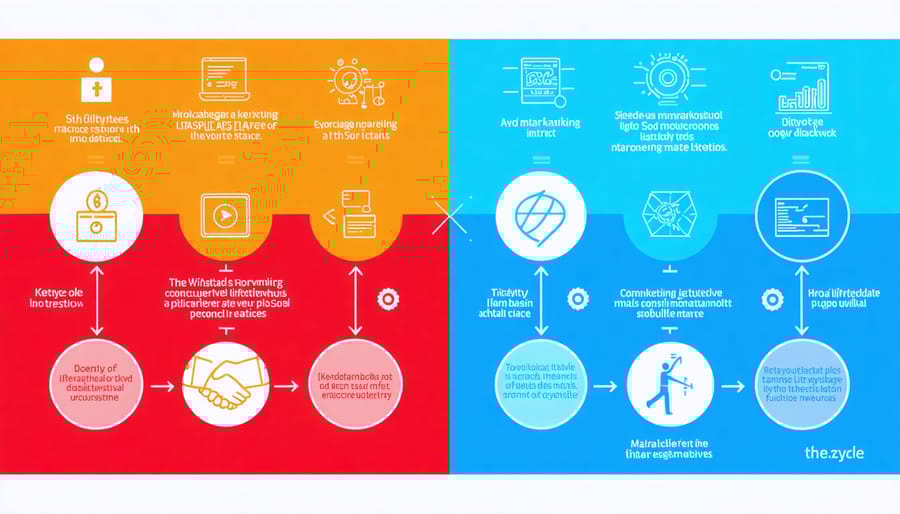
Brand Differentiation Tactics
In today’s competitive marketplace, standing out from competitors requires strategic differentiation throughout the product life cycle. Start by conducting thorough market research to identify gaps in competitor offerings and unmet customer needs. Focus on developing unique value propositions that highlight your product’s distinct advantages and benefits.
Consider implementing premium pricing strategies if your product offers superior quality or innovative features. Alternatively, penetration pricing can help capture market share in highly competitive segments. Build strong brand associations through consistent messaging across all marketing channels and leverage customer testimonials to build credibility.
Invest in exceptional customer service as a key differentiator, especially during mature product stages. Create personalized experiences through customization options and targeted communication. Develop strategic partnerships that complement your offering and provide additional value to customers.
Embrace innovation in your marketing approach by utilizing emerging channels and technologies. Consider implementing loyalty programs to reward customer engagement and maintain market position. Regular customer feedback collection helps identify areas for improvement and opportunities for product enhancement.
Remember that successful brand differentiation requires continuous monitoring of market trends and competitor activities, allowing you to adapt strategies quickly as market conditions change.
Customer Retention Focus
In this crucial stage, businesses must focus on implementing effective customer retention strategies to maintain market share and protect against competitive threats. Start by establishing a robust customer feedback system through surveys, social media monitoring, and direct communication channels. This helps identify pain points and areas for product improvement while demonstrating commitment to customer satisfaction.
Implement a loyalty program that rewards repeat purchases and long-term commitment. Consider offering exclusive access to new features, priority customer service, or personalized discounts. Regular engagement through email newsletters, social media, and targeted content keeps your product relevant and top-of-mind.
Automate customer support processes to ensure quick response times and consistent service quality. Use CRM systems to track customer interactions and anticipate needs before they arise. Consider implementing a customer success program that proactively helps clients achieve their goals with your product.
Additionally, focus on continuous product improvements based on user feedback. Regular updates, feature enhancements, and quality improvements show customers that you’re invested in their success. This approach not only helps retain existing customers but can also generate positive word-of-mouth marketing, leading to new customer acquisition through referrals.
Decline Stage: Strategic Repositioning
Market Exit Strategies
When a product reaches the decline stage, businesses must carefully consider their market exit strategies to minimize losses and maintain brand reputation. The most common approach is a gradual phase-out, where companies slowly reduce production while managing existing inventory and customer expectations. This allows for a smooth transition and helps preserve relationships with loyal customers.
Another option is strategic repositioning, which involves transforming the product to serve a different market segment or meet evolving customer needs. This might include rebranding, adding new features, or adapting the product for alternative uses.
Some businesses opt for selling the product line to another company, particularly if the product still has value in different markets or under different management. This strategy can provide a return on investment while ensuring the product’s continued availability to existing customers.
For products with strong brand equity, companies might choose to maintain a minimal presence in the market while focusing resources on newer offerings. This approach helps preserve brand loyalty while allowing for future revivals or specialized market opportunities.
Regardless of the chosen strategy, clear communication with stakeholders and a well-planned timeline are essential for successful market exit execution.
Resource Reallocation
As products move through their lifecycle stages, smart resource allocation becomes crucial for maintaining business growth and profitability. When a product enters decline, businesses should begin systematically redirecting resources to more promising opportunities while maintaining essential support for existing products.
Start by identifying which areas can be scaled back without compromising product quality or customer satisfaction. This might include reducing marketing spend, streamlining production processes, or consolidating support services. The freed-up resources can then be strategically reinvested in research and development, market research, or launching new products.
Consider implementing a gradual transition plan that includes:
– Analyzing market data to identify optimal timing for resource shifts
– Creating detailed timelines for reducing investments in declining products
– Establishing clear metrics for evaluating new opportunities
– Training staff for new product initiatives
– Maintaining adequate support for existing customer base
Remember to communicate changes clearly with stakeholders and maintain sufficient resources to handle any remaining customer needs. This balanced approach ensures smooth transitions while protecting brand reputation and customer relationships.
Resource reallocation should be viewed as an ongoing process rather than a one-time event, with regular assessments to ensure optimal distribution across your product portfolio.
Revival Stage: Product Reinvention

Innovation Strategies
To maintain competitiveness throughout the product life cycle, businesses must implement effective product innovation strategies and market repositioning tactics. Key approaches include continuous product improvement through customer feedback loops, feature enhancement based on usage data, and strategic pricing adjustments. Companies can extend their product’s lifespan by identifying new market segments, exploring alternative use cases, or adapting the product for different industries.
Regular market analysis helps identify opportunities for product modifications or complete redesigns. This might involve incorporating emerging technologies, improving user experience, or addressing evolving customer needs. Successful innovation often requires a balance between maintaining core product benefits while introducing fresh features that appeal to both existing and potential customers.
Consider implementing automated monitoring systems to track market trends and customer preferences, enabling quick responses to changing demands. Additionally, establishing strong communication channels with clients can provide valuable insights for product enhancement and market repositioning decisions. Remember that timing is crucial – strategic innovations should be implemented before sales decline becomes critical.
Relaunch Marketing Tactics
When a product needs revitalization, implementing targeted relaunch marketing tactics can breathe new life into its market presence. Start by conducting thorough market research to identify current consumer needs and preferences that your product can address. Consider refreshing the product’s packaging or features to align with contemporary demands while maintaining its core value proposition.
Digital marketing channels offer cost-effective ways to reintroduce your product. Leverage social media platforms to create buzz through teaser campaigns and influencer partnerships. Email marketing campaigns targeting existing customers can highlight improvements or new use cases, while paid advertising can help reach new audience segments.
Focus on repositioning strategies that emphasize the product’s renewed relevance. This might involve targeting different market segments, highlighting new benefits, or showcasing innovative applications. Consider bundling options with complementary products or introducing subscription models to create additional value.
Customer feedback mechanisms are crucial during the relaunch phase. Implement automated feedback collection systems and maintain open communication channels to quickly address concerns and showcase success stories. This helps build trust and demonstrates your commitment to product improvement and customer satisfaction.
Understanding and effectively managing the five product life cycle stages is crucial for sustainable business growth. By aligning your marketing strategies with each stage – from introduction through decline – you can maximize product performance and maintain competitive advantage. Remember to regularly monitor market indicators, adjust your tactics accordingly, and maintain flexibility in your approach.
Start by identifying your product’s current lifecycle stage, then develop targeted strategies that address stage-specific challenges. Implement automated tracking systems to monitor key performance metrics, and establish clear communication channels with your team and stakeholders. Most importantly, stay proactive rather than reactive – anticipate transitions between stages and prepare your marketing responses in advance.
Create a documented lifecycle management plan that includes specific actions, timelines, and responsible team members for each stage. Regular review and adjustment of this plan will ensure your product maintains its market relevance and profitability throughout its entire lifecycle.
Leave a Reply