Why Your Customers Don’t Care About Sustainability (And How to Change Their Minds)

Recognize that your customers care about sustainability but aren’t buying your eco-friendly products—this intention-action gap costs businesses billions annually. Most green marketing fails because it appeals to rational thinking while purchase decisions happen in the automatic, habit-driven part of our brains. The solution lies in applying behavioral science principles that nudge customers toward sustainable choices without requiring dramatic lifestyle changes.
Make sustainable options the default choice on your website and in your stores. When customers must actively opt out of the eco-friendly version rather than opt in, conversion rates increase by up to 400%. This works because our brains are wired to follow the path of least resistance.
Frame your messaging around immediate, tangible benefits rather than distant environmental outcomes. Instead of “Save the planet,” communicate “Save $200 annually” or “Breathe cleaner air in your home.” People respond to personal, present-day advantages over abstract future scenarios.
Leverage social proof by showcasing how many customers have already made the sustainable choice. Display real-time purchase notifications, customer counts, or community impact metrics. We’re hardwired to follow the crowd, and seeing others take action removes the perception that sustainable choices are fringe or inconvenient.
The science is clear: sustainable behavior isn’t about changing values—it’s about redesigning the environment where decisions happen.
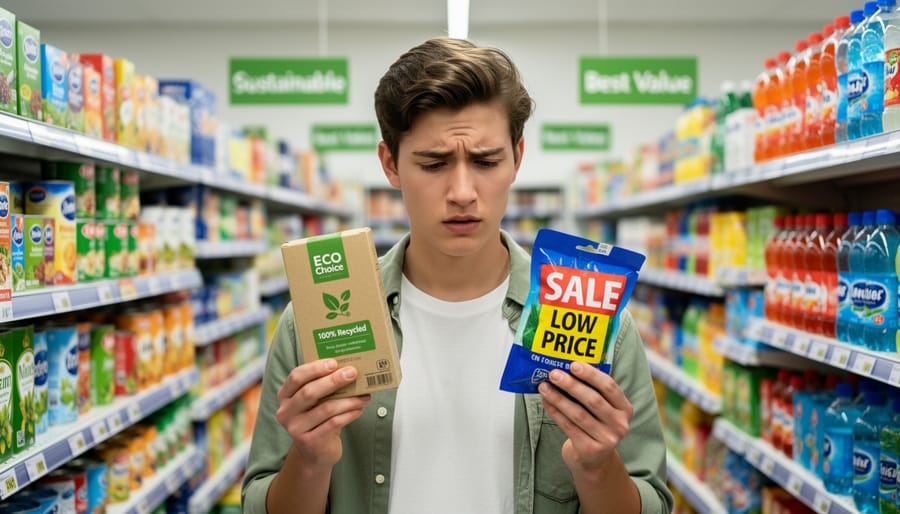
The Intention-Action Gap: Why Sustainable Marketing Fails
The Cost of Complexity
Even customers who genuinely care about sustainability often abandon eco-friendly purchases when faced with too many choices or complex information. This phenomenon, known as decision fatigue, occurs when evaluating multiple environmental certifications, carbon footprint data, and competing sustainability claims becomes mentally exhausting. Research shows that when people feel overwhelmed by information, they default to familiar, convenient options rather than making the “right” choice.
The marketplace compounds this problem. A typical grocery aisle might feature products with dozens of different eco-labels, each requiring background knowledge to interpret. Consumers must decode terms like “carbon neutral,” “regenerative,” and “responsibly sourced” while comparing prices and quality. This cognitive load is particularly problematic in digital environments where customers make split-second decisions.
The solution isn’t providing more information. Instead, businesses should streamline the decision-making process by highlighting one clear sustainability benefit, using simple visual cues, and automating product comparisons. When you reduce friction in the purchasing journey, sustainable choices become the path of least resistance rather than an additional burden on already overwhelmed customers.
When Green Becomes ‘Too Expensive’ in the Mind
Here’s the truth: sustainable products aren’t always more expensive, but consumers consistently believe they are. This perception gap drives purchasing decisions more powerfully than actual price tags.
Research shows customers overestimate the cost premium of eco-friendly products by 30-40%. A reusable water bottle may cost $25 versus $5 for disposable plastic, but consumers rarely calculate the long-term savings. Instead, they anchor on the immediate sticker shock.
This mental accounting trick works in reverse too. When sustainable options are priced competitively, customers often assume they’re lower quality. Your marketing must proactively address this psychology rather than ignore it.
Smart businesses reframe the conversation entirely. Instead of defending higher upfront costs, highlight total cost of ownership. Show the math: “This LED bulb costs $8 but saves $120 over its lifetime.” Make the financial benefit impossible to miss in your product descriptions, email campaigns, and checkout pages.
For competitively priced sustainable products, emphasize quality indicators and certifications prominently. Combat the assumption that affordable and eco-friendly means compromised performance. Use customer testimonials that specifically address durability and effectiveness to build credibility where skepticism naturally exists.
Five Behavioral Science Principles That Drive Sustainable Choices

Make It the Default Option
The most powerful nudge requires zero customer effort: simply make sustainability the default choice. Research shows that when eco-friendly options are pre-selected, adoption rates increase by 30-80% compared to opt-in alternatives.
Major e-commerce platforms now automatically offset carbon emissions for every purchase, with customers needing to actively opt-out if they prefer not to participate. This reversal yields participation rates above 85%. Similarly, subscription services are setting recyclable packaging as the standard option, with minimal resistance from customers.
Apply this to your business by pre-selecting sustainable shipping methods at checkout, automatically enrolling customers in digital receipts instead of paper, or defaulting to eco-friendly product variations. Your website’s design should position these choices as the path of least resistance.
The key is transparency. Clearly communicate what you’ve set as default and why, giving customers simple control to change preferences. This approach respects autonomy while leveraging inertia. Most customers appreciate not having to make additional decisions, especially when the default aligns with their values. The result is increased sustainable behavior without complicated decision-making processes or additional customer effort.
Reduce Friction at Every Touchpoint
Every additional click, confusing option, or unclear product description creates an opportunity for customers to abandon their sustainable purchase. Your website should make choosing eco-friendly options the easiest path forward.
Start by optimizing your site navigation. Place sustainable products prominently on your homepage and in main menu categories rather than burying them in a separate “green” section. This normalization reduces the perception that sustainable choices require extra effort.
Simplify your product pages by highlighting one or two key sustainability features rather than overwhelming visitors with certification details. Use clear labels like “Climate Positive” or “Zero Waste Packaging” that communicate benefits instantly.
Streamline your checkout process by removing unnecessary form fields and offering guest checkout options. Each extra step increases cart abandonment, particularly for time-conscious consumers who already made the mental effort to choose sustainably.
Implement automated email sequences that guide uncertain buyers through their decision. A well-timed message addressing common sustainability questions can convert hesitant browsers into committed customers without requiring manual intervention from your team.
Use Social Proof to Normalize Green Behavior
People are more likely to adopt sustainable behaviors when they see others doing the same. Display customer testimonials highlighting eco-friendly purchases, showcase the number of customers choosing sustainable options, or feature user-generated content from satisfied green consumers. For example, “Join 10,000+ customers who’ve switched to our carbon-neutral shipping” creates powerful motivation through community validation.
Make your social proof visible and specific. Rather than vague environmental claims, share concrete metrics: “Our customers have collectively saved 50,000 plastic bottles this year.” This approach is effective for building customer trust while normalizing sustainable choices.
Automate social proof display on your website through real-time purchase notifications or review widgets showing recent eco-friendly transactions. Highlight community achievements in email campaigns and social media posts. When potential customers see their peers making sustainable choices, the decision becomes less about sacrifice and more about joining a positive movement. This strategy works because it transforms sustainability from an individual burden into a collective norm.
Frame Benefits in Immediate, Personal Terms
Most consumers won’t act on climate change alone. Instead, highlight immediate personal benefits that matter to your customers right now. Frame your sustainable products or services in terms of cost savings, health improvements, convenience, or social status.
For example, promote energy-efficient appliances by emphasizing lower monthly bills rather than reduced carbon footprints. Market reusable products by showcasing their durability and long-term value, not just environmental impact. Highlight how organic foods benefit personal health before mentioning planetary benefits.
This approach works because people prioritize present concerns over abstract future outcomes. Research consistently shows that personal, tangible benefits drive purchasing decisions far more effectively than environmental appeals alone. When you communicate sustainability through a lens of individual advantage, you remove the psychological barrier between intention and action. The environmental benefit becomes a bonus rather than the primary selling point, making it easier for customers to justify their purchase decision to themselves and others.
Create Visible Progress and Feedback
People need to see their sustainable actions matter. Without visible progress, eco-friendly behaviors feel abstract and meaningless, leading customers to abandon their good intentions.
Implement progress tracking that shows cumulative impact. A simple dashboard displaying “You’ve saved 47 plastic bottles this month” or “Your choices have offset 12kg of CO2” transforms individual purchases into measurable environmental wins. This works because our brains respond strongly to concrete numbers over vague environmental benefits.
Consider automated email updates that celebrate milestones. When a customer reaches their tenth sustainable purchase, acknowledge it. These touchpoints require minimal manual effort once set up but create ongoing engagement.
Visual indicators like badges, progress bars, or impact counters on your website make sustainability tangible. Clothing brand Reformation displays the environmental savings of each product compared to industry standards, making the choice clear and rewarding.
The key is automation. Set up systems that track and communicate impact without requiring constant manual input, allowing you to scale these behavioral nudges across your entire customer base efficiently.

Implementing Sustainable Behavior Strategies in Your Digital Marketing
Website Design Changes That Nudge Sustainable Choices
Small design tweaks can significantly influence purchasing decisions without overwhelming customers. Start by making sustainable options the default choice during checkout. When customers must actively opt out of eco-friendly packaging or carbon-neutral shipping, adoption rates increase by up to 40%.
Product pages should prominently display environmental impact data in digestible formats. Use visual progress bars showing carbon savings or water conservation instead of lengthy paragraphs. Position this information near pricing and add-to-cart buttons where decision-making happens.
Implement comparison tools that highlight sustainability differences between similar products. A side-by-side view showing one item’s lower environmental footprint makes the green choice tangible and immediate.
Streamline your checkout process to reduce decision fatigue. Complicated forms drain mental energy, making customers less likely to choose sustainable add-ons. Automated cart recovery emails can reintroduce green options to customers who abandoned purchases, presenting sustainability features as value-adds rather than premium costs.
Add social proof elements like “2,847 customers chose eco-friendly packaging this month” near sustainable options. This leverages our tendency to follow others’ behaviors while reinforcing that green choices are normal, not exceptional.
Consider badge systems or loyalty points specifically for sustainable purchases. These small rewards create positive reinforcement loops, turning occasional eco-conscious shoppers into consistent ones.
Social Media Messaging That Moves Beyond Virtue Signaling
Social media sustainability content often falls flat because it relies on guilt-driven messaging or vague environmental appeals. A more effective sustainable marketing approach focuses on tangible benefits that resonate with your audience’s daily lives.
Instead of posting abstract statistics about carbon footprints, highlight specific improvements your sustainable practices deliver. Show how your eco-friendly packaging protects products better, or how your energy-efficient processes translate to cost savings you can pass along. People respond to concrete advantages, not moral lectures.
Build community around shared values through user-generated content. Encourage customers to share their own sustainability wins while using your products. This creates social proof and normalizes sustainable behavior without the preachy undertone that typically triggers resistance.
Make your calls-to-action specific and achievable. Rather than asking followers to “save the planet,” invite them to take one simple step: switching to your refillable option, joining a local pickup program, or participating in a product take-back initiative. Small, actionable requests convert better than overwhelming environmental mandates.
Track engagement metrics to identify which sustainability messages actually drive clicks, shares, and conversions. Let data guide your content strategy rather than assumptions about what should matter to your audience.
Automated Campaigns That Reinforce Sustainable Habits
Automated campaigns excel at reinforcing sustainable habits because they deliver consistent messaging at critical decision points. Set up email sequences that trigger after eco-friendly purchases, offering tips to maximize product longevity or suggesting complementary sustainable choices. This builds on the commitment already made rather than starting from scratch.
Retargeting campaigns work particularly well when they focus on social proof and community. Show customers how many others have made similar sustainable choices, or highlight the collective environmental impact of your customer base. These automated touchpoints transform individual actions into shared achievements, strengthening behavioral commitment.
Create automated abandoned cart sequences specifically for sustainable products that address common hesitation points. Instead of generic discount offers, use behavioral triggers like limited availability messaging or showcase the long-term cost savings of sustainable alternatives. Include calculator tools showing environmental impact over time.
Schedule post-purchase follow-ups at strategic intervals—30, 60, and 90 days—to reinforce habits and gather feedback. Ask customers to share their experiences or results, creating user-generated content that serves both as social proof and accountability mechanism. These automated touchpoints maintain engagement without requiring constant manual intervention, building sustainable behavior patterns that stick while freeing your team to focus on strategy and optimization.
Measuring What Matters: Tracking Behavioral Change
Awareness doesn’t pay the bills. You need to track whether your sustainability initiatives are actually changing customer behavior, not just generating warm feelings.
Start with action-based metrics rather than vanity numbers. Instead of counting social media likes on your eco-friendly campaign, measure repeat purchase rates among customers who chose sustainable product options. Track the percentage of customers who opt for carbon-neutral shipping when offered the choice, or monitor how many download and use your product recycling guide.
Focus on conversion metrics at key decision points. Set up automated tracking for the percentage of customers who complete sustainable actions after exposure to behavioral nudges. For example, if you’ve implemented a default opt-in for eco-packaging, measure acceptance rates versus the old opt-out system. Compare cart abandonment rates between standard and sustainable product variants to identify friction points.
Customer lifetime value segmentation reveals the real impact. Create automated reports comparing the retention rates and spending patterns of customers who engage with sustainable options versus those who don’t. This data demonstrates whether your behavioral strategies attract valuable, loyal customers or just one-time buyers.
Don’t forget the pre-post comparison. Establish baseline measurements before implementing behavioral interventions, then track changes over time. Monitor metrics like the average carbon footprint per order, percentage of customers choosing reusable options, or return rates for sustainable versus conventional products.
Set up automated dashboards that update weekly, making it easy to spot trends without manual data crunching. Track these metrics consistently for at least three months to account for seasonal variations and establish reliable patterns that inform your next strategic moves.
Sustainable marketing doesn’t win through moral superiority or environmental lectures. It succeeds by removing friction and making green choices the easiest option for customers. The businesses seeing real results understand that behavioral design matters more than brand messaging alone.
Start small and test deliberately. Choose one behavioral intervention from this article, whether it’s adjusting your default settings, simplifying your sustainable product display, or reframing how you present environmental benefits. Implement it, measure the results, and refine your approach based on actual customer behavior rather than assumptions.
The path forward combines avoiding greenwashing with smart behavioral nudges that align customer convenience with environmental impact. Your sustainable offerings already exist. The question is whether you’re making them genuinely accessible or just virtue signaling.
Test your first behavioral intervention this week. Track conversion rates, customer feedback, and sales data. Scale what works, abandon what doesn’t, and remember that small, consistent changes in customer experience drive more sustainable behavior than any marketing campaign ever could.
Leave a Reply