Why Your Email Marketing ROI Doesn’t Tell the Whole Story

Track every email touchpoint in your customer journey by implementing multi-touch attribution models that assign revenue credit to each nurturing message. Most marketers report email ROI at $36-$42 for every dollar spent, yet they can’t explain which specific campaigns drive those returns because they’re measuring last-click conversions instead of the entire nurturing sequence.
Calculate true email marketing ROI by dividing attributed revenue minus campaign costs by total investment, then multiply by 100. This requires connecting your email platform to your CRM and sales data so you can trace which prospects engaged with your nurturing emails before converting. Without this connection, you’re blind to how your automated sequences move prospects through the funnel.
Set up first-touch, last-touch, and linear attribution models simultaneously to understand how different email campaigns contribute to revenue. Your welcome series might excel at first-touch attribution while your re-engagement campaigns shine in last-touch scenarios. This granular view reveals which automated processes deserve more investment and which need optimization.
Stop relying on open rates and click-through rates as success metrics. These vanity numbers tell you nothing about revenue impact. Instead, measure email-influenced revenue, cost per acquisition from email campaigns, and the time-to-conversion for email-nurtured leads versus other channels. These metrics directly connect your email efforts to business outcomes and provide the clarity you need for strategic decisions about resource allocation and campaign optimization.
The Real Cost of Ignoring Email Nurturing Attribution
When businesses calculate email marketing ROI using only surface-level metrics like open rates and click-through rates, they’re missing a significant portion of the revenue story. This oversight can lead to devastating budget decisions, including cutting or underinvesting in one of your most profitable marketing channels.
Consider a typical customer journey: Someone downloads your lead magnet, receives a welcome email, gets added to your email nurturing sequences, and eventually makes a purchase three months later. Most basic tracking systems will attribute that sale to the last touchpoint, often a retargeting ad or direct website visit. Your email nurturing gets zero credit, despite doing the heavy lifting of building trust and moving that prospect toward a buying decision.
This attribution gap creates a false narrative about your marketing effectiveness. You might see emails generating modest direct revenue while paid ads appear to be converting like crazy. In reality, those ads are simply claiming credit for conversions your email campaigns made possible. Without proper attribution, you’re essentially flying blind, potentially reallocating budget away from your most effective channel.
The problem compounds with automated nurturing sequences. These set-it-and-forget-it campaigns work quietly in the background, educating prospects and addressing objections over weeks or months. They generate conversions long after the initial send, making them nearly impossible to track with traditional last-click attribution models.
The financial impact of this blind spot is substantial. Research shows that nurtured leads produce a 20% increase in sales opportunities compared to non-nurtured leads. Yet when these sales close, the nurturing emails rarely get proper credit. You’re left undervaluing a channel that might be responsible for a significant portion of your actual revenue, leading to poor strategic decisions about where to invest your marketing dollars. Understanding the full attribution picture isn’t just about better reporting; it’s about making smarter business decisions that directly impact your bottom line.

What Email Nurturing Attribution Actually Measures
First-Touch vs. Last-Touch Attribution
First-touch attribution credits the initial interaction that brought a prospect into your system, such as the welcome email or first newsletter signup. Last-touch attribution, conversely, assigns all credit to the final touchpoint before conversion, typically the last email opened before a purchase.
For email nurturing campaigns, both models present significant limitations. First-touch ignores the valuable work your nurture sequences do to educate and warm up prospects over time. If someone subscribes to your newsletter but doesn’t convert until receiving your fifth educational email three weeks later, first-touch gives no credit to those crucial middle touchpoints.
Last-touch creates the opposite problem. It suggests that your product announcement email drove the entire sale, completely dismissing the relationship-building emails that preceded it. This often leads businesses to cut nurturing content in favor of promotional messages, damaging long-term customer relationships.
Neither model captures the reality of modern buyer journeys, where multiple email interactions work together to move prospects toward a decision. A prospect might discover you through a blog signup, engage with three educational emails, ignore two promotional messages, then convert after a targeted case study email. Both single-touch models fail to represent this complexity accurately.
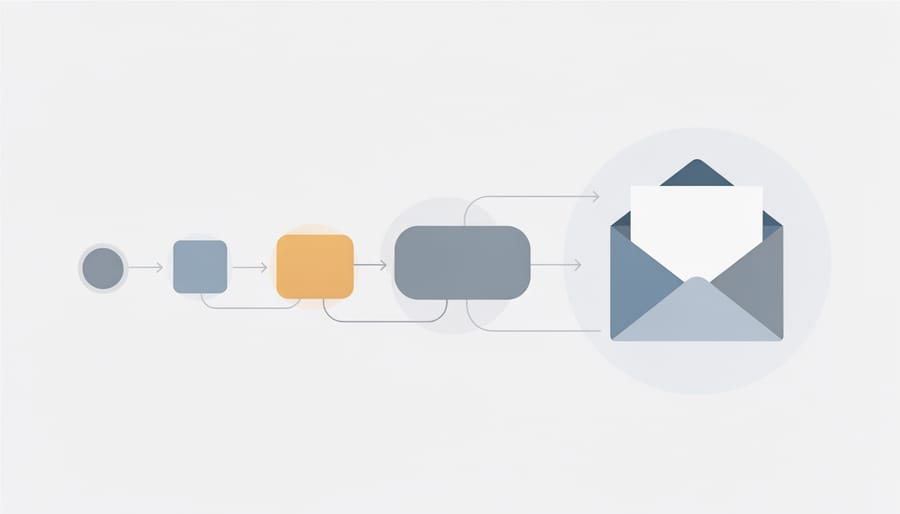
Multi-Touch Attribution for Email Sequences
Most email campaigns involve multiple touchpoints before a customer converts, yet many businesses only credit the final email that led to a purchase. This approach dramatically undervalues your email nurturing efforts and provides an incomplete picture of your marketing ROI.
Multi-touch attribution solves this problem by assigning credit to every email that contributed to a conversion. When a prospect receives your welcome email, engages with educational content two weeks later, and finally converts after receiving a promotional offer, all three touchpoints played a role in that decision.
Think of it like a relay race. The runner who crosses the finish line gets the glory, but the race wouldn’t be won without the entire team. Your email sequences work the same way. An introductory email builds awareness, follow-up emails establish trust and authority, and promotional emails drive action. Each deserves recognition for its contribution.
Common multi-touch attribution models include linear attribution, which divides credit equally among all touchpoints, and time-decay attribution, which gives more weight to emails closer to conversion. Position-based attribution splits credit between first and last interactions while still acknowledging middle touches.
Implementing multi-touch attribution requires tracking tools that monitor email engagement across your entire sequence. Most email platforms and CRM systems offer built-in attribution reporting, making it easier than ever to understand which sequence elements drive results. This data helps you refine your nurturing strategy, allocate budget more effectively, and demonstrate the true value of your email marketing investment.
Time-Decay and Position-Based Models
Time-decay attribution assigns increasing value to touchpoints closer to conversion, recognizing that your final emails often carry more decision-making weight. This model typically gives the last interaction 40% credit, with decreasing percentages moving backward through your sequence. Position-based (or U-shaped) attribution takes a different approach, splitting 40% credit between the first and last touchpoints, with the remaining 20% distributed among middle interactions. This reflects how automated email nurturing actually works—your welcome email captures attention, middle emails build trust, and closing emails drive action. For most businesses, position-based models provide the most realistic picture of email contribution, especially when nurture sequences run 30-90 days. These approaches require tracking software but deliver significantly more accurate ROI calculations than single-touch models.
Calculating True Email Marketing ROI
Essential Metrics Beyond Open and Click Rates
While open and click rates provide surface-level engagement data, they don’t tell you whether your emails actually generate revenue. To measure true email marketing ROI, you need to track critical metrics that connect directly to your bottom line.
Conversion attribution reveals which specific emails in your nurture sequence drive actual purchases or sign-ups. By implementing proper tracking parameters in your email links, you can identify whether conversions happen after someone clicks your welcome email, educational content, or promotional offer. This shows you which messages actually move prospects toward a sale, not just which ones get opened.
Customer lifetime value (CLV) from email subscribers demonstrates the long-term revenue impact of your email list. Compare the total revenue generated by customers acquired through email versus other channels over their entire relationship with your business. Email subscribers often generate 20-40% higher CLV because they maintain an ongoing relationship with your brand.
Influenced revenue tracks purchases made by contacts who engaged with your emails even if they didn’t click directly to buy. A prospect might read your email on their phone but purchase later on their desktop. Modern attribution tools can connect these touchpoints, revealing the true impact of your email nurturing on revenue generation. This metric often uncovers significant hidden value in your email campaigns that direct conversion tracking misses entirely.
The Complete ROI Formula for Email Nurturing
Calculating email nurturing ROI requires a comprehensive approach that captures both your complete investment and the attributed revenue. Here’s the formula that accounts for all touchpoints in your nurturing sequence:
Email Nurturing ROI = [(Attributed Revenue – Total Email Marketing Costs) / Total Email Marketing Costs] × 100
Let’s break down each component to ensure accurate measurement.
Attributed Revenue represents the portion of your sales that email nurturing genuinely influenced. If a customer received five touchpoints before purchasing—three emails, one social media ad, and one website visit—you might attribute 30-40% of that sale to your email sequence based on your chosen attribution model. This prevents inflating your results while recognizing email’s real contribution.
Total Email Marketing Costs must include every expense:
Software and tools: Your email platform subscription, automation tools, and analytics software typically run $50-500 monthly depending on list size.
Content creation: Calculate the hours spent writing emails, designing templates, and creating assets. If your team spends 10 hours monthly at $50 per hour, that’s $500 in labor costs.
List management: Include time spent segmenting audiences, cleaning your database, and maintaining compliance.
Testing and optimization: Factor in A/B testing efforts and performance analysis time.
For example, if your monthly costs total $1,200 and your emails contributed $8,400 in attributed revenue through your nurturing sequences, your ROI would be: [($8,400 – $1,200) / $1,200] × 100 = 600%.
This formula gives you an honest picture of performance. Track these numbers monthly to identify trends, justify your email marketing budget, and make data-driven decisions about scaling your nurturing programs. The key is consistency in how you measure and attribute results across all campaigns.
Setting Up Attribution Tracking That Actually Works
Tools and Systems You Need
Successfully tracking email attribution requires the right technology foundation. At minimum, you need an email service provider (ESP) with robust analytics capabilities—platforms like Mailchimp, HubSpot, or ActiveCampaign offer built-in tracking for opens, clicks, and conversions.
The critical piece is integration between your ESP and customer relationship management (CRM) system. This connection allows you to follow the entire customer journey from initial email engagement through to closed deals. Without this integration, you’re left with fragmented data that can’t accurately measure ROI.
Consider adding Google Analytics with UTM parameters to track website behavior after email clicks, and marketing automation software to score leads based on email engagement. For e-commerce businesses, ensure your email platform connects directly to your shopping cart system to attribute purchases accurately.
The investment in proper integration pays for itself by revealing which email campaigns actually drive revenue, not just engagement.
Automating Your Attribution Reporting
Manual attribution reporting becomes unsustainable as your email program scales. Setting up automated dashboards ensures you maintain visibility into your email ROI without dedicating hours each week to spreadsheet analysis.
Start by connecting your email platform to your CRM through native integrations or tools like Zapier. This creates a data pipeline that automatically logs email interactions alongside customer journey data. Most modern CRM systems can track when contacts receive emails, which ones they open, and what actions they take afterward.
Configure your analytics platform to create custom conversion paths that include email touchpoints. In Google Analytics, set up Multi-Channel Funnel reports that specifically track email as a traffic source. For more sophisticated tracking, implement UTM parameters consistently across all email links and create automated reports that segment conversions by campaign type.
Build a dashboard that displays your key attribution metrics in real-time. Include metrics like assisted conversions, time-to-conversion by email type, and revenue influenced by nurture sequences. Tools like Google Data Studio, Tableau, or your CRM’s native reporting can pull data automatically and refresh daily.
Set up scheduled email reports that deliver attribution summaries to stakeholders weekly or monthly. This keeps your team and clients informed without requiring manual data compilation. Focus these reports on business outcomes rather than email-specific metrics to maintain relevance for decision-makers.
Finally, establish automated alerts for significant changes in attribution patterns. If your nurture sequence suddenly shows a drop in assisted conversions or a spike in attribution value, you’ll know immediately rather than discovering it in your next manual review. This proactive approach lets you optimize continuously rather than reactively.

Common Attribution Mistakes That Skew Your ROI
Even experienced marketers make attribution mistakes that significantly distort their email marketing ROI calculations. Understanding these common pitfalls helps you avoid undervaluing or overvaluing your nurturing campaigns.
The most prevalent error is last-click attribution, where you credit only the final touchpoint before conversion. This approach ignores the entire nurturing journey that warmed up your prospect. If someone received six educational emails over three weeks before clicking a promotional message and purchasing, last-click attribution gives all credit to that final email while dismissing the foundational work that made the conversion possible.
Tracking setup failures create another major problem. Many businesses fail to implement proper UTM parameters or use inconsistent naming conventions across campaigns. When your analytics can’t distinguish between different email sequences, you’re essentially measuring in the dark. Automated email platforms should integrate seamlessly with your CRM and analytics tools to capture every touchpoint accurately.
Attribution window mistakes also skew results dramatically. Setting too short a window, like seven days, misses conversions from prospects with longer consideration cycles. Conversely, overly long windows may credit emails that had minimal influence on decisions made months later. Most B2B companies find 30-60 day windows appropriate, while B2C businesses often use shorter periods of 7-30 days depending on their sales cycle.
Another common issue is ignoring assisted conversions. These are touchpoints that didn’t directly trigger the purchase but played a supporting role. Your welcome series might not generate immediate sales, but it establishes trust that makes later promotional emails more effective. Proper attribution models account for these contributions rather than dismissing them as unsuccessful campaigns.
Finally, many businesses fail to exclude unsubscribes and spam complaints from their ROI calculations. Including these negative outcomes alongside positive conversions creates an incomplete picture of campaign effectiveness. Your tracking system should flag these actions separately to calculate true net revenue impact and adjust your strategies accordingly.
Understanding your true email marketing ROI through proper nurturing attribution isn’t just about proving value—it’s about making smarter business decisions. When you accurately measure how your email sequences contribute to revenue, you gain the clarity needed to allocate your marketing budget effectively and refine strategies that actually drive results.
Without proper attribution, you’re essentially flying blind. You might be over-investing in channels that look good on paper while under-funding the email campaigns that quietly generate consistent revenue. Or worse, you could be cutting budgets from nurturing sequences that play crucial roles in your customer journey simply because their impact isn’t being properly tracked.
The good news is that getting your attribution right doesn’t require a complete overhaul of your marketing stack. Start with the fundamentals: define clear conversion paths, implement multi-touch attribution where possible, and regularly review your data for insights.
Now it’s time to take action. Audit your current email attribution approach. Ask yourself: Are we tracking the full customer journey? Do we understand which emails actually influence purchasing decisions? Are we making budget decisions based on complete data or just last-click conversions? Your answers will reveal exactly where to focus your improvement efforts and set you on the path to more accurate ROI measurement and better marketing outcomes.
Leave a Reply