How Agent-Based Modeling Predicts Your Next Viral Campaign

Consumer trends don’t spread uniformly across markets—they ripple through networks of influence, following patterns that traditional analytics often miss. Agent-based modeling (ABM) changes this by simulating how individual consumers interact, make decisions, and influence each other, creating a digital laboratory where you can test marketing strategies before spending a dollar on campaigns.
Think of ABM as creating thousands of virtual customers, each with distinct preferences, social connections, and behaviors. These digital agents interact just like real consumers—sharing recommendations, responding to advertising, and adopting products based on peer influence. By running these simulations, you observe exactly how trends cascade through different customer segments, which influencers matter most, and when momentum reaches critical mass.
The practical advantage is clear: you identify the optimal moment to launch campaigns, pinpoint the specific customer segments that accelerate adoption, and allocate budget to channels that maximize viral spread. Instead of guessing whether a trend will gain traction, you model multiple scenarios and choose strategies with quantifiable success probabilities.
For marketing professionals managing limited budgets, ABM transforms uncertainty into data-driven decisions. You test messaging variations, compare influencer strategies, and predict adoption curves without the risk and cost of real-world experimentation. The result is marketing campaigns grounded in behavioral science rather than intuition, giving small and medium-sized businesses the strategic sophistication previously available only to enterprises with massive research budgets.
What Is Agent-Based Modeling for Marketing?
The Three Core Components Every Marketer Should Know
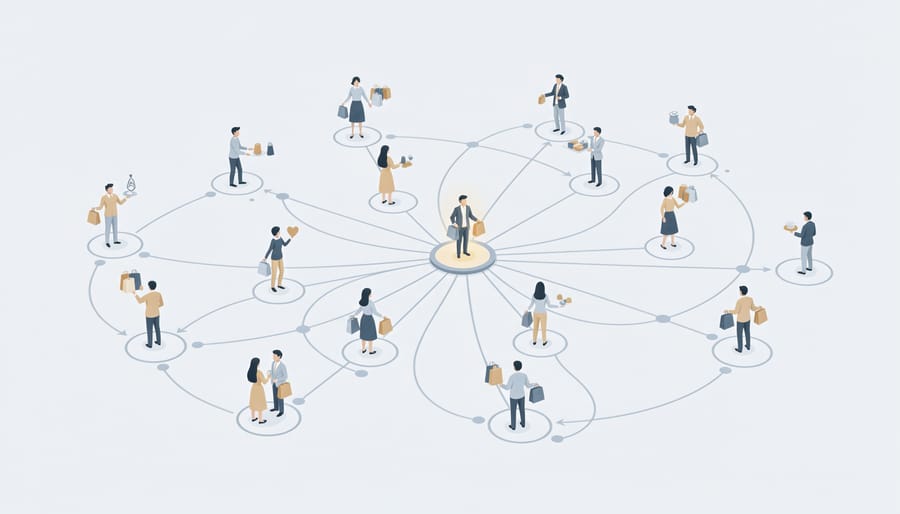
At its core, agent-based modeling consists of three fundamental components that work together to simulate how consumer trends spread through your market. Understanding these elements helps you predict buying patterns and time your marketing campaigns more effectively.
The first component is individual agents, which represent your actual consumers. Each agent in the model has unique characteristics like income level, age, purchasing habits, and openness to new products. Think of these as detailed customer profiles that can make independent decisions. For instance, an agent representing a tech-savvy millennial might adopt a new product faster than one representing a budget-conscious retiree. These agents mirror how consumers actually behave in real markets, complete with personal preferences and decision-making patterns.
The second component covers interaction rules, which determine how your consumers influence each other. This is where word-of-mouth, social media sharing, and peer recommendations come into play. When one agent adopts your product and shares their experience, nearby agents might follow suit. These rules can be simple, like “people trust recommendations from three or more friends,” or complex, accounting for online reviews and influencer impact.
The third component encompasses environmental factors, representing market conditions that affect everyone simultaneously. This includes pricing changes, competitor actions, seasonal trends, economic shifts, and your own marketing campaigns. When you launch a promotional campaign, the environment changes for all agents, potentially accelerating trend adoption across different consumer segments.
Together, these three components create a dynamic system that reveals how individual decisions, social influence, and market conditions combine to drive consumer trends through your target audience.
Why Traditional Marketing Forecasting Falls Short
Traditional marketing forecasting relies heavily on aggregate data and historical trends, treating your entire audience as a uniform group with predictable behaviors. These conventional methods use averages, demographic segments, and past performance to project future outcomes. While this approach offers a baseline, it misses crucial dynamics that determine whether a campaign will gain traction or fall flat.
The fundamental problem is that real markets don’t behave like smooth statistical curves. When you launch a product or campaign, its success depends on how individual consumers interact with your message, share it with their networks, and influence each other’s decisions. Traditional models can’t capture these peer-to-peer effects because they treat consumers as isolated data points rather than connected individuals.
Consider how trends actually spread. A viral social media campaign doesn’t grow at a steady, predictable rate determined by your ad spend alone. Instead, it depends on which specific consumers see it first, whether they find it share-worthy, who’s in their network, and how receptive their connections are at that moment. One influencer sharing your content can trigger exponential growth that no aggregate model would predict. Conversely, reaching the “wrong” initial audience might doom an otherwise strong campaign.
Traditional forecasting also struggles with timing. Aggregate models might tell you a trend will gain 30% adoption, but they can’t predict when momentum will accelerate or when saturation will hit. This leaves you guessing about optimal campaign timing and budget allocation.
Agent-based modeling addresses these gaps by simulating individual consumer behaviors and their network interactions. Instead of averaging everyone together, it tracks how specific behaviors, preferences, and social connections create the complex patterns we see in real markets.
How Consumer Trends Actually Spread (According to ABM)
The Tipping Point: When Trends Go Viral
Understanding when a trend reaches its tipping point can mean the difference between a campaign that fizzles and one that catches fire. Agent-based modeling reveals these critical thresholds by tracking how individual consumer interactions compound into viral momentum.
In ABM simulations, trends typically follow a pattern: slow initial adoption, rapid acceleration at a specific threshold, then plateau. This threshold represents your critical mass—the point where enough consumers have adopted your message that it becomes self-sustaining. For most consumer trends, research shows this occurs between 10-25% market penetration, though the exact number varies by industry and product type.
The practical application for your marketing campaigns is straightforward. Rather than spreading resources thinly across broad audiences, ABM insights suggest concentrating initial efforts on reaching that critical threshold within specific segments. Focus on highly connected individuals—those influencers and early adopters who interact with multiple consumer groups. Their adoption carries more weight than equal numbers of isolated consumers.
Timing matters equally. ABM simulations demonstrate that campaigns launched when market conditions show readiness indicators—such as increased social media chatter or competitor movement—reach critical mass faster and with less investment. Monitor these signals to identify optimal launch windows.
The key takeaway: successful viral campaigns aren’t about luck. They’re about strategically targeting the right people and timing your push to efficiently reach the tipping point where your message becomes self-propagating through consumer networks.

Network Effects That Multiply Your Reach
Word-of-mouth remains your most powerful marketing channel, and agent-based models reveal exactly why. When consumers talk to each other about your product, they create network effects that exponentially amplify your initial marketing investment. A single satisfied customer doesn’t just represent one purchase—they become a node in a network that can influence dozens of others.
Agent-based models simulate these consumer-to-consumer interactions by tracking how opinions, preferences, and purchasing decisions spread through social network structures. The key insight: not all customers hold equal influence. Some individuals occupy central positions in their networks, serving as bridges between different groups. When these influencers adopt your product, trend diffusion accelerates dramatically.
Understanding network topology changes everything about your targeting strategy. Dense, tightly-knit networks spread trends quickly but may resist outside influence. Loose networks with many bridges allow trends to jump between communities but spread more slowly within each group. Your campaign timing should align with these structural realities.
Practical application means identifying and reaching network influencers first, then allowing organic spread to do the heavy lifting. ABM simulations show that investing 70% of your budget reaching 20% of strategically-positioned early adopters often outperforms broad-based campaigns. The model also reveals optimal timing for follow-up campaigns—strike when network chatter peaks, not before momentum builds or after conversations die down.
Practical Applications for Your Marketing Strategy
Identifying Your Most Influential Customer Segments
Agent-based modeling excels at pinpointing which customer segments wield the most influence over trend adoption in your market. Unlike traditional demographic analysis, ABM tracks how different groups interact and influence each other’s purchasing decisions, revealing your true trendsetters.
The model identifies three key customer archetypes that drive adoption. First are the innovators, typically comprising 2-5% of your market who try new products immediately regardless of social proof. Second are the early adopters, making up 10-15% of customers who embrace trends quickly and influence others through their visible choices. Third are the opinion leaders, individuals whose purchasing decisions create ripple effects throughout their networks.
By running simulations with different network configurations, ABM shows you exactly which segments create the fastest, most sustainable trend diffusion. For instance, you might discover that targeting middle-income millennials in urban areas generates 3x more secondary conversions than focusing on high-income demographics, simply because of their network density and communication patterns.
This insight transforms your targeting strategy. Rather than spreading marketing budgets evenly or relying solely on understanding consumer sentiment through surveys, you can concentrate resources on the specific segments that amplify your message organically. The model quantifies each segment’s influence coefficient, allowing you to calculate expected return on investment for different targeting approaches and allocate budgets where they’ll generate maximum viral momentum.
Timing Your Campaigns for Maximum Impact
Agent-based modeling reveals that timing isn’t just about choosing a launch date—it’s about understanding where a trend sits in its lifecycle. ABM simulations show how consumer adoption follows predictable patterns, with early adopters creating momentum that mainstream audiences later follow.
Your models can identify the inflection point where a trend transitions from niche to mainstream. This sweet spot is where your campaign investment yields maximum returns. Launch too early, and you’ll burn resources educating an unreceptive market. Launch too late, and you’re competing in a saturated space.
ABM insights also guide scaling decisions. The models track adoption velocity—how quickly consumers move from awareness to action. When simulations show accelerating adoption rates, that’s your signal to increase campaign spend and expand reach. Conversely, when momentum plateaus, reallocate resources to emerging opportunities.
Monitor your ABM dashboard regularly to adjust campaign intensity in real-time. This automated approach removes guesswork from budget allocation. You’ll see exactly when to amplify messaging, which channels drive adoption fastest, and when to shift focus. The result is efficient spending that rides trend momentum rather than fighting against market readiness.

Predicting Campaign Outcomes Before You Spend
Agent-based modeling functions as your marketing test laboratory, allowing you to run virtual campaigns before committing real budget dollars. Instead of launching a full-scale initiative and hoping for the best, ABM simulations let you explore multiple scenarios with different messaging, timing, and target segments.
The process works by creating digital representations of your customer segments within the model. You can then test how various marketing approaches might perform by observing how these virtual consumers respond and influence each other. For instance, you might discover that targeting early adopters in one demographic cluster creates better cascade effects than broader initial outreach.
This simulation capability directly impacts your bottom line by identifying which strategies show the most promise before you spend. You’ll see which channels generate momentum, which message variations drive sharing behavior, and where your budget delivers maximum return. The insights parallel predicting customer behavior through data analysis, but with the added advantage of testing future scenarios.
Rather than learning from expensive mistakes, you gain actionable intelligence upfront. This approach transforms campaign planning from educated guessing into data-informed decision-making, reducing wasted spend and improving your confidence in marketing investments.
Automating Trend Analysis for Continuous Optimization
Once you understand how consumer trends spread through agent-based modeling principles, the next step is making this analysis work for you continuously without constant manual oversight. The real power emerges when you automate the monitoring and analysis processes, freeing your team to focus on what matters most: strategic client communication and campaign refinement.
Setting up automated tracking systems allows you to monitor trend diffusion patterns in real-time. Marketing automation platforms can be configured to track specific indicators that signal trend adoption across different customer segments. Instead of manually reviewing analytics weekly or monthly, automated dashboards flag significant shifts in consumer behavior insights, enabling faster response times to emerging opportunities.
The key is identifying which metrics matter for your specific business context. For most companies, this includes engagement rates across different customer network segments, adoption velocity of new product features, and referral patterns that indicate organic trend spread. Automated reporting tools can track these indicators and alert your team when predetermined thresholds are met, signaling when a trend is gaining traction or losing momentum.
This automation approach aligns perfectly with resource-conscious business operations. Rather than dedicating hours to data compilation, your team receives actionable summaries highlighting what requires attention. This systematic approach ensures consistent monitoring without the risk of missing critical trend shifts during busy periods.
The time saved through automation should be redirected toward high-value activities: having meaningful conversations with clients about their evolving needs, testing new campaign variations, and refining targeting strategies based on automated insights. This combination of automated analysis and human strategic thinking creates a sustainable optimization cycle that continuously improves campaign performance while maintaining strong client relationships.
Getting Started Without Breaking the Bank
You don’t need a massive budget or a team of data scientists to benefit from agent-based modeling insights. Several practical pathways exist for businesses ready to explore how consumer trends spread through their target markets.
Start with accessible simulation platforms designed for business users. Free or low-cost tools like NetLogo offer user-friendly interfaces where you can experiment with pre-built models demonstrating trend diffusion patterns. While these won’t replicate your exact market conditions, they provide valuable intuition about how influencers, network effects, and timing impact adoption curves.
Consider partnering with university research programs or analytics consultancies that specialize in ABM applications. Many academic institutions seek real-world case studies and offer reduced-rate consulting through their business schools. This approach gives you customized insights at a fraction of enterprise pricing while supporting meaningful research.
For businesses with existing customer data, automated analytics platforms increasingly incorporate ABM-derived algorithms without requiring you to build models from scratch. These systems identify influencer segments and predict diffusion pathways based on your actual customer networks and behavior patterns. The automated processes run in the background, delivering actionable recommendations for campaign timing and targeting.
Take an incremental approach rather than attempting a comprehensive overhaul. Begin by applying ABM principles to a single product launch or campaign segment. Track how information spreads among your customer base, identify key connectors who amplify your message, and measure the cascade effect. Document what works and scale gradually.
Focus on maintaining clear client communication throughout implementation. Stakeholders don’t need to understand the technical mechanics behind the models. Instead, translate insights into concrete decisions about where to allocate marketing resources, which customer segments to prioritize, and when to intensify outreach efforts for maximum impact.
Understanding how consumer trends spread through agent-based modeling isn’t just an academic exercise. It’s a competitive advantage that can transform your marketing results. When you grasp the patterns of trend diffusion, you’re no longer guessing about campaign timing or throwing budget at broad audiences hoping something sticks. Instead, you’re making informed decisions based on how real consumers actually discover, evaluate, and adopt new products or ideas.
The beauty of ABM lies in its simplicity, not its complexity. You don’t need sophisticated software or a data science team to apply these insights. What matters is recognizing that your customers are influenced by their networks, that early adopters behave differently than mainstream buyers, and that timing your message to match each group’s readiness makes all the difference.
Think about your next campaign through this lens. Who are your influencers? Which communication channels will carry your message most effectively? What resistance points might slow adoption, and how can you address them proactively? These questions, informed by diffusion patterns, lead to smarter resource allocation and stronger results.
The gap between businesses that understand trend diffusion and those that don’t will only widen as markets become more connected and competitive. Start small. Apply one insight from agent-based modeling to your next campaign. Test whether targeting based on network position improves your conversion rates. Measure the impact of timing your message for different adopter segments. The data will speak for itself, and your marketing strategy will never look the same.
Leave a Reply